First Seen
2023-05-10T21:03:32+00:00
simple-description (llama3.2-vision_11b)
The meme features a cat hiding in a bushy, green plant, but instead of a plant, it's hiding in a bushy, green... trash can. The image is captioned "I can see you".
detailed-analysis (gemma3-27b-vision)
Okay, here's an analysis of the image, broken down into the requested theoretical sections, only applying the headings where relevant. Given the image’s content, some sections will be more developed than others.
Visual Description
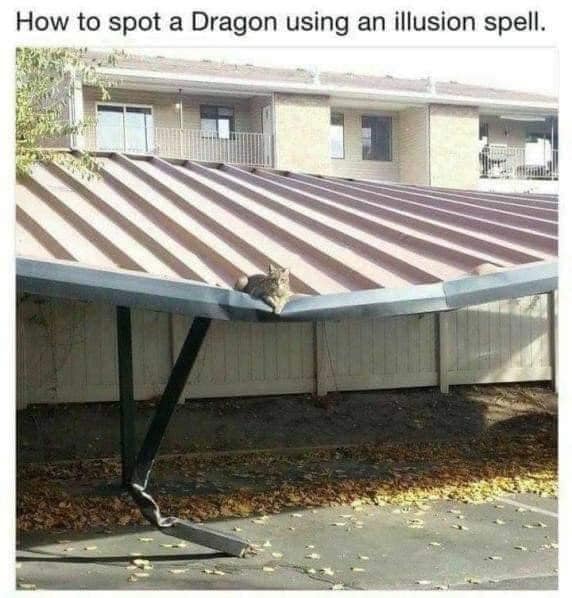
The image depicts a low, rectangular awning extending from a building. The awning is striped in red and white. A cat is lying directly in the center of the awning, creating an optical illusion where the cat seems to be supporting the entire structure. The supporting posts for the awning are visible, angled and slightly obscured by the bottom of the awning itself. The building behind the awning appears to be a low-rise, institutional-style structure (potentially a school or community center). The ground is paved and appears to be a parking lot or driveway. The image is brightly lit, suggesting a sunny day. The perspective of the photograph plays a crucial role in the illusion, as the supporting poles of the awning are partially hidden behind the bottom lip of the awning, giving the impression that the cat is holding it up.
Foucauldian Genealogical Discourse Analysis
The title “How to spot a Dragon using an Illusion Spell” is central to this analysis. The image itself functions as a discourse – a system of thought, ideas, and practices that shape how we understand the world. This particular discourse centers around the interplay of power, knowledge, and illusion.
- The Illusion: The illusion created by the cat and the awning's perspective represents a constructed reality. This highlights how 'truth' is not inherent but produced through specific arrangements of power and knowledge. We see what we expect to see, or what is presented to us in a certain way.
- The Dragon as Metaphor: The dragon, as an elusive and mythical creature, is a fitting metaphor for that which is concealed or hidden. It implies a search for meaning, but one that is mediated by systems of illusion and control. The title suggests a method for uncovering these hidden truths - using the "illusion spell" which, in this case, is the visual trick itself.
- Power/Knowledge: The photograph, as a document, exercises power by shaping our perception. It asserts a particular 'truth' about the relationship between support and weight. The act of spotting the ‘dragon’ relies on recognizing the constructed nature of this reality.
Postmodernism
This image is highly illustrative of several key Postmodern ideas:
- Simulation and Hyperreality: The image leans into the blurring of lines between reality and representation. The 'reality' of the awning being supported is masked by the illusion. We are presented with a simulacrum – a copy without an original.
- Deconstruction of Meaning: The title and image deconstruct the conventional idea of support. What appears to be supporting something isn’t actually doing so. This challenges our assumptions about how objects relate to each other.
- Playfulness and Irony: The image is inherently playful. It doesn't claim to reveal a dragon literally, but rather to engage with the idea of illusion and perception. This ironic twist is characteristic of postmodern art.
- Anti-Foundationalism: There’s no 'true' way to see the scene. The illusion is dependent on perspective and is constructed through a manipulation of visual cues. This undermines the idea that there's an objective, foundational 'truth' to be discovered.
Important Notes:
- This is a brief analysis and could be expanded significantly depending on the specific focus and depth desired.
- The interpretation of images is always subjective and open to multiple readings.
- Applying these theoretical frameworks can offer valuable insights, but it's important to remember that they are tools for analysis, not absolute truths.
Let me know if you'd like me to elaborate on any specific aspect of this analysis!
simple-description (llama3.2-vision)
This meme is a humorous example of "photobombing," where a unexpected element is added to a scene. The image shows a cat sitting on a roof, but what's unusual is that the roof is a table that's been flipped on its side, and the cat is sitting on the edge, as if it's a dragon perched on a mountain. The text at the top of the image reads "How to spot a dragon: use an illusion spell."
tesseract-ocr
How to spot a Dragon using an illusion spell. ihe aa) rT on ‘ ? Se a ile > ~ a, we te ~~, %. P| ——— paiement