First Seen
2023-05-10T21:03:32+00:00
simple-description (llama3.2-vision_11b)
The meme depicts a scene where a person is trying to communicate with a wild gorilla in a jungle setting. The gorilla is attempting to understand the person's gestures, but the person is struggling to convey their message. The image is captioned "I can explain it better with a diagram" to convey the person's frustration.
detailed-analysis (gemma3-27b-vision)
Okay, here's an analysis of the image, broken down into the sections you requested, only including those relevant. Due to the complexity of theoretical applications, these will be nuanced interpretations and not exhaustive treatments.
Visual Description
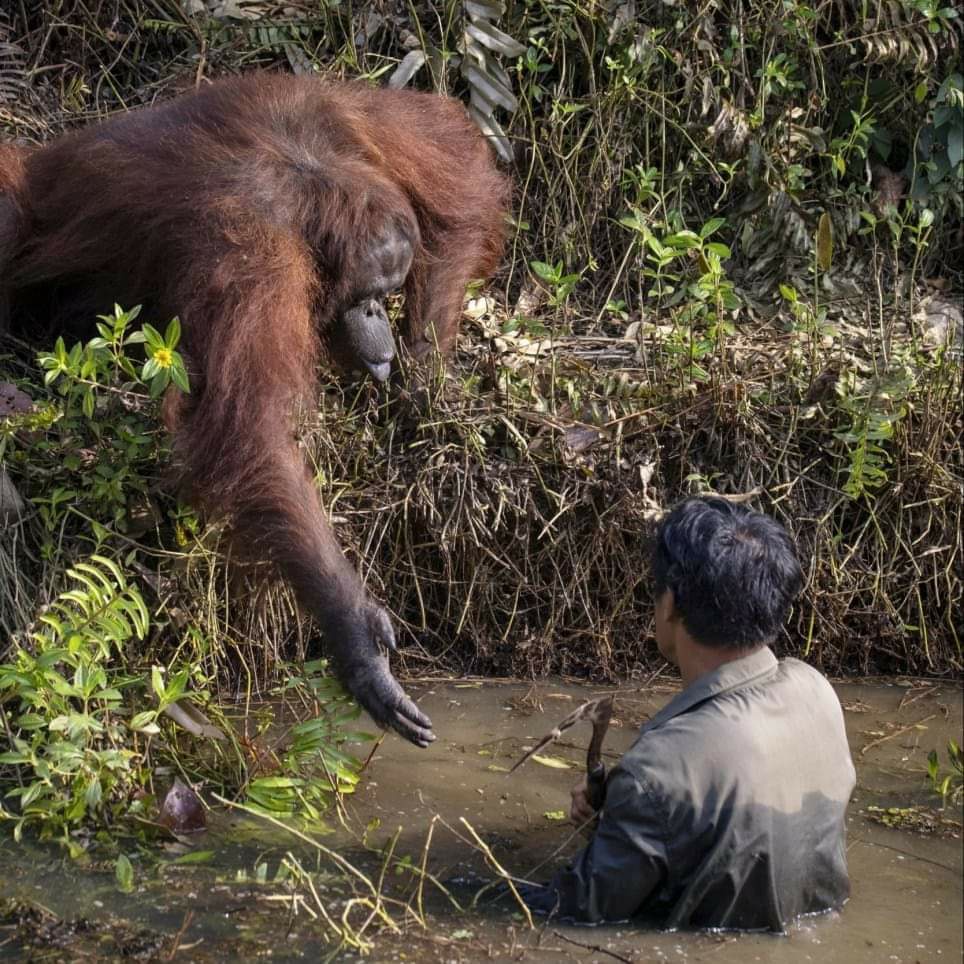
The photograph depicts a dramatic encounter between a large orangutan and a man immersed in murky water, likely a river or swamp within a dense tropical forest. The orangutan is in mid-leap, extending a hand (or foot) towards the man, its body filling a large portion of the upper frame. Its gaze seems directly at the man, creating a sense of intense connection.
The man is kneeling/sitting in the water, his back to the viewer, looking up at the orangutan. He appears to be holding out something, perhaps food, as a gesture of offering or enticement. The water is clouded with debris and vegetation, suggesting a wild, untamed environment. The background is a wall of lush green foliage, creating a sense of depth and enclosure. The lighting is dappled, with sunlight breaking through the canopy, highlighting the orangutan and the man. The composition emphasizes the interaction, framing it as a pivotal moment.
Foucauldian Genealogical Discourse Analysis
This photograph lends itself to a Foucauldian examination of the discourses surrounding "wildness," "animal behaviour," and human-animal relationships. Traditionally, "wildness" has been constructed in opposition to civilization, with animals being categorized and studied based on presumed "natural" instincts. The orangutan in this image, presented in such a powerful pose, challenges that binary.
A genealogical approach would ask how the very categories of “wild” and “domesticated,” “human” and “animal” have been historically produced through power relations. The fact that this photograph exists – that a human is photographing an orangutan in this manner – is itself an act of power and categorization. It constructs the orangutan as an object of observation, subject to human scrutiny and interpretation. The discourse around conservation (likely present in the context of this image) is also tied to power: who defines what is "endangered," and what measures are deemed necessary for "protection" are shaped by dominant societal forces. This moment, seemingly a connection, is framed by a broader network of knowledge and control.
Critical Theory
Applying Critical Theory (particularly informed by the Frankfurt School) to this image, we can examine it as a commentary on the alienation of modern humans from nature. The orangutan, representing the "natural world," approaches a human in what appears to be a hopeful gesture. However, that gesture is mediated by the act of photography and the viewer's gaze. This suggests a disconnect: we look at nature, but are increasingly separated from it, transforming it into an object of fascination rather than a realm of lived experience.
The act of "taking" this photograph can be seen as a metaphor for the human tendency to dominate and control the natural world. The human subject (both the photographer and the man in the image) exercises power over the orangutan by framing it within a visual narrative. The orangutan's agency is, in a sense, diminished by its being reduced to a spectacle for human consumption.
Marxist Conflict Theory
From a Marxist perspective, this photograph can be seen as indicative of the broader power imbalances driving environmental destruction. The orangutan’s habitat is likely threatened by deforestation, driven by capitalist exploitation of resources. The encounter captured in the image can be interpreted as a desperate plea for survival on the part of the orangutan, and perhaps a poignant symbol of the conflict between humans and the natural world.
The man’s interaction with the orangutan—offering food, for instance—could be seen as a temporary alleviation of the systemic issues that are destroying the orangutan’s environment. It is a band-aid solution, masking the underlying conflict between capital accumulation and ecological preservation. The photographer’s act of documenting this encounter could also be seen as a form of symbolic capital, reinforcing the photographer’s position within a system of power.
Important Note: These are interpretations, and the photograph can be analyzed through many other lenses. The richness of a visual image lies in its capacity for multiple readings.
simple-description (llama3.2-vision)
The meme features a photo of a person sitting in a muddy pit, surrounded by a large male orangutan who is reaching out to him. The text overlayed on the image reads "When you finally get a job at the zoo and the new guy is already making friends with the boss."
tesseract-ocr
Va AEA) aD V AS Ree ARS. SI oy; Mee ee SAAN a ie EN dN Ne SS =f SING ec os NO eee rainy ry i (ye) eae \ rept. aes i ta GS OIE, 26 my | Am ae NN ee ee Oe OW 4 — Wy oy SONRare Dae Can . Be a Oh a Nas Lk WN NRC: AN =i Gu ye ed ASRS AG wae © ee i aE Me Fe. Rt) NO 5 ore Ra RG ay cts as Ses BG EP BeNe Asi wich ae at ee AN aaa ccs ses i lalip at hi i eS eee be ak Sasi ke es pe Wie ee COONS Nwiisat eae 4 ea ae eS) Be si a et ta r aoe a Yi ee tee i Vos ‘de a ie WA, arya et: mA iy ND ieee MN SAWN 8M fk ie aaaNA Ue Serer RUN iii oo oa Ess) anit at. my Wiss Pde IRE, BS ees Ny | pos 0 Oe ee Rep cht Men ee ~ SG Tao, \ ES, Val ae — . Mess Bre a ~ IGS - Sea i ; aes nent a Se eS > Be go a ge ee . ep cat oe PRE Dn, ne eS OL i tome st