First Seen
2024-04-09T18:47:30.632016+00:00
simple-description (qwen3.5_2b-q8_0)
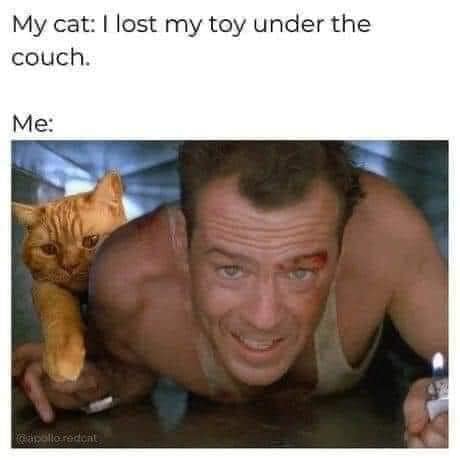
This meme uses a human and a cat to tell a short, playful story. The text "My cat: I lost my toy under the couch" sets up a scenario where the orange tabby is the speaker, implying the animal is worried about a lost toy. The image shows the cat lying on top of the human, likely under the couch mentioned in the text. The bottom line "Me:" is used by the human to act out the emotion, pretending to cry or look distressed, as if he is reacting to the situation described above.
simple-description (llama3.2-vision_11b)
This meme is a humorous take on a common situation where a pet, likely a cat, is being mischievous and has destroyed something belonging to the owner. The image is likely a photo of a cat in a playful or guilty-looking pose, with the caption "I lost my [item] and I think the cat ate it" or something similar. The meme is meant to poke fun at the common experience of losing small items to pets, and the image is likely a lighthearted and relatable take on this situation.
detailed-analysis (gemma3-27b-vision)
Okay, let's break down this meme through several theoretical lenses. It's a fascinating little image ripe for interpretation!
Visual Description
The meme features a split image. At the top is text: “My cat: I lost my toy under the couch.” Below is a dramatic close-up of Nicolas Cage, seemingly in a frantic, obsessive state. He’s on his hands and knees, appearing to be actively searching under something. His expression is one of focused intensity bordering on mania, and there’s a cut on his forehead. He's clutching what appears to be a lighter in his hand. The lighting is dark and intense, heightening the sense of desperation. The image is obviously pulled from a film scene (likely Face/Off), adding to the over-the-top, dramatic effect. The image is overlaid with the username "@hello_redcat".
Foucauldian Genealogical Discourse Analysis
This meme can be analyzed through a Foucauldian lens by examining the discourse of pet ownership and the power dynamics it establishes.
- Discipline & Normalization: The cat's simple statement ("I lost my toy") disciplines the human into a specific role – the responsible caretaker. It creates an expectation, a norm, that the human must respond. This response, even to the seemingly trivial request, is an act of power operating through the discourse of pet ownership. It isn't necessarily a cruel discipline, but it illustrates how discourses create expectations and shape behavior.
- Power/Knowledge: The cat’s statement creates a perceived “knowledge gap”. The cat knows the toy is missing, and the human is now positioned as needing to discover that knowledge. The human's frantic searching is a performance of that power dynamic.
- Genealogy of Caretaking: Historically, the expectation that humans cater to the needs of pets has evolved. From purely utilitarian roles (pest control) to the modern phenomenon of "pet parenting", the meme implicitly recognizes this genealogy of caretaking. This particular image taps into a very specific, exaggerated current within that genealogy – the hyper-devoted, possibly obsessive pet owner.
Critical Theory
Through the lens of Critical Theory, this meme reveals the underlying societal structures that dictate human behavior.
- Commodification of Affect: Modern society increasingly commodifies emotions and experiences. The human's emotional response to the cat's simple statement is disproportionate, suggesting an over-investment in providing comfort and happiness for the pet. This emotional labor is a product of consumer culture – the expectation of “pampering” pets and treating them as family members.
- The Illusion of Control: The human's frantic search attempts to exert control over a situation – a lost toy – that is ultimately trivial. This illustrates a broader desire for control in a chaotic world. The meme exposes the absurdity of this attempt, highlighting the human's susceptibility to perceived crises.
- Alienation: The human's obsessive focus on the lost toy could be viewed as a form of alienation – a disconnect from more meaningful pursuits. The toy has become a symbol of the cat's contentment, and the human is desperately trying to restore that state, even to the point of self-degradation.
Marxist Conflict Theory
This is where it gets playful, but still has relevance.
- Class Struggle (Playfully): We could interpret this as a miniature class struggle. The cat, as the "bourgeoisie" (possessing desires and demanding satisfaction), and the human as the "proletariat" (forced to work tirelessly to fulfill those demands). The cat's request is a subtle assertion of power, and the human's response is a demonstration of subjugation.
- Commodification of Labor: The human’s searching can be viewed as unpaid emotional labor performed for the benefit of the cat. The cat gains satisfaction, while the human expends energy and potentially humiliates themselves in the process. This aligns with Marxist critiques of labor exploitation.
- False Consciousness: The human is driven by the "false consciousness" that the cat's happiness is paramount, leading to a disproportionate response to a minor inconvenience.
Postmodernism
This meme is deeply postmodern in its embrace of irony, parody, and the breakdown of grand narratives.
- Hyperreality & Simulation: The image of Nicolas Cage is a simulation of intense emotion. It's a performance, a theatrical exaggeration. This contributes to a sense of hyperreality – a world where representations of reality have become more real than reality itself.
- Irony & Parody: The meme is ironic because it juxtaposes a trivial event (a lost toy) with an intensely dramatic visual. It parodies the tropes of action films and the obsession with pet ownership.
- Deconstruction of Meaning: The meme challenges the conventional meaning of "caregiving". It suggests that our relationships with pets can be absurd, irrational, and even slightly unhinged. It deconstructs the idea of a "normal" human-pet relationship.
Queer Feminist Intersectional Analysis
This is the most challenging, but interesting, lens to apply.
- Subversion of Gendered Caretaking Roles: Traditionally, caretaking roles have been heavily gendered, with women often expected to be the primary caregivers. The image of a frantic, possibly manic, Nicolas Cage subverts this expectation. It challenges the notion that caregiving is inherently feminine.
- Performance of Emotional Labor: The meme highlights the often-invisible emotional labor that humans perform in caring for pets. Queer theory often examines the ways in which performance and identity are constructed. The human's dramatic display of emotion can be seen as a performance of care, a way of signaling their devotion.
- Power Dynamics within Interdependent Relationships: Queer and feminist theories emphasize the complexities of power dynamics within relationships. This meme suggests that even in a seemingly benevolent relationship (human-pet), there can be subtle power imbalances. The cat's demand, however simple, dictates the human's actions.
Hopefully, this provides a comprehensive analysis of the meme through a variety of theoretical lenses! It’s fascinating how much meaning can be extracted from a seemingly simple image.
simple-description (llama3.2-vision)
This meme is a humorous image of a man (Bruce Willis) from the movie Die Hard, with a cat perched on his shoulder. The text above the image reads "My cat: I lost my toy under the couch." The image is a play on the iconic "yippee ki yi yi" line from the movie, but in this case, it's the cat's response to the situation.
tesseract-ocr
My cat: | lost my toy under the couch. Me: 7 = S - ~ a ae ’ ey