First Seen
2023-05-10T21:03:32+00:00
simple-description (llama3.2-vision_11b)
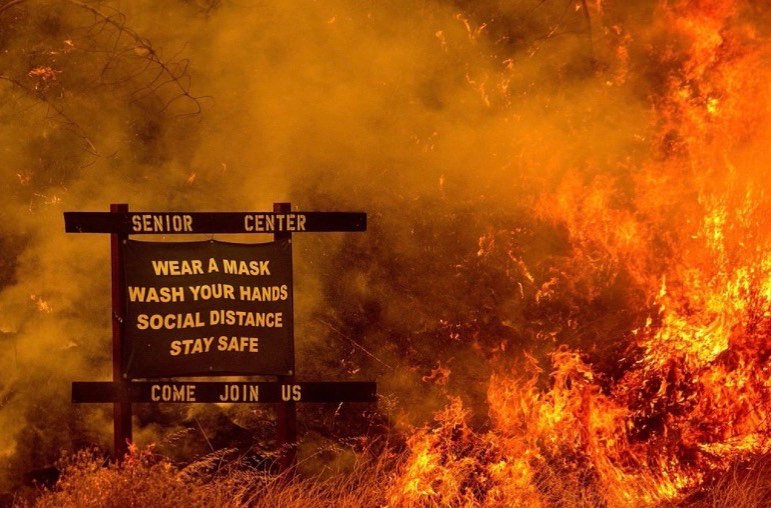
The meme is a humorous image of a sign from a "Senior Center" that is surrounded by a raging wildfire. The sign is still intact, but the context is absurd, implying that even in the midst of a catastrophic event, the senior center is still following proper protocol to maintain social distancing and hygiene.
detailed-analysis (gemma3-27b-vision)
Okay, here’s an analysis of the image broken down into the sections you requested, focusing on what’s present in the image and how these theories might address it. I’ll note if a section isn't strongly applicable.
Visual Description
The image depicts a large, intense wildfire encroaching upon a sign for a "Senior Center." The fire is a vivid orange and red, consuming dry grass and creating a chaotic, threatening backdrop. The sign, while relatively small in the frame, is clearly legible. It lists instructions: "WEAR A MASK, WASH YOUR HANDS, SOCIAL DISTANCE, STAY SAFE," followed by "COME JOIN US." This creates a stark and unsettling juxtaposition between preventative health measures and a catastrophic, immediate threat. The overall mood is one of impending doom and a dark irony. The scene feels both literal and metaphorical, hinting at a breakdown of systems and societal priorities.
Foucauldian Genealogical Discourse Analysis
This image provides fertile ground for a Foucauldian analysis. The sign itself is a manifestation of power/knowledge. It represents the discourses of public health, safety regulations, and biopower. Foucault argued that modern power operates not through brute force, but through regulating life—managing populations through health, hygiene, and security.
- Genealogy of Safety: Tracing the history of "safety" reveals it’s not a natural state, but a historically constructed concept. The instructions on the sign (“wear a mask,” etc.) represent the evolution of these discourses, particularly intensified by the recent pandemic.
- Discipline & Control: The sign is a directive aimed at disciplining bodies – shaping behavior to conform to accepted norms of health and safety.
- The Paradox of Control: The image's power resides in the failure of this control. The fire represents a force far beyond the scope of these minor disciplinary measures, undermining the authority of the sign. The irony underscores that these seemingly vital public health measures are rendered absurdly inadequate in the face of broader systemic failures and existential threats. It begs the question of where the true failures lie - individual hygiene or a larger crisis?
Critical Theory
From a critical theory perspective (rooted in the Frankfurt School), this image embodies the alienation and contradictions of late capitalism.
- Instrumental Reason: The sign represents the application of instrumental reason – focusing on efficient means to achieve ends (health and safety). However, the image suggests that this focus on control can become divorced from broader concerns of justice and sustainability. The prioritization of surface-level safety measures (masks) while a catastrophic environmental event unfolds speaks to a fundamental misdirection of priorities.
- Commodification of Safety: The emphasis on individual responsibility (“wash your hands”) can be interpreted as a shift in blame away from systemic issues (environmental degradation, climate change) towards individuals. This allows those in power to avoid accountability.
- The Loss of Meaning: The image hints at the erosion of traditional values and the loss of a sense of collective purpose. The juxtaposition of the mundane sign with the apocalyptic scene creates a jarring disconnect, suggesting a society out of touch with reality.
Marxist Conflict Theory
The image can be analyzed through a Marxist lens by examining the underlying class conflicts and power dynamics that contribute to the situation.
- Exploitation of Nature: The wildfire could be seen as a direct consequence of capitalist exploitation of natural resources and disregard for environmental sustainability. Profit maximization often prioritizes short-term gains over long-term ecological health.
- Vulnerability of Marginalized Groups: Senior citizens (the intended audience of the sign) are often more vulnerable to both environmental disasters and health crises. This highlights the uneven distribution of risk and vulnerability within society.
- Ideological Control: The sign, while seemingly benevolent, could be seen as a form of ideological control. By focusing on individual safety measures, it diverts attention from the systemic factors that contribute to the crisis. The "COME JOIN US" seems particularly cynical in the face of an actual existential threat.
Postmodernism
This image strongly aligns with postmodern themes:
- Simulacra & Simulation: The sign is a simulacrum – a copy without an original. It represents safety, but in this context, it is divorced from genuine safety. The image becomes more about the representation of safety than actual protection.
- Deconstruction of Meaning: The juxtaposition of the sign and the fire deconstructs the conventional meaning of "safety." The sign’s message is rendered absurd and meaningless.
- Fragmentation & Chaos: The fire represents fragmentation and chaos, mirroring the postmodern emphasis on the breakdown of grand narratives and stable meanings. The image resists a single, coherent interpretation.
- Irony & Parody: The image is profoundly ironic. The earnestness of the sign is undermined by the overwhelming reality of the fire, creating a sense of parody.
Queer Feminist Intersectional Analysis
This is a potentially less direct application but still relevant:
- Vulnerability and Care: The sign's targeting of seniors, a group often marginalized and reliant on care, can be connected to feminist concepts of care work and vulnerability. The fire exposes the inadequacy of the systems meant to protect them.
- Intersectionality of Crises: The image highlights the intersection of multiple crises – the pandemic (represented by the mask/handwashing) and the environmental disaster. These crises disproportionately affect marginalized communities (age, health status, socioeconomic position).
- Disrupting Normative Narratives of Safety: The image challenges the conventional, often patriarchal, narratives of safety that prioritize order and control. The fire is a disruptive force that exposes the fragility of these systems. It calls for a rethinking of safety that incorporates intersectional considerations and a focus on collective resilience.
I hope this multi-layered analysis is helpful! Let me know if you'd like me to elaborate on any specific aspect or theory.
simple-description (llama3.2-vision)
The image depicts a sign in front of a massive fire, with the sign reading "SENIOR CENTER" at the top and "WEAR A MASK, WASH YOUR HANDS, SOCIAL DISTANCE, STAY SAFE" below. The sign is surrounded by flames, indicating that it is located in a area where a fire is taking place.
The image is likely intended to be humorous, as it appears to be a situation where someone would expect to see a sign about safety and social distancing, but instead, it is surrounded by a massive fire. The image is likely meant to be seen as humorous or satirical, rather than serious.
tesseract-ocr
; 3 ee ae - ie dee a f 3 a : ; ee SENIOR _CENTER | Mae em ts = i : gf : se ba j S - “4 a | WEAR A MASK a ret 8 3p. ee te ES es eg oF: |» SOCIAL DISTANCE | ~ ne a ry eae A I ee ee rey ee _* ee he ee ee Rio OR eRe . eS k J eee. eo A ee _ > Pi eee Hee ee ee ee sg d Bow oes es ” a ue a Be ip PE ee BO. Ee Me eee eee Oe GIR ee