First Seen
2023-05-10T21:03:32+00:00
simple-description (llama3.2-vision_11b)
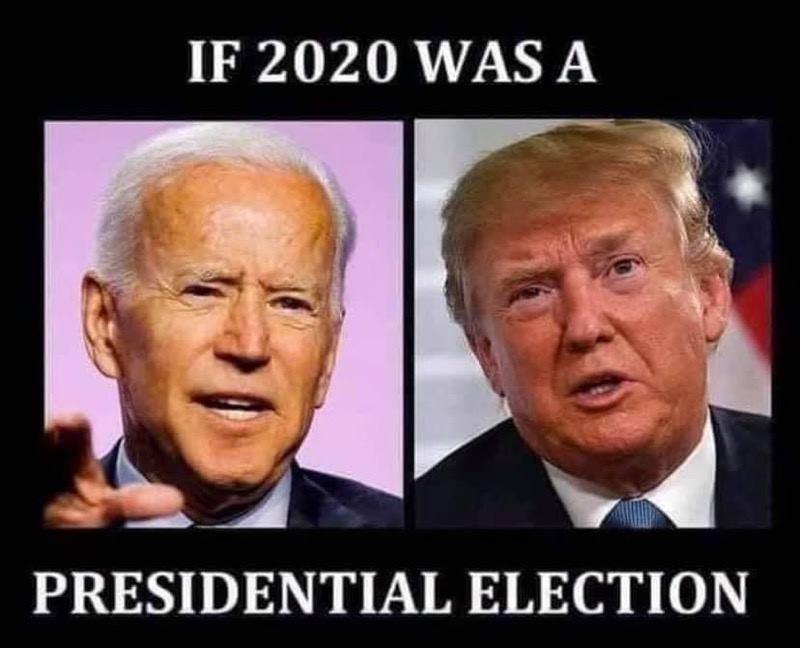
This meme is a humorous commentary on the 2020 US presidential election. The image juxtaposes two photos of former US presidents Joe Biden and Donald Trump, with the text "If 2020 was a presidential election" above them. The meme is a lighthearted way to poke fun at the chaotic and divisive nature of the 2020 election, implying that it was a wild and unpredictable event.
detailed-analysis (gemma3-27b-vision)
Okay, let's break down this image through the lenses you've requested. Given the nature of the image, some of these frameworks will be more applicable and produce more insightful analysis than others.
Visual Description
The image is a side-by-side comparison of photographs, depicting Joe Biden on the left and Donald Trump on the right. Both portraits are headshots, showing their faces in a direct gaze towards the viewer. Biden appears in a blue suit, speaking with a somewhat furrowed brow and pointing with one finger. Trump also wears a suit, though with a more intense expression and an open mouth as if speaking. The image is overlaid with text at the top ("IF 2020 WAS") and bottom ("PRESIDENTIAL ELECTION"). The background is black and slightly blurred in the case of Trump. This suggests a deliberate framing intended to evoke the 2020 election.
Foucauldian Genealogical Discourse Analysis
This image can be read through a Foucauldian lens. Foucault would be interested in how discourses surrounding power and the state are constructed and maintained.
- Discourse of Presidential Authority: The images themselves are immediately recognizable as markers of power – portraits of those vying for the highest office. This activates existing discourses about leadership, authority, and legitimacy.
- Genealogy of Political Persona: The images aren't neutral representations. They're specific constructions of Biden and Trump, shaped by years of media coverage, political messaging, and public perception. A genealogical approach would trace how these constructions (their "presidential personas") developed over time, influenced by various power dynamics.
- The Power of the Image: The image focuses solely on the faces of the candidates, amplifying their visual presence. This can be seen as a way of asserting authority through physical presence—a tactic often employed in political campaigns.
- Discipline and Control: The image suggests a binary opposition, framing the choice as a clear ‘either/or’. This contributes to the disciplining of political opinion, forcing individuals to align themselves with one side or the other.
Critical Theory
This image lends itself well to Critical Theory, particularly the Frankfurt School's emphasis on the culture industry and the manipulation of mass media.
- Culture Industry & Spectacle: The image is a product of the culture industry—a distilled, simplified representation of complex political processes. The use of portraits, rather than nuanced policy discussions, prioritizes image and persona over substance.
- Ideology and False Consciousness: The image implicitly promotes a particular ideological framework: the idea that political choice is primarily about selecting the ‘best’ leader. This can obscure underlying structural inequalities and systemic problems. It can contribute to ‘false consciousness’ by framing politics as a matter of individual personalities rather than collective action.
- Dominant Narratives: By presenting Biden and Trump as the sole options, the image reinforces a dominant narrative that excludes other political perspectives or potential candidates.
- Commodification of Politics: The images themselves are commodities – circulating widely in media and online – contributing to the commodification of politics.
Marxist Conflict Theory
While less directly applicable than Critical Theory, a Marxist analysis can identify class and power dynamics.
- Struggle for Hegemony: The image represents a struggle for political hegemony – a battle to control the dominant ideology and maintain power. The visual contest between Biden and Trump can be seen as a symbolic representation of class conflict.
- Representing Interests: Both candidates represent, to varying degrees, the interests of specific classes or groups. A Marxist analysis would examine how their policies and rhetoric benefit or disadvantage different social classes.
- Ideological Apparatus: The image itself functions as part of the ideological apparatus of the ruling class, reinforcing the status quo and legitimizing the existing power structure.
Postmodernism
Postmodern analysis would focus on the image’s deconstruction of the idea of a singular, stable truth.
- Simulation and Hyperreality: The image presents a "simulation" of an election, a simplified representation of a complex process. This contributes to a state of "hyperreality" where the image and the representation become more important than the actual event.
- Deconstruction of Binary Oppositions: While the image presents a clear binary (Biden vs. Trump), a postmodern analysis would deconstruct this opposition, revealing the underlying complexities and ambiguities. It questions the idea of an either/or choice and the assumption that these two candidates represent the only viable options.
- Loss of Grand Narratives: Postmodernism rejects grand narratives or universal truths. This image can be seen as contributing to the erosion of faith in traditional political institutions and ideologies.
Queer Feminist Intersectional Analysis
This framework is the least directly applicable, but some points can be made.
- Absence of Marginalized Voices: The image's focus solely on two white, male candidates reinforces the historical exclusion of women, people of color, and LGBTQ+ individuals from positions of power.
- Masculinity and Power: The image implicitly reinforces a traditional association between masculinity and political authority. Both candidates embody a conventional form of masculinity, reinforcing gender norms.
- Intersectional Considerations: An intersectional analysis would examine how gender, race, class, and other social categories intersect to shape political representation and power dynamics. The image's lack of diversity highlights the need for greater intersectional representation in politics.
In conclusion, while not every framework is equally strong in this instance, the image of the 2020 election candidates lends itself best to a Critical Theory analysis, highlighting the commodification and simplification of political processes within the culture industry. The Foucauldian, Marxist, and Postmodern lenses offer valuable insights into the power dynamics, ideological constructions, and deconstruction of truth embedded within the image. The Queer Feminist Intersectional analysis, while less central, points to the ongoing need for greater diversity and representation in politics.
simple-description (llama3.2-vision)
The meme is a comparison between two images of former US President Donald Trump and current President Joe Biden. The left image shows Joe Biden with a serious expression, while the right image shows Donald Trump with a serious expression. The text above the images reads, "If 2020 was a presidential election." The text below the images reads, "Presidential." The meme is suggesting that both candidates' serious expressions are similar and that 2020 was a presidential election.
tesseract-ocr
IF 2020 WASA 4 Bc. " i eA neh cy | \ Se = : ae Sy eee PRESIDENTIAL ELECTION