First Seen
2024-01-31T03:22:54.529650+00:00
simple-description (qwen3.5_2b-q8_0)
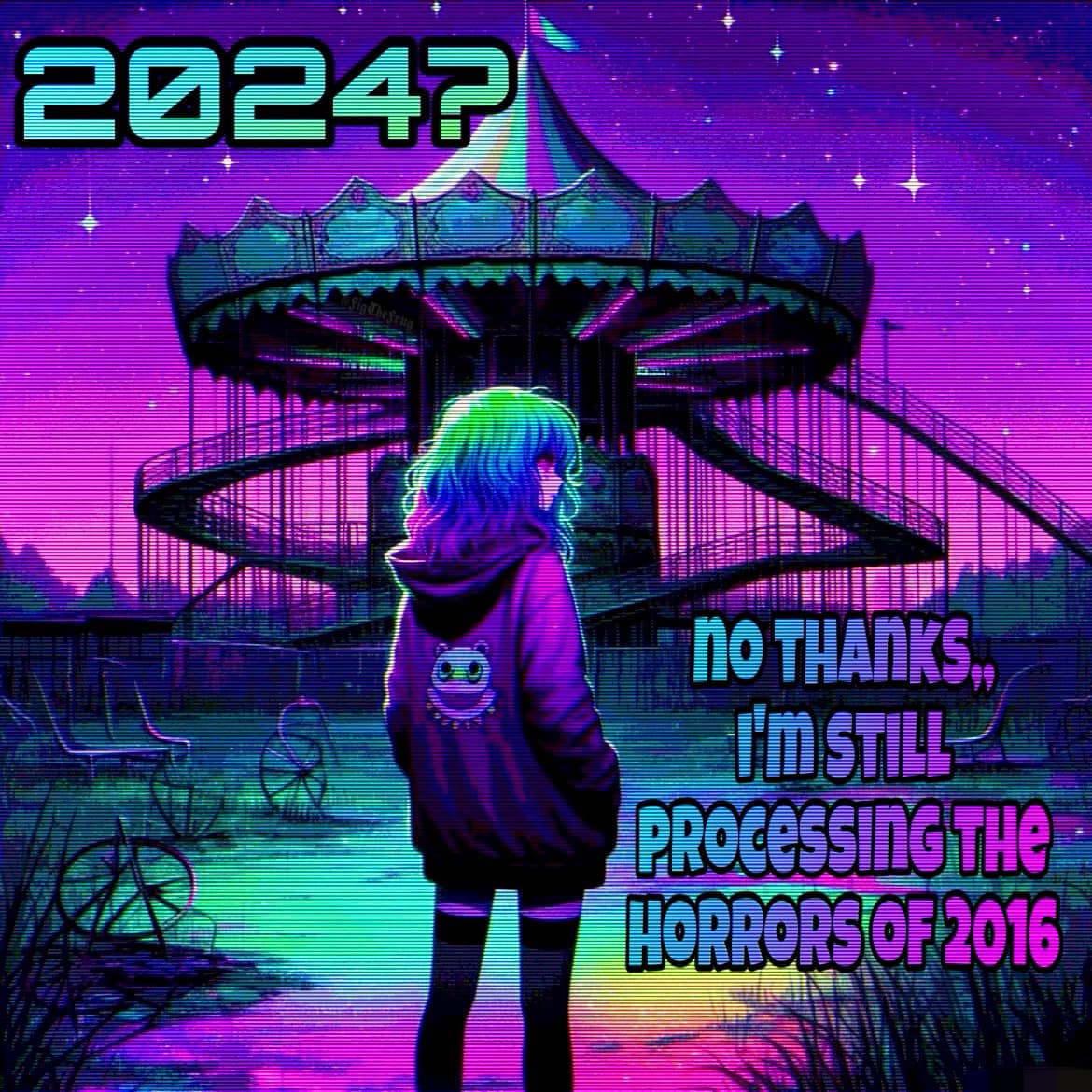
This image is a classic example of annualism (or the "post-annualism"), a social phenomenon where people make fun of their own past year to avoid feeling bad about the current one.
The meme relies on the popular internet joke about the 2016 holiday season (the "Silent Night Run"). The image features a text overlay that reads:
- "2024?" (asking for the current year)
- "NO THANKS.. I'M STILL PROCESSING THE HORRORS OF 2016"
The creator uses this to make a self-deprecating joke: they can't laugh at the past because they are still remembering the trauma, so they instead create a joke to make the year easier. It's a way to use a specific memory of a specific time to make the current year feel less painful.
simple-description (llama3.2-vision_11b)
The meme is a play on the idea that a person's future self would have to deal with the consequences of their current actions, but in a humorous and ironic way. The text "2024?" is a question mark that implies the person is looking forward to the future, but is also aware of the potential problems that could arise. The phrase "I'm still processing the horrors of 2016" is a tongue-in-cheek reference to the many controversies and scandals that occurred during that year, implying that the person is still trying to make sense of them.
detailed-analysis (gemma3-27b-vision)
Okay, let's break down this image using the requested theoretical frameworks. It's a visually striking piece, and there's a lot to unpack.
Visual Description
The image presents a digitally rendered scene drenched in a vaporwave aesthetic. Dominated by neon pinks, purples, and blues, it evokes a sense of nostalgia for an imagined retro-future. A young, anime-style figure stands with their back to the viewer, appearing melancholic or withdrawn. They are positioned in front of a highly stylized, tiered, circular architectural structure. This structure, resembling a futuristic amphitheater or perhaps a bizarre stadium, is visually prominent.
The entire image has a distorted, pixelated effect, reminiscent of old computer graphics or a glitch in a digital system. The sky is a deep purple with scattered white stars. Text overlays the image: "2024?" at the top, and "no thanks. I’m still processing the horrors of 2016" at the bottom. There's a broken toy (perhaps a drone or small aircraft) lying in the foreground. The overall impression is one of both beauty and unease.
Foucauldian Genealogical Discourse Analysis
This image is rich with discourse. The text "2024?" immediately establishes a temporal concern, framing a future that is being questioned or resisted. The primary discourse, however, is the declaration that the viewer/subject is still processing the "horrors of 2016."
From a Foucauldian perspective, this points to the construction of 2016 as a site of trauma and horror. This isn’t an inherent quality of the year itself, but a result of the discourses surrounding it – specifically, the discourses of political upheaval (the 2016 U.S. presidential election is a likely reference), social polarization, and anxieties about the future.
The image genealogically demonstrates how power operates through these discourses. The "horrors" of 2016 become a normalizing force, an established narrative shaping perceptions of the present and future. The refusal of 2024 (“no thanks”) represents a resistance to being swept along by new narratives and a clinging to the ongoing processing of the past. The glitchy, distorted aesthetic could represent the disruptive effects of these discourses on subjective experience and the inherent instability of any seemingly fixed narrative.
Critical Theory
From a critical theory perspective, this image embodies several key themes. The central statement – being stuck in the trauma of 2016 – reflects the delayed effects of ideological crisis. The image suggests that the ideological shock of 2016 wasn’t a single event, but an ongoing process that continues to shape present experience.
The aesthetic – vaporwave, retro-futurism – operates as a critique of late capitalism. Vaporwave often utilizes nostalgia for failed or unfulfilled promises of the past, highlighting the disillusionment with consumer culture and technological progress. Here, this aesthetic suggests that the future promised by late capitalism has not materialized in a positive way; instead, it feels fractured, unstable, and haunted by the failures of the past.
The isolated figure, facing away from the viewer, symbolizes alienation – a common theme in critical theory. The individual is disengaged from the promise of 2024, stuck in a cycle of processing past trauma, demonstrating a sense of powerlessness in the face of larger social and political forces.
Marxist Conflict Theory
Within a Marxist framework, this image speaks to the continuing impact of class struggle and ideological control. The "horrors of 2016" can be interpreted as the intensification of existing inequalities and the rise of reactionary ideologies that serve the interests of the ruling class.
The resistance to 2024 ("no thanks") suggests a rejection of the continuation of these oppressive systems. The aesthetic – a stylized, almost artificial landscape – can be read as a symbol of the commodification of culture and the alienation of individuals from authentic experience under capitalism.
The broken toy in the foreground could represent the broken promises of technological progress and the ways in which technology is often used to exacerbate existing inequalities. The image implicitly calls for a radical break with the systems that produced these "horrors," rather than simply accepting a new cycle of exploitation and control.
Postmodernism
This image is deeply entrenched in postmodern aesthetics and concepts. The central theme—being stuck in the past—speaks to the loss of grand narratives and the fragmentation of time. The past isn't neatly left behind, but continuously loops back into the present.
The image's pastiche of aesthetics (vaporwave, anime, glitch art) embodies intertextuality and a rejection of originality. The image does not present a coherent, unified vision, but a collage of borrowed styles and fragmented references.
The ambiguity and irony inherent in the message also align with postmodern sensibilities. The image does not offer a clear solution or a path forward, but rather presents a state of prolonged processing and resistance. The deconstruction of temporal linearity and the challenge to the idea of a progressive future are central themes within postmodern thought.
Queer Feminist Intersectional Analysis
Through a queer feminist intersectional lens, the image can be interpreted as reflecting the cumulative trauma experienced by marginalized communities, particularly in the wake of 2016 (which saw a rise in hate crimes and reactionary policies affecting women, LGBTQ+ individuals, and people of color).
The resistance to 2024 ("no thanks") can be seen as a refusal to accept a future that perpetuates these systems of oppression. The fragmented and distorted aesthetic mirrors the disrupted experiences of individuals navigating a world that is hostile to their identities.
The melancholic figure, disconnected from the future, represents the emotional labor and psychological toll of constantly having to fight for recognition and liberation. The image implicitly challenges the notion of a universal or neutral experience of time and trauma, acknowledging that marginalized communities are often forced to carry the weight of history and navigate the present with a heightened sense of vulnerability. The refusal to look forward is a form of self-preservation, a rejection of a future that threatens to repeat the cycles of violence and oppression.
Hopefully, this breakdown gives you a comprehensive understanding of the image through the requested theoretical lenses. Let me know if you'd like me to elaborate on any of these points!
simple-description (llama3.2-vision)
This meme is a humorous take on the concept of "2024 is going to be terrible" jokes that were popular in the early 2010s. The image features a cartoon girl standing in front of a creepy, abandoned amusement park, with the text "2024?" and "No thanks, I'm still processing the horrors of 2016" written above and below her. The meme is a lighthearted way to poke fun at the idea that every year is going to be worse than the last.
tesseract-ocr
42,2 Fr — = —— eer 2 SE Z = = ee SE