First Seen
2024-01-27T02:48:42.845997+00:00
simple-description (qwen3.5_2b-q8_0)
In 2025, an Annualist might wonder if the feeling of "we deserve better" will repeat itself, only this time perhaps realizing it wasn't just a threat to their future but a reality. This is a classic example of annualism, where the same feeling—believing in justice or better treatment—will come back in the next cycle, only to reveal itself as just another threat to the status quo.
simple-description (llama3.2-vision_11b)
The meme is a screenshot of a Twitter post from the account @xoxoAOC, featuring a photo of Alexandria Ocasio-Cortez with a caption "The year 2024 is going to be wild". The meme is a humorous take on the idea that 2024 will be a challenging year, with the phrase "the year 2024 is going to be wild" being used to express a sense of anticipation or anxiety about the upcoming year.
detailed-analysis (gemma3-27b-vision)
Okay, here's an analysis of the social media post, broken down into sections addressing the requested theoretical frameworks where relevant.
Visual Description
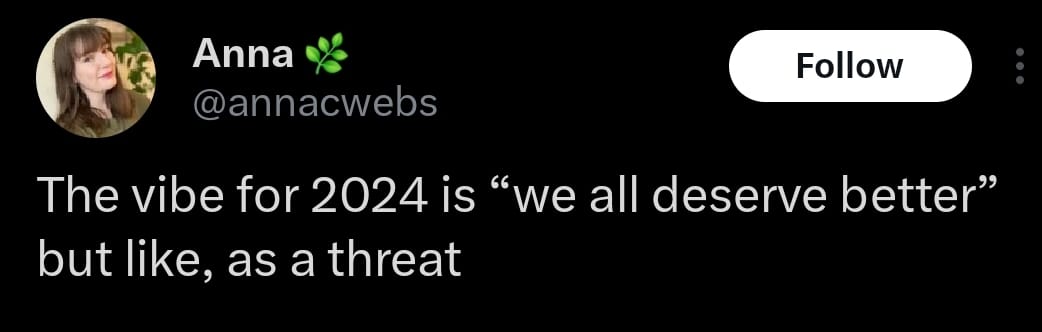
The image is a screenshot of a Twitter (now X) post. It features a profile image of a person with long dark hair and a neutral expression, along with the username "@annacwebs." A green plant emoji is visible next to the name. The main content of the post is a text statement reading: “The vibe for 2024 is ‘we all deserve better’ but like, as a threat.” There are buttons available on the side of the post to “Follow.” The background is black.
Foucauldian Genealogical Discourse Analysis
This post is interesting within a Foucauldian framework, particularly in how it disrupts dominant discourses surrounding hope and expectation. The phrase "we all deserve better" has become a common refrain, often associated with self-care, aspiration, and a hopeful call for positive change. Foucault would be less interested in whether this statement is true and more interested in its function within a power structure.
The addition of "but like, as a threat" dramatically shifts the meaning. It’s no longer a simple expression of aspiration. It becomes a counter-discourse hinting at potential consequences if conditions do not improve. A genealogical approach would examine how this simple phrase has evolved in its usage: from genuine hope to a passive-aggressive demand, or even a veiled promise of disruption. The shift signifies a move away from accepting the status quo and towards a position of resistance, even if that resistance is expressed through a pointed statement, rather than overt action. The phrase, divorced from sincerity, becomes a tool to expose the underlying power dynamics that make "deserving better" even necessary.
Critical Theory
From a Critical Theory perspective, this post exposes a deep-seated social critique. The seemingly innocuous phrase "we all deserve better" is laden with implication when framed as a threat. It suggests a collective recognition of systemic failings – economic inequality, political corruption, social injustice – that prevent people from realizing their full potential.
The post implies a growing dissatisfaction with structures that perpetuate harm. The phrase isn't about individual shortcomings but a critique of a system that consistently denies people basic needs and fundamental rights. Framing it as a threat suggests the potential for collective action (or at least, the threat of it) if those systemic issues are not addressed. It's a form of challenging the legitimacy of the current order and signaling a demand for radical change.
Marxist Conflict Theory
Within a Marxist framework, the statement encapsulates the inherent contradictions of capitalism. “We all deserve better” can be interpreted as a critique of the exploitation and alienation that are fundamental to the capitalist mode of production. The phrase highlights the gap between the potential wealth and well-being of society and the actual conditions experienced by the working class (and increasingly, broader segments of the population).
Framing it as a threat points to the potential for class conflict. It suggests that the growing dissatisfaction with economic inequality and social injustice could lead to resistance, disruption, or even revolution. The "threat" isn't necessarily a direct call for violence, but rather a warning that the status quo is unsustainable and that the marginalized are no longer willing to passively accept their situation.
Postmodernism
The post embodies a postmodern sensibility through its embrace of irony and its subversion of traditional meaning. The phrase "we all deserve better" is a cliché, a sentiment typically associated with positive messaging. However, by adding "but like, as a threat", the author deflates that sincerity, creating a deliberately ambiguous and unsettling statement.
This ambiguity is key to a postmodern reading. The post doesn’t offer a clear solution or a straightforward call to action. It instead relies on disrupting expectations and forcing the audience to question the meaning behind the words. It embraces a playful, self-aware tone, rejecting the grand narratives and definitive truths of modernity. The power is shifted from a declarative statement to an ironic jab, signifying a rejection of simple answers.
Queer Feminist Intersectional Analysis
This statement can be read through an intersectional lens, suggesting a particularly acute awareness of systemic oppression. For marginalized groups (queer people, women, people of color, disabled individuals, etc.), "deserving better" is not merely a general sentiment; it's a demand for justice and liberation from interlocking systems of oppression.
Framing it as a threat speaks to the anger and frustration that many marginalized individuals feel towards a society that consistently devalues and harms them. It's a refusal to politely request equality; instead, it's a declaration that the current state of affairs is unacceptable and that change is necessary. The "threat" can be interpreted as a warning to those in power that they will be held accountable for their actions and that they will face consequences if they continue to perpetuate harm. The statement subtly implies the recognition of collective power and the potential for solidarity among marginalized communities.
Hopefully, this breakdown is useful. Let me know if you'd like me to elaborate on any of these points.
simple-description (llama3.2-vision)
This meme is a screenshot of a tweet from the Twitter account "Anna" (@annacwebs) with a humorous take on the 2024 vibe. The text reads: "The vibe for 2024 is 'we're all going to die' but like, as a threat." The meme is a tongue-in-cheek commentary on the anxiety and fear that many people are feeling about the future, using a darkly comedic tone to poke fun at the idea that the world is on the brink of disaster.
tesseract-ocr
(Cae y @annacwebs The vibe for 2024 is “we all deserve better” but like, as a threat