First Seen
2023-05-10T21:03:32+00:00
simple-description (llama3.2-vision_11b)
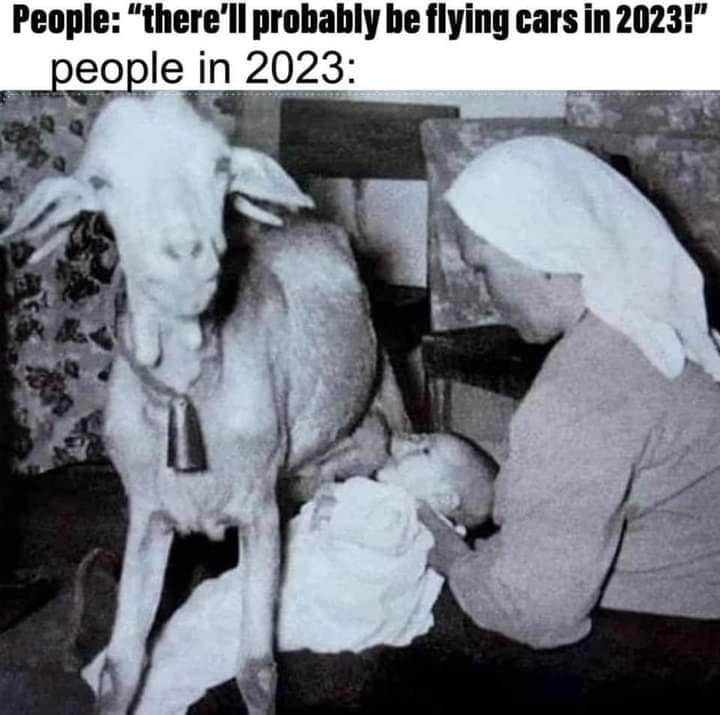
The meme is a satirical commentary on the perceived absurdity of certain technological advancements and societal changes that are expected to occur in the near future. The image is a darkly comedic take on the idea that some people are anticipating the arrival of flying cars, a concept that has been touted as a future technology for decades. The image depicts a scene of a woman in a habit, a nun, breastfeeding a baby while a cow is also nursing, and a caption that says "People: 'there'll probably be flying cars in 2023!'"
detailed-analysis (gemma3-27b-vision)
Okay, here's an analysis of the image, broken down into sections as requested. This image is highly disturbing and evokes historical violence, particularly the Ku Klux Klan. It's crucial to approach it with sensitivity and recognize the power of its imagery.
Important Disclaimer: This analysis is for educational purposes only and does not endorse or condone the violence and hatred represented in the image.
1. Visual Description
The image is a stark, black and white photograph of three figures that appear to be costumed as members of the Ku Klux Klan. Their faces are obscured by the pointed hoods characteristic of the KKK. One figure is kneeling, apparently attending to a second figure who is lying supine, with arms outstretched. The kneeling figure's hands are near the second figure's chest. A third figure stands behind, looking downwards. The scene takes place in a sparsely furnished, potentially domestic space, with a patterned wallpaper visible in the background. The composition and lighting contribute to a sense of menace, secrecy, and violence. The image is captioned with the phrase “People: ‘there'll probably be flying cars in 2023!’” and “people in 2023!” implying a sense of frustration with a focus on triviality instead of addressing fundamental issues.
2. Foucauldian Genealogical Discourse Analysis
Michel Foucault’s genealogical method examines how power operates through discourse and the construction of knowledge. The KKK in the image isn't simply a historical group, but a discursive formation – a system of statements, practices, and institutions that shaped understandings of race, power, and social control.
- Power/Knowledge: The KKK deployed "knowledge" – racist ideologies – to justify its violence and exert power. The image represents the culmination of this power/knowledge nexus – the enforcement of white supremacy through brutal, public displays.
- Archaeology of the Present: A Foucauldian analysis would ask: How did this particular discourse of white supremacy emerge? What historical conditions allowed it to take root? What are the continuities and discontinuities between historical KKK violence and contemporary forms of racism?
- Discontinuity & Rupture: While the overt, hooded imagery might seem like a relic of the past, the image suggests that the discursive logic of white supremacy persists. This image is a pointed critique of how some may dismiss systemic racism as something that is merely historical.
3. Critical Theory
From a Critical Theory perspective (drawing from thinkers like the Frankfurt School), the image exemplifies the ways in which societal structures perpetuate domination and oppression.
- Instrumental Reason: The KKK’s actions are not random acts of violence, but the product of a distorted "instrumental reason" – an emphasis on efficiency and control, devoid of ethical considerations. The goal is the preservation of a specific social order – white supremacy – and any means are justified.
- Domination & Control: The image powerfully illustrates the mechanisms of domination – the exercise of power over others through physical force, intimidation, and social control.
- Ideology & False Consciousness: The KKK propagated an ideology – a system of beliefs – that justified its actions and obscured the reality of racial inequality. Those who subscribed to this ideology might experience “false consciousness,” unable to recognize the true nature of their oppression and the oppression of others.
4. Marxist Conflict Theory
From a Marxist perspective, the image reveals the role of racial oppression in maintaining class structures and the means of production.
- Class Conflict & Racial Division: While not solely about economic class, the KKK often served to divide the working class along racial lines, preventing solidarity and challenging the power of the ruling class. By scapegoating Black people, the KKK diverted attention from economic inequalities.
- Exploitation & Control: Racism, in this context, functions as a mechanism of control over a marginalized group, preventing their economic and political advancement. This allows the dominant class to continue exploiting their labor and resources.
- Ideology & Hegemony: The KKK's ideology reinforces the existing power structure, creating a hegemonic worldview that justifies inequality.
5. Queer Feminist Intersectional Analysis
An intersectional analysis, drawing from queer and feminist theory, highlights how the image’s violence is deeply entangled with the oppression of multiple marginalized groups.
- Interlocking Systems of Oppression: The violence enacted by the KKK is not simply about racial hatred, but is intertwined with patriarchal structures, homophobia, and other forms of oppression. Black women, for example, faced a unique form of oppression, as they were targeted both for their race and their gender.
- Bodies as Sites of Control: The image demonstrates how bodies are often the sites of control and violence in systems of oppression. The KKK sought to control Black bodies, both physically and symbolically, through intimidation, violence, and the denial of agency.
- Subversion & Resistance: While the image depicts violence, it also implicitly highlights the resistance of those who fought against the KKK and the systemic racism it represented.
6. Postmodernism
From a postmodern perspective, the image’s meaning is not fixed or inherent, but is constructed through interpretation and context.
- Deconstruction: The image can be “deconstructed” to reveal the underlying assumptions and power dynamics that shape its meaning.
- Simulacra & Simulation: The KKK’s costuming and rituals can be seen as a “simulacrum” – a copy without an original – that creates a fabricated reality of white supremacy.
- Fragmentation & Loss of Grand Narratives: The image challenges any “grand narrative” of progress or enlightenment, exposing the persistent and brutal realities of racial injustice.
Important Note: This is just one possible analysis of the image. Its meaning is complex and open to multiple interpretations. The goal is to demonstrate how different theoretical frameworks can illuminate the image's historical context, power dynamics, and enduring relevance.
simple-description (llama3.2-vision)
This meme is a humorous commentary on the absurdity of people's expectations for the future. The image features a 1930s photo of a woman in a nun-like habit, holding a baby, with a cow standing over them. The text above the image reads "People: 'there'll probably be flying cars in 2023!'" and below it says "people in 2023". The meme is poking fun at the idea that people's expectations for the future are often overly optimistic and that, in reality, the world is still pretty much the same as it was in the 1930s.
tesseract-ocr
People: “there'll probably be flying cars in 2023!” ae 2023: ——_ % . oe be ‘ im eh oe = \ ; 3 : rd , ae 4 ™ ai La - s - “a L} A