First Seen
2023-05-10T21:03:32+00:00
simple-description (llama3.2-vision_11b)
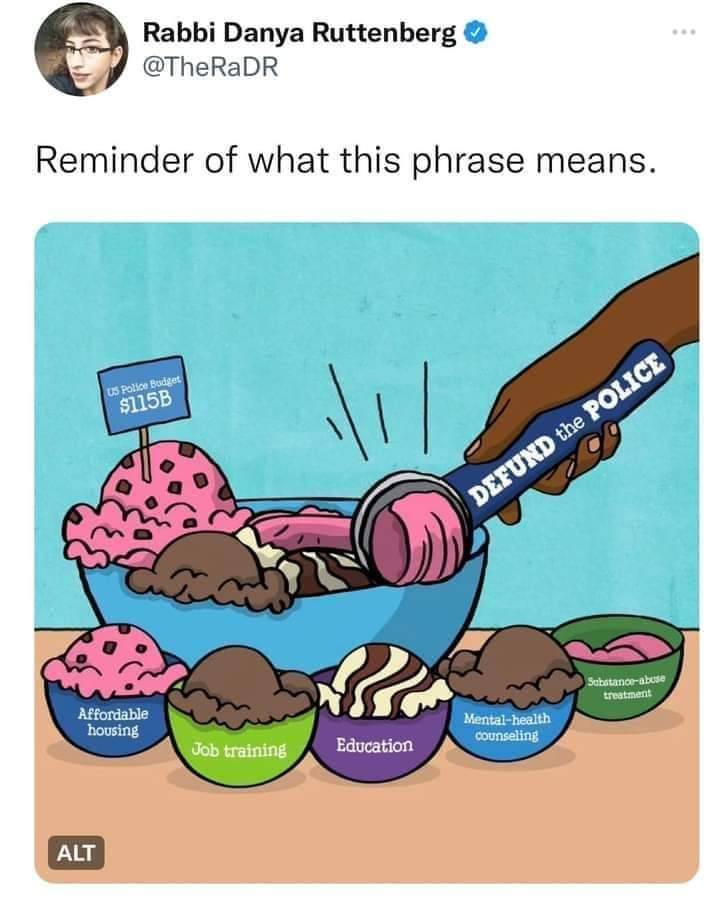
The meme is a satirical image of a person pouring a large bucket of ice cream into a bowl labeled "Defund the Police." The image is meant to be humorous and ironic, as "defund the police" is a popular slogan in the anti-police reform movement. The image is poking fun at the idea that "defund the police" is a catch-all phrase for a wide range of social and economic issues, rather than a specific policy.
detailed-analysis (gemma3-27b-vision)
Okay, let's break down this image shared by Rabbi Danya Ruttenberg in relation to the theoretical frameworks you requested.
Please note: Analyzing an image like this through these frameworks is inherently interpretive. Different scholars might emphasize different aspects. I will aim to provide a detailed and thoughtful examination within the bounds of the requests.
Visual Description
The image is a cartoon-style illustration depicting a machine labeled "US Police Budget $115B". The machine is processing (or rather, seemingly not processing) various social services as input. These inputs include "Affordable Housing", "Job Training", "Education", "Mental-health counseling", and "Substance-abuse treatment."
Instead of outputting anything of value, the machine appears to be malfunctioning—it's spraying out bits and pieces, indicating a failure to transform these vital resources into positive outcomes. A banner wraps around the machine proclaiming "DEFUND the POLICE." The dominant colors are pink and green, giving a slightly surreal and playful, yet urgent, appearance. A small "ALT" tag is visible, indicating it's designed for accessibility with alternative text.
Foucauldian Genealogical Discourse Analysis
This image is deeply relevant to Foucauldian discourse analysis.
- Discourse & Power/Knowledge: The image actively challenges the dominant discourse surrounding policing and public safety. The prevailing discourse frames police as the solution to social problems. This image argues that the problem is the misallocation of resources—that prioritizing policing over social services actually hinders addressing the root causes of those problems. This challenges the "truth" produced within the dominant power/knowledge regime.
- Genealogy of Policing: The image implicitly engages in a genealogical project. By highlighting the redirection of funds from social services to policing, it invites us to question how policing became so central to social problem-solving. What historical power dynamics led to the prioritization of punishment/control over prevention/care? It begs us to trace the genealogy of the modern police force – its roots in maintaining social hierarchies, control of marginalized communities, and expanding its reach into areas where social workers or healthcare professionals could be more effective.
- Disciplinary Power: The “machine” metaphor powerfully illustrates how policing operates as a form of disciplinary power. The machine should process and transform inputs into benefits for society, but instead, it extracts resources and produces little positive output. The policing machine doesn’t solve the root causes of the issues it claims to address; it merely manages the symptoms, perpetuating the conditions that require its intervention.
Critical Theory
The image is fundamentally rooted in Critical Theory, specifically the Frankfurt School’s tradition of examining power structures and social control.
- Critique of Instrumental Reason: The image critiques the "instrumental reason" driving the allocation of resources. Instrumental reason prioritizes efficiency and quantifiable outcomes without considering ethical implications or social justice. The “machine” metaphor embodies this logic. The focus is on “processing” problems (through policing) rather than addressing the underlying causes.
- Domination & Emancipation: Critical Theory posits that societal structures often function to maintain domination. This image exposes how the current system disproportionately benefits those who uphold the existing power structures by perpetuating conditions requiring police intervention. The call to “defund” represents an attempt to disrupt this system and create a more just and equitable society. It is a move toward emancipation from systems of social control.
- Ideology: The image challenges the ideological underpinnings that justify massive spending on policing. The prevailing ideology suggests that policing is necessary for safety and order, but this image argues that this is a false consciousness. The resources diverted to policing could be used to create a truly safe and equitable society.
Marxist Conflict Theory
The image lends itself to a Marxist interpretation by highlighting the inherent class conflict and unequal resource distribution within society.
- Class Struggle: The image implicitly points to a struggle over resources between social services (which benefit the working class and marginalized communities) and policing (which often serves to control and suppress these same groups). The billions spent on policing could be invested in programs that uplift the working class and address the root causes of poverty and crime.
- Means of Production: The "machine" can be seen as a metaphor for the "means of production" in a capitalist society—in this case, the means of social welfare. The image suggests that the current system prioritizes the control of the population (policing) over the well-being of the population (social services).
- False Consciousness & Ideology: The image suggests that the belief that policing is the only solution to social problems is a form of "false consciousness"—a belief system that prevents the working class from recognizing its own interests. The call to “defund” represents an attempt to raise class consciousness and challenge the dominant ideology.
Postmodernism
While not as central as the other frameworks, postmodern thought can also illuminate aspects of the image.
- Deconstruction of Grand Narratives: The image challenges the "grand narrative" that policing is the sole provider of safety and order. It deconstructs this narrative by showing how resources could be allocated in alternative ways.
- Relativism and Situated Knowledge: The image implies that there are multiple ways to approach social problems. Safety is not simply a matter of more policing, but a complex issue requiring a nuanced and contextualized approach.
- Simulation and Hyperreality: The "machine" can be seen as a metaphor for the increasing simulation of social control in modern society. The focus is on appearing to address problems rather than actually solving them.
Queer Feminist Intersectional Analysis
This framework is particularly powerful in understanding the image.
- Intersectionality: The image implicitly acknowledges that those most harmed by the current system are those at the intersections of multiple marginalized identities – particularly Black, Indigenous, and People of Color (BIPOC), those with mental health issues, the unhoused, LGBTQ+ individuals, and people with substance use disorders. These groups are disproportionately targeted by policing and underserved by social services.
- Gendered & Racialized Violence: Policing historically and contemporarily operates as a tool of gendered and racialized violence. The image calls for the redirection of resources from systems that perpetuate this violence to systems that support the healing and liberation of marginalized communities.
- Care as Resistance: The emphasis on funding social services (housing, healthcare, education) can be seen as an act of resistance to a system that prioritizes control and punishment. It centers care, compassion, and mutual aid as essential components of a just and equitable society. The emphasis on these services can be a direct response to issues that many queer and feminist theorists identify as key areas where these communities are most affected.
I hope this detailed analysis is helpful! Let me know if you’d like me to elaborate on any particular aspect.
simple-description (llama3.2-vision)
This meme is a humorous illustration of a person's hand pouring a large scoop of ice cream into a bowl, with each flavor representing a different aspect of a proposed budget cut. The text "DEFUND THE POLICE" is written on the spoon, and the flavors include "Affordable Housing", "Job Training", "Education", "Mental Health", and "Substance Abuse Treatment", all of which are being replaced by a police budget of $115 billion. The image is a clever and satirical commentary on the idea of "defunding the police" and using the money for more important things.
tesseract-ocr
\ Rabbi Danya Ruttenberg @ =< jf @TheRaDR Reminder of what this phrase means. & Berl a oS \ \ y i A\ i Po Oe Lae )) 7 Meat hg Ce = : an ——J, Education :