First Seen
2023-05-10T21:03:32+00:00
simple-description (llama3.2-vision_11b)
The meme is from the "Anti-America" category, which is a satirical and humorous take on the concept of "America" as a country. The meme features a cartoon character, Mr. Magoo, who is known for his misadventures and clumsy nature. In this particular meme, Mr. Magoo is depicted as a fireman, holding a fire extinguisher and a fire hose, with a caption that reads "It's not a fire, it's just a little warm". This is a humorous take on the concept of America, implying that even the most basic of tasks can be a disaster, much like the country's reputation for being a "land of the free and the home of the brave" is a joke.
detailed-analysis (gemma3-27b-vision)
Okay, here's an analysis of the image, broken down by the requested theoretical frameworks. It’s worth noting that the image lends itself strongly to several of these approaches due to its inherent irony and commentary.
Visual Description
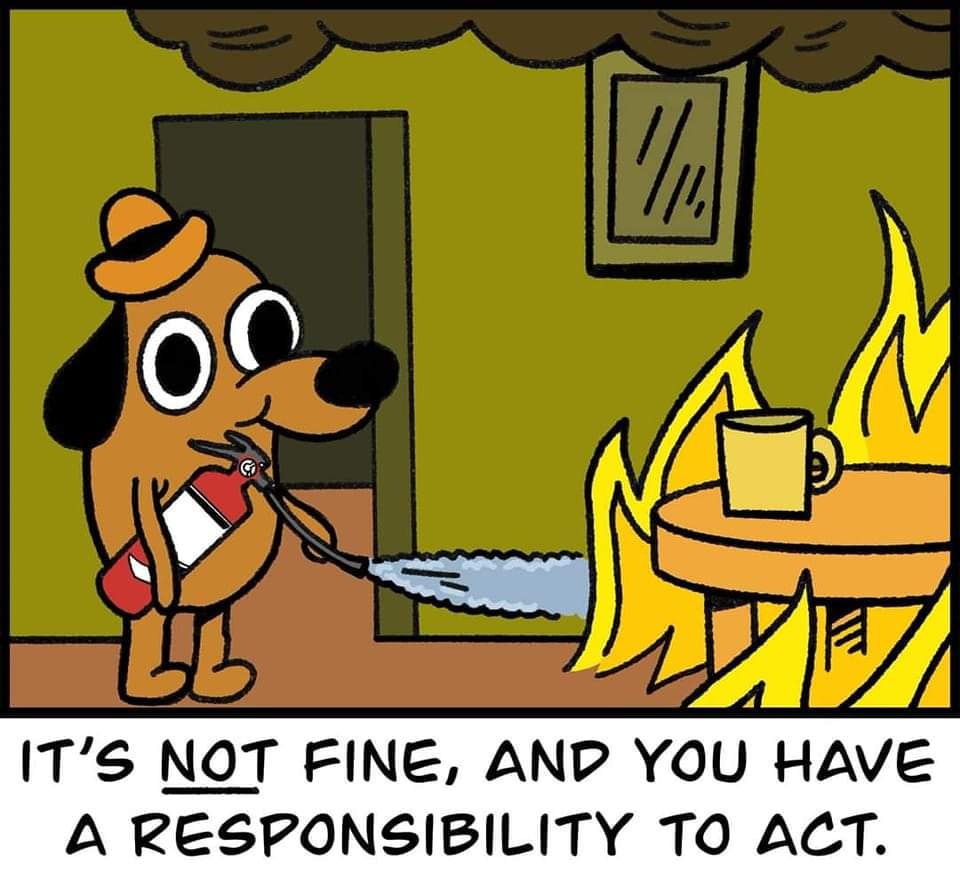
The image is a cartoon depiction of the “This is Fine” dog, a meme originating from KC Green’s webcomic Gunshow. The dog is seated at a table engulfed in flames, wearing a hat, and calmly using a fire extinguisher to attempt to quell the blaze. Its expression is one of forced composure, and it declares "This is fine," despite the clearly disastrous situation. The room appears to be a standard interior space, with a door and a picture on the wall. The color palette is muted, with dominant greens and browns, and the flames provide a stark contrast. The image is purposefully simple in style, emphasizing the symbolic weight of the scene. The text at the bottom says "IT’S NOT FINE, AND YOU HAVE A RESPONSIBILITY TO ACT."
Foucauldian Genealogical Discourse Analysis
This image is ripe for Foucauldian analysis. The "This is Fine" meme itself can be understood as a discourse – a system of thought, ideas, and practices – that normalizes complacency in the face of crisis. The dog’s denial (“This is fine”) isn’t simply an individual reaction; it’s a representation of a broader cultural tendency to accept systemic problems as inevitable or manageable even when they are deeply damaging.
A genealogical reading would trace the historical development of this discourse. When did we start accepting minor inconveniences as ‘fine,’ and how has that escalated to accepting larger, more destructive phenomena as ‘manageable’? The meme itself emerged in a specific historical context – the 2010s, marked by escalating social, political, and environmental crises – and its popularity reflects a certain learned helplessness or ironic detachment.
Foucault’s concept of power/knowledge is also relevant. The acceptance of “this is fine” as a response creates a reality where action is seen as unnecessary or even disruptive. The dog's composure is a performative act that maintains the status quo, even as it burns around him. This performs a specific power dynamic where the dog willingly accepts the destruction to maintain a sense of control.
Critical Theory
The image powerfully evokes themes central to Critical Theory, particularly the idea of false consciousness. The dog, in proclaiming “This is fine,” is effectively internalizing and perpetuating a system that is destroying him. It’s a prime example of how ideology can obscure reality, preventing individuals from recognizing their own oppression or the need for change.
The image speaks to the alienation inherent in modern society. The dog is isolated in its predicament, seemingly incapable of (or unwilling to) seek help or address the root causes of the fire. This isolation and the dog’s acceptance of the situation contribute to the perpetuation of the crisis.
The fire itself can be seen as a metaphor for systemic issues – climate change, political corruption, social injustice – that are slowly but surely consuming the world. The dog's inaction represents the complacency and apathy that allow these problems to continue unchecked. The added text at the bottom is a call for action and an acknowledgement of accountability that is absent in the original meme.
Marxist Conflict Theory
From a Marxist perspective, the image can be interpreted as a representation of class struggle. The fire represents the exploitative forces of capitalism, which consume resources and individuals for the benefit of a few. The dog, as a figure seemingly accepting its fate, embodies the working class who are often conditioned to accept their exploitation as inevitable.
The dog’s passivity can also be seen as a result of false consciousness, as mentioned above. The ruling class (represented by the unseen cause of the fire) maintains its power by convincing the working class that their suffering is normal or unavoidable. The fire extinguisher, while appearing to be a tool for addressing the problem, is ultimately ineffective, symbolizing the limitations of reform within a capitalist system. The text at the bottom is a critique of this false consciousness and a demand for transformative action.
Postmodernism
Postmodernism finds a lot to work with in this image. The meme's very existence is a commentary on the fragmentation of meaning and the rise of simulacra. The dog’s statement (“This is fine”) is a deliberate contradiction of reality, a play on language that undermines the notion of objective truth.
The image can also be seen as a pastiche, blending elements of cartoon aesthetics, irony, and social commentary. It deconstructs the traditional notion of heroism, presenting a protagonist who is not actively fighting the fire but rather passively accepting it.
Furthermore, the meme's wide circulation and constant remixing are characteristic of postmodern culture, where meaning is fluid and constantly negotiated. The image is not a fixed statement but rather a platform for ongoing dialogue and interpretation. The addition of the text is an acknowledgement of the fragmentation of the original message and a call to re-establish agency.
Queer Feminist Intersectional Analysis
While not immediately apparent, an intersectional lens can reveal nuanced meanings in the image. The dog's forced composure can be read as a performance of resilience in the face of ongoing trauma, a common experience for marginalized groups. The fire can be seen as a metaphor for the systemic oppressions that disproportionately affect queer and feminist communities.
The dog’s passivity could also be interpreted as a result of the pressure to conform to societal expectations and maintain a facade of normalcy, even in the face of adversity. The meme's popularity among these communities could reflect a shared experience of navigating a hostile world and finding humor in the absurdity of it all. The text added to the image is a rebuke of this normalization and a call for the disruption of these oppressive power dynamics.
I hope this analysis is helpful! Let me know if you'd like me to elaborate on any of these points or explore other theoretical frameworks.
simple-description (llama3.2-vision)
This meme features a cartoon dog holding a fire extinguisher, with a house on fire in the background. The text at the bottom of the image reads: "It's not a fire, it's just a little excitement." The humor comes from the dog's nonchalant attitude towards the situation, implying that the fire is no big deal.
tesseract-ocr
IT’S NOT FINE, AND YOU HAVE A RESPONSIBILITY TO ACT.