First Seen
2023-05-10T21:03:32+00:00
simple-description (llama3.2-vision_11b)
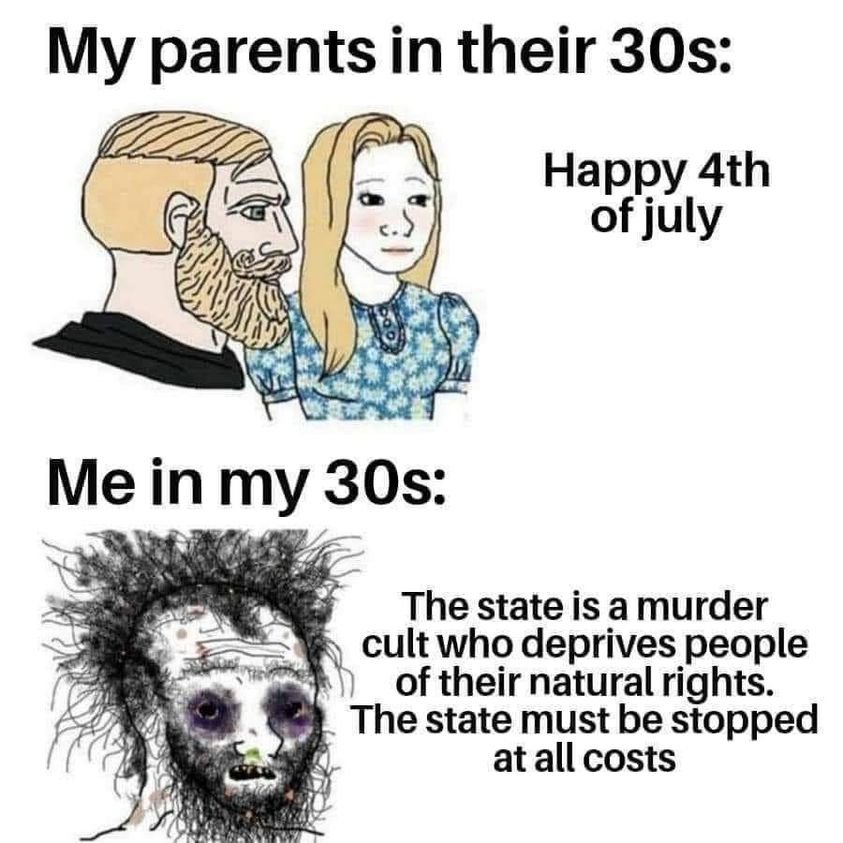
The meme is a commentary on the absurdity of celebrating the 4th of July, which is a holiday that commemorates the signing of the Declaration of Independence, but is now a day of fireworks, BBQs, and patriotic celebrations. The image shows a cartoon of a man and woman, with the text "My parents in their 30s: Happy 4th of July" and "Me in my 30s: The state is a murder cult that deprives people of their natural rights. The state must be stopped at all costs." The meme is a darkly humorous take on the contrast between the idealized American patriotism of the 4th of July and the harsh reality of the state's power and control.
detailed-analysis (gemma3-27b-vision)
Here's an analysis of the meme, broken down into sections as requested, focusing on those areas where the image and text lend themselves to deeper theoretical engagement. Keep in mind the meme is often operating at a satirical or ironic level, so interpretations need to account for that.
Visual Description
The meme is a two-panel comparison.
- Top Panel: Depicts a digitally rendered man and woman, rendered in a style that recalls the "soyjak" or "NPC" aesthetic often used in online subcultures. The man has a beard and a slightly vacant expression. The woman is smiling and also appears slightly detached. The text reads "Happy 4th of July" suggesting a conventional, celebratory attitude. The visual style aims for a kind of bland, mass-produced look.
- Bottom Panel: Features a dramatically different image. It's a highly distorted, heavily edited portrait of a person, eyes heavily shadowed and surrounded by chaotic, dark tendrils that resemble hair or vines. The overall effect is one of extreme dishevelment and possibly mental distress. The text accompanying this image is a radical anti-state declaration: "The state is a murder cult who deprives people of their natural rights. The state must be stopped at all costs."
The stark contrast between the two panels immediately establishes a binary—a "normal," conventionally patriotic representation versus a figure embodying perceived alienation and radical opposition.
Foucauldian Genealogical Discourse Analysis
This meme is ripe for a Foucauldian reading. Foucault would be interested in how "truth" about the state and its role in society is produced through discourse, and how certain discourses become dominant while others are marginalized.
- Power/Knowledge: The meme implicitly critiques the dominant discourse surrounding the state, which typically emphasizes legitimacy, protection, and national identity. The bottom panel figure rejects this discourse, framing the state as inherently violent and oppressive. This is a challenge to the “knowledge” produced by the state.
- Genealogy: A genealogical analysis would trace the historical development of the concept of the "state" and how it has been constructed through various practices and institutions (law, policing, education, etc.). The meme suggests that this history is not one of benevolent governance, but one of systemic control and violence. The phrase "natural rights" evokes a particular lineage of political thought (Locke, Enlightenment liberalism) that is being repurposed in a highly critical way.
- Disciplinary Power: The “normal” panel could be read as embodying the “docile body” that the state seeks to create – conformist, predictable, and obedient. The bottom panel represents a rejection of this disciplinary regime, a figure outside of control.
The meme isn’t presenting a reasoned argument, but interrupting the dominant narrative and forcing a confrontation with the underlying power dynamics.
Critical Theory
This meme touches on themes central to Critical Theory, specifically related to the critique of ideology and social control.
- Ideology: The “Happy 4th of July” panel can be seen as representing a kind of complacent acceptance of the dominant ideology, a belief system that legitimizes the existing social order. The bottom panel actively rejects this ideology, exposing the perceived brutality and oppression inherent within the state.
- Reason and Emancipation: The meme, despite its chaotic presentation, implies that true emancipation requires a rejection of conventional rationality and an embracing of a more radical critique. The fragmented image represents a breakdown of established order and a call for a fundamental transformation of society.
- Domination: The core of the meme is the idea that the state is a source of domination. This aligns with Critical Theory’s focus on uncovering hidden power structures and challenging systems of oppression.
Marxist Conflict Theory
From a Marxist perspective, the meme highlights the inherent contradictions within the state and the class conflict that underlies them.
- State as an Instrument of Class Rule: The meme implies the state isn't a neutral arbiter, but a tool used by the ruling class to maintain its power and exploit the working class. The "murder cult" phrasing is an extreme, but potentially evocative way of expressing this.
- Alienation: The grotesque image of the person in the bottom panel can be interpreted as a visual representation of alienation—a sense of estrangement from oneself, from others, and from society as a whole. The meme suggests that the state contributes to this alienation through its oppressive practices.
- Revolutionary Potential: While the meme doesn't explicitly call for revolution, the radical critique of the state and the rejection of conventional norms can be seen as a prelude to revolutionary thought.
Postmodernism
A postmodern reading would focus on the meme's deconstruction of grand narratives and its embrace of fragmentation and irony.
- Rejection of Metanarratives: The meme actively challenges the traditional narrative of the benevolent, legitimate state. It suggests that there is no universal truth about the state, only power relations and competing interpretations.
- Simulation and Hyperreality: The digital aesthetics of the meme (the "soyjak" style, the heavy editing) contribute to a sense of simulation and hyperreality—a blurring of the lines between reality and representation.
- Deconstruction of Meaning: The meme deliberately disrupts conventional meanings and associations. The juxtaposition of the "Happy 4th of July" imagery with the radical anti-state declaration creates a jarring effect, forcing the viewer to question their assumptions. The fragmented and distorted visual style is itself a deconstruction of representational norms.
Important Note: The meme's tone is often satirical or ironic, and it frequently appears within online subcultures that embrace extreme and provocative viewpoints. Interpretations should account for this context. The meme isn't necessarily a sincere endorsement of radical political views, but rather a commentary on societal alienation and disillusionment.
simple-description (llama3.2-vision)
This meme is a humorous comparison of the way parents in their 30s (or younger) would typically celebrate the 4th of July with their children, versus how the same person would behave by the time they reach their 30s. The text "Happy 4th of July" is juxtaposed with a darkly humorous description of how one's life would be by their 30s, reading "In my 30s: The state is a murder cult that deprives people of their natural rights. The state must be stopped at all costs."
tesseract-ocr
My parents in their 30s: (ir \ Happy 4th = iy J of july CB] (7 me an eM y Sys Bae Me in my 30s: = ee PMs Thestate is amurder i. =e cult who deprives people (rae. a )) Of their natural rights. Fo =) =}. The state must be stopped eg x fee 5 at all costs JR