First Seen
2023-05-10T21:03:32+00:00
simple-description (llama3.2-vision_11b)
The meme is a satirical commentary on the American flag, with the image featuring a character from the show "Star Wars: The Clone Wars" holding a flag and speaking out against the country's values. The text "You must speak the truth, even if it kills you" is juxtaposed with the flag, highlighting the tension between the country's ideals and the reality of its actions. The character's statement "You must speak the truth, even if it kills you" is a commentary on the country's inability to live up to its own ideals.
detailed-analysis (gemma3-27b-vision)
Okay, let's break down this meme through the lenses you've provided. It's a rather dense meme, so each section will have varying degrees of depth depending on relevance.
Visual Description
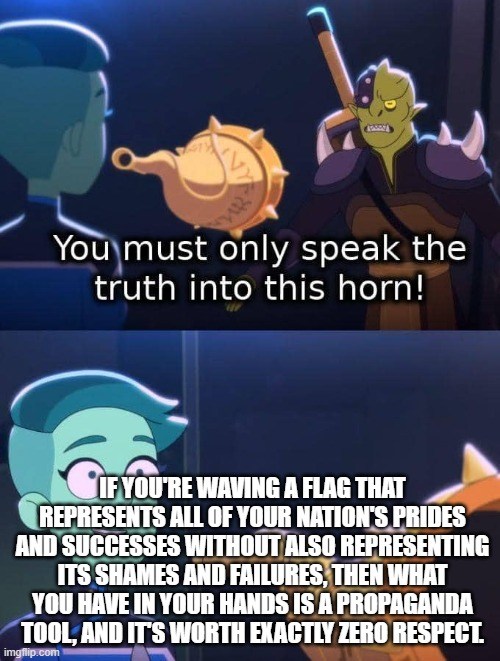
The meme is a reaction image, utilizing a two-panel format. The first panel shows a purple, unicorn-like character (Twilight Sparkle from "My Little Pony: Friendship is Magic") holding a large, golden horn. Text superimposed reads "You must only speak the truth into this horn!". The second panel depicts the same character, with a much sterner expression, and text that reads: "IF YOU'RE WAVING A FLAG THAT REPRESENTS ALL OF YOUR NATION’S PRIDES AND SUCCESSES WITHOUT ALSO REPRESENTING ITS SHAMES AND FAILURES, THEN WHAT YOU HAVE IN YOUR HANDS IS A PROPAGANDA TOOL, AND IT'S WORTH EXACTLY ZERO RESPECT." The bottom has a watermark identifying the website where it was created. The overall tone is didactic, presenting a strong moral/political assertion. The contrasting visuals (peaceful horn vs. angry face) amplify the message.
Foucauldian Genealogical Discourse Analysis
This meme is highly amenable to a Foucauldian reading. The "horn" functions as a technology of truth—an instrument that claims to filter and legitimize only “the truth.” This draws directly from Foucault's exploration of how power operates through discourse and the creation of knowledge.
- Power/Knowledge: The meme implies that “truth” isn’t inherent, but rather constructed and controlled. The horn represents an authority imposing its definition of truth. This immediately questions who controls the horn and whose truth is being privileged.
- Genealogy: The meme, while short, hints at a genealogy of nationalist symbols (flags). It suggests that historically, flags have often been used to obscure failures and amplify successes, serving a power dynamic by crafting a selective narrative. The meme asks us to trace the historical construction of the flag as a symbol and unpack its ideological function.
- Discourse: The meme itself is a discourse. It attempts to regulate what is considered acceptable discourse regarding national identity. It’s actively intervening in the way people think about and express patriotism.
Critical Theory
The meme fundamentally aligns with tenets of Critical Theory, particularly the Frankfurt School.
- Ideology Critique: The meme directly challenges the uncritical acceptance of national narratives. It argues that the presentation of a "perfect" nation (represented by the flag) is a form of ideology – a system of beliefs that obscures power relations and justifies existing structures.
- Hegemony: The meme suggests that the dominant presentation of national symbols (flags) contributes to hegemonic control. Hegemony, in Gramscian terms, isn't about force but about consent – making dominant ideologies seem natural and inevitable. The meme is attempting to disrupt this consent.
- Emancipatory Potential: By demanding the inclusion of "shames and failures," the meme proposes a path towards a more honest and critical national identity – a move towards emancipation from ideological manipulation.
Marxist Conflict Theory
While not solely Marxist, conflict theory is strongly present.
- Power Dynamics: The meme highlights the inherent power dynamics within national narratives. The control over the story being told (and the omissions within it) represents a form of class (or elite) control over ideology.
- False Consciousness: The meme implicitly argues that uncritical patriotism can lead to "false consciousness"— a state where people are unaware of their exploitation or oppression. By accepting a sanitized version of history, people are prevented from recognizing the injustices that may have been committed in the name of the nation.
- Class Struggle (Implicit): The "shames and failures" often relate to exploitation, inequality, or oppression of specific groups within the nation. Therefore, acknowledging these failures is a step towards recognizing and potentially addressing class conflict.
Postmodernism
Postmodern elements are present, particularly concerning truth and grand narratives.
- Deconstruction: The meme functions as a form of deconstruction. It deconstructs the simplistic, celebratory image of the flag, revealing the underlying complexities and contradictions.
- Rejection of Meta-Narratives: The meme implicitly challenges the "grand narrative" of national pride and exceptionalism. It suggests that there is no single, overarching "truth" about a nation, but rather a multitude of perspectives and experiences.
- Relativism (Nuance): While not advocating complete relativism, the meme implies that truth is contingent and situated. The “truth” about a nation depends on whose story is being told.
Queer Feminist Intersectional Analysis
This is the most subtle layer, but still relevant.
- Silenced Histories: "Shames and failures" often disproportionately affect marginalized groups—women, people of color, LGBTQ+ individuals, etc. The meme’s call for inclusivity can be interpreted as a demand to acknowledge the specific harms experienced by these groups within the national context.
- Intersectionality: The “shames and failures” are likely not singular, but rather interwoven and interconnected. The meme’s call for honesty demands recognizing how different forms of oppression intersect and reinforce one another.
- Challenging Dominant Narratives: The meme subtly challenges the traditionally masculine and heteronormative narratives often embedded within national pride. By demanding honesty, it creates space for alternative perspectives and experiences that have been historically marginalized.
I hope this comprehensive breakdown is helpful! It's important to note that these theoretical lenses aren't mutually exclusive—they often overlap and inform one another.
simple-description (llama3.2-vision)
The meme is a humorous exchange between two characters from the animated series "She-Ra and the Princess of Power." The first character, a villainous leader, tells a hero to "speak the truth into the horn of a truth-telling device." The hero responds with a sarcastic comment about the device's ability to reveal the truth, but the villain's response is a darkly comedic statement about the device's true purpose.
tesseract-ocr
am o. Y“ Paes only speak the truth into this horn! W a. oN TEYOURE WAVING A FLAG THAT - Peo A tT AND SUCCESSES WITHOUT ALSO REPRESENTING se Ey TY OT OT Se Cae ease ee a aa,