First Seen
2023-05-10T21:03:32+00:00
simple-description (llama3.2-vision_11b)
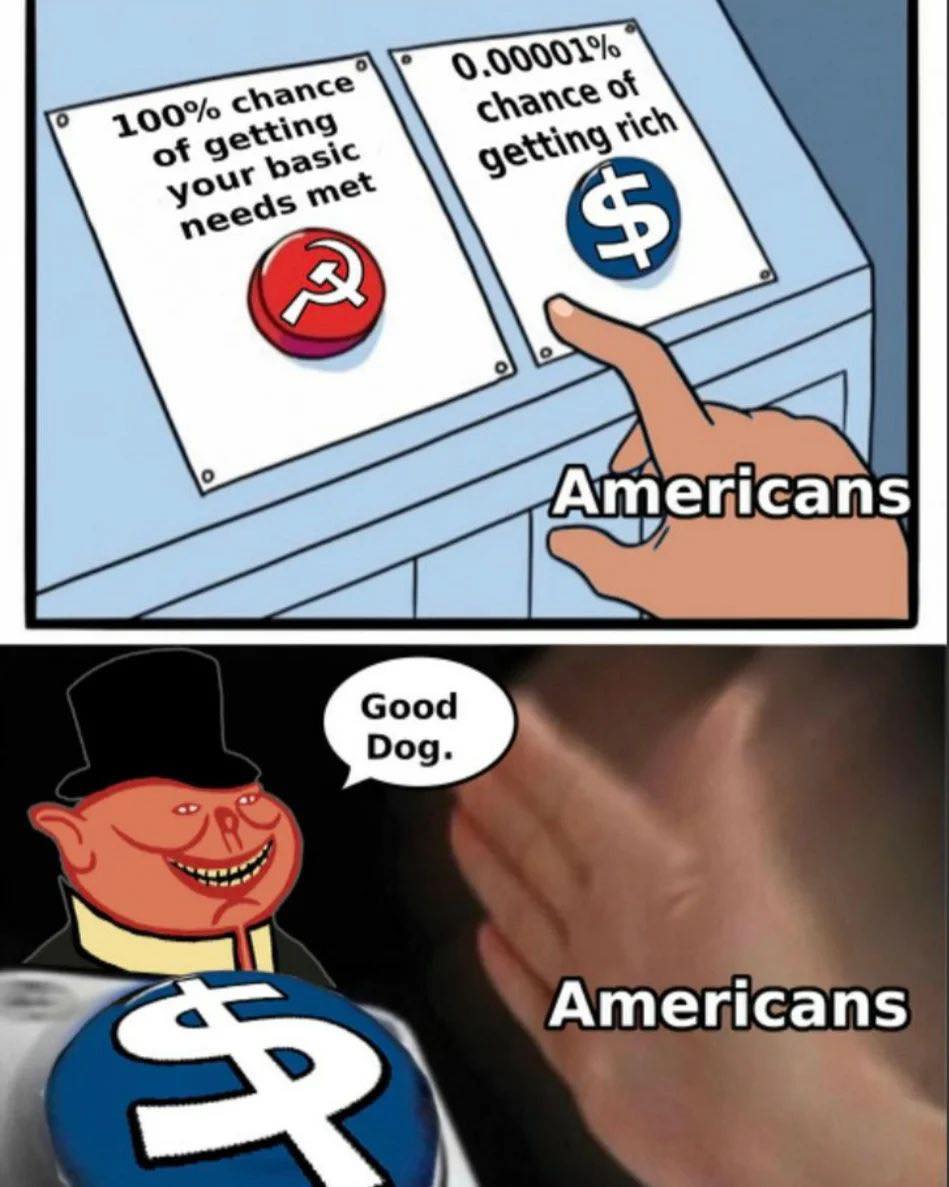
This meme is a commentary on the perceived differences in economic and social opportunities between the United States and the former Soviet Union. The image depicts a person choosing between two doors, one labeled "100% chance of getting your basic needs met" (implied to be the Soviet Union) and the other labeled "0.00001% chance of getting rich" (implied to be the United States). The meme is often used to humorously illustrate the perceived disparities in economic and social opportunities between the two countries.
detailed-analysis (gemma3-27b-vision)
Okay, let's break down this meme through the requested theoretical lenses. It's a potent piece of political commentary, so there's a lot to unpack.
Visual Description
The meme is a two-panel image. The top panel depicts a vending machine-like interface with two buttons. One button reads, "100% chance of getting your basic needs met," and has a hammer-and-sickle symbol (representing communism/socialism) next to it. The other button reads, “0.00001% chance of getting rich," and has a dollar sign next to it. A hand (presumably representing the American populace) is reaching to press the button for becoming rich.
The bottom panel shows a caricatured, monstrous figure (resembling a wealthy, greedy capitalist) petting a large, rolling dollar sign with a sinister smile. The figure says, "Good Dog." Again, the hand of the American populace is present, seemingly reaching out (though not touching) toward the dollar sign.
Marxist Conflict Theory
This meme is deeply rooted in Marxist conflict theory. At its core, it illustrates the inherent class struggle within a capitalist system.
- The Core Conflict: The "vending machine" metaphor perfectly encapsulates the choices presented to individuals under capitalism. They can opt for guaranteed basic needs, symbolically represented by socialist/communist principles, or they can gamble on the extremely slim chance of accumulating vast wealth.
- Exploitation and False Consciousness: The bottom panel, with the capitalist figure treating the dollar sign like a pet, highlights the power dynamic and the absurd prioritization of wealth accumulation. The capitalist figure rewards the "dollar sign" (representing capital itself) – and by extension, the logic of accumulation – while the populace remains in a state of pursuit, perhaps even rewarding this system through their efforts. It implies the populace is effectively "trained" to chase wealth, even if it's fundamentally unattainable for most.
- Alienation: The image implies alienation. The populace is not directly benefiting from the system, but rather contributing to the wealth of a small, elite group. They are distanced from the fruits of their labor.
- Critique of Capitalism: The meme serves as a direct critique of the inequalities inherent in the capitalist system, suggesting it's rigged to benefit the few at the expense of the many.
Critical Theory
This meme aligns with the principles of Critical Theory, particularly in its aim to deconstruct power structures and expose ideology.
- Ideology: The meme deconstructs the pervasive ideology that equates success with wealth accumulation. The absurdly low probability of "getting rich" challenges the American Dream narrative, suggesting it’s a myth perpetuated to maintain social order.
- Power Relations: The meme exposes the power relations embedded within the system. The capitalist figure in the bottom panel has the power to reward and control, while the populace is effectively subjugated to a system that prioritizes profit over well-being. The capitalist’s treatment of capital as a "good dog" is a powerful metaphor for the way capital is fetishized and valued above all else.
- Dominant Discourse: The meme challenges the dominant discourse around economic success and individual responsibility. It suggests that systemic factors, not individual merit, largely determine economic outcomes.
Foucauldian Genealogical Discourse Analysis
From a Foucauldian perspective, the meme can be examined through the lens of power/knowledge and discourse.
- Discourse of Success: The meme challenges the "discourse of success" that defines wealth as the ultimate goal in American society. It exposes how this discourse is constructed and maintained through institutions (media, education, etc.).
- Power/Knowledge: The capitalist figure embodies the power/knowledge nexus. They possess the knowledge (and power) to control the flow of capital, and this knowledge reinforces their position of dominance.
- Normalization: The image of the capitalist rewarding the dollar sign suggests the normalization of extreme wealth accumulation and the prioritization of capital over human needs. This normalization is achieved through repetition and the construction of a system that rewards such behavior.
- Genealogy: We can trace the genealogy of this "success" discourse to the historical development of capitalism, the emphasis on individualism, and the ideological construction of the American Dream.
Postmodernism
While not a central focus, a postmodern reading could emphasize the absurdity of the situation.
- Hyperreality: The meme could be seen as a representation of hyperreality, where the simulation of wealth and success has become more real than the underlying reality of economic inequality.
- Deconstruction: The meme deconstructs the myth of the American Dream, exposing it as a constructed narrative rather than an inherent truth.
- Irony: The meme’s darkly humorous tone and its exaggerated depiction of wealth and power suggest a sense of irony and skepticism towards grand narratives of progress and success.
Queer Feminist Intersectional Analysis (Less Directly Applicable, but Possible)
This is the least directly applicable lens, but it's not entirely absent.
- Intersectionality: While the meme doesn't explicitly focus on identity, it’s important to remember that the “American populace” is not monolithic. The impacts of economic inequality are disproportionately felt by marginalized groups (people of color, women, LGBTQ+ individuals, disabled people, etc.). The "basic needs" guaranteed by the socialist option could be understood as addressing the specific needs of these groups, while the "rich" option remains largely inaccessible to them.
- Power Dynamics: The meme can be read as an example of broader power dynamics, where certain groups are systematically excluded from accessing wealth and resources.
- Critique of Capitalist Patriarchy: The meme could be interpreted as a critique of capitalist patriarchy, where wealth and power are concentrated in the hands of a few privileged individuals (often white, cisgender men).
Let me know if you’d like me to expand on any of these analyses or explore different theoretical frameworks!
simple-description (llama3.2-vision)
This meme is a humorous commentary on the perceived odds of certain events happening in the United States. The top panel shows two buttons labeled "100% chance of getting your basic needs met" and "0.00001% chance of getting rich". The bottom panel features a cartoon image of a person who has just pressed the "0.00001% chance of getting rich" button, with a speech bubble saying "Good Dog." The text on the image is a commentary on the perceived disparity between the chances of getting one's basic needs met versus becoming wealthy, with the implication that the latter is extremely unlikely.
tesseract-ocr
mance \ ——s o P/o © S \Na' * meee | genase “@ © TK A SEZ a Dog. est =< Americans Do t