First Seen
2023-05-31T18:57:54+00:00
simple-description (qwen3.5_2b-q8_0)
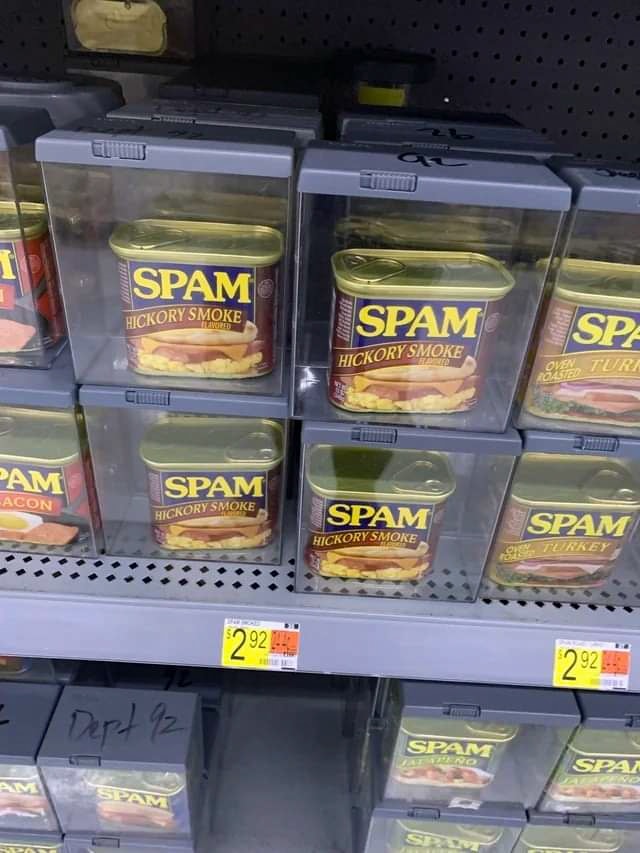
This meme features a shelf of Spam cans (specifically labeled "Hickory Smoke," "Bacon," and "Chicken Turkey") that have been repackaged into clear plastic "Spam" branded cases. From the perspective of "Anti-America," the joke plays on the fact that the cans are labeled as "Spam" (the brand), but the packaging looks like a gift box or a military supply case rather than the standard food packaging. The text "Hickory Smoke" is a funny nod to a cigar brand, contrasting it with the savory meat flavors of Spam.
simple-description (llama3.2-vision_11b)
The meme is a picture of a can of Spam, but with a label that says "Anti-American" instead of the usual "Spam". This is a play on the word "spam" having a different meaning in internet culture, referring to unwanted or excessive content, but also referencing the fact that Spam is a product of American company Hormel.
detailed-analysis (gemma3-27b-vision)
Okay, here's an analysis of the image, broken down into sections as requested, only including sections where the image genuinely lends itself to that particular framework. Note that some of these are stretches, and some frameworks are more applicable than others!
Visual Description
The image depicts a shelf stocked with cans of SPAM, a processed meat product. The most prevalent variety shown is "Hickory Smoke" flavored SPAM, displayed in clear plastic boxes. Other flavors, "Bacon" and "Turkey" are also visible. The cans are neatly arranged, suggesting a retail environment, likely a supermarket. Price tags displaying "$2.92" are visible beneath some of the cans. The lighting is bright and somewhat sterile. The overall impression is one of mass-produced consumer goods presented in a functional, utilitarian way. There's a handwritten sign to the left that appears to contain a department number.
Foucauldian Genealogical Discourse Analysis
This image allows for a brief exploration through a Foucauldian lens. SPAM, as a food product, isn’t simply what it is but how it came to be what it is. Its origins are tied to WWII rations – a strategic attempt to feed troops economically and efficiently. This establishes a discourse around food security, resource management, and the normalization of processed food.
The packaging—individual plastic boxes—marks a shift in this discourse. Initially created out of practicality, it has become normalized as a way of presentation. The fact that it's stocked in a supermarket demonstrates how this historically wartime ration, originally associated with necessity, has been disciplined into a commodity presented for consumer choice. The price tag, too, is an act of calculation and control, defining value and normalizing economic exchange. The normalization of SPAM as a staple food product is the result of the application of disciplinary power throughout its historical journey.
Critical Theory
The image functions as a potent symbol of the “culture industry” (Adorno & Horkheimer). SPAM, as a mass-produced, standardized product, embodies the principles of commodification and homogenization that characterize modern consumer culture. It's a product that is manufactured to be universally appealing (or at least, broadly acceptable) in order to maximize profit. The neat arrangement in the store, the plastic packaging, and the price tag all contribute to the illusion of choice while ultimately reinforcing the system of control.
Beyond the commodification aspect, this image highlights the loss of authenticity. SPAM is not a naturally occurring food. It’s a heavily processed amalgamation of ingredients, designed to mimic flavor and texture. This represents a broader cultural trend where “real” experiences are increasingly replaced by manufactured simulations. The plastic packaging also contributes to a broader trend of alienation.
Marxist Conflict Theory
From a Marxist perspective, this image embodies the contradictions inherent in capitalist production. SPAM represents a product created for mass consumption, but its very existence relies on the exploitation of labor and resources. The relatively low price point ($2.92) masks the true costs of production, including the labor of farmworkers, factory workers, and transportation personnel.
The image also demonstrates the creation of a "false need" within capitalist society. Through advertising and cultural conditioning, consumers are encouraged to purchase products they don’t necessarily need – SPAM, in this case. The profit generated from these purchases ultimately benefits the owners of capital, while the working class receives only a fraction of the value they create. The neat arrangement of the SPAM cans in the supermarket reinforces the illusion of abundance and choice, concealing the underlying inequalities of the capitalist system.
Note: The image doesn't readily lend itself to Postmodern or Queer Feminist Intersectional analyses. While one could attempt to force these frameworks onto the image, it would result in a strained and unsupported interpretation.
Hopefully, this breakdown provides a sufficiently thorough analysis of the image, incorporating the requested theoretical lenses where appropriate! Let me know if you'd like me to expand on any of these points or explore other potential interpretations.
simple-description (llama3.2-vision)
This meme is an image of a grocery store shelf with a sign that says "Limit 3" above a stack of Spam cans. The sign is accompanied by a note that says "We're not kidding". The implication is that the store is trying to prevent customers from buying too much of the canned meat product.
tesseract-ocr
: aie a iS, a — = % een = 3 4 | 3 ; ee q -“ Se my 1 KE) | Ni : a ae ae - — a 4 ee aenaaen—"e , Sail Say ——— : € = —¥ ae = : ro oh i eee ooo oeiietisee Sere — = 3 ———————— S — = = 2 a