First Seen
2023-07-05T20:28:06+00:00
simple-description (qwen3.5_2b-q8_0)
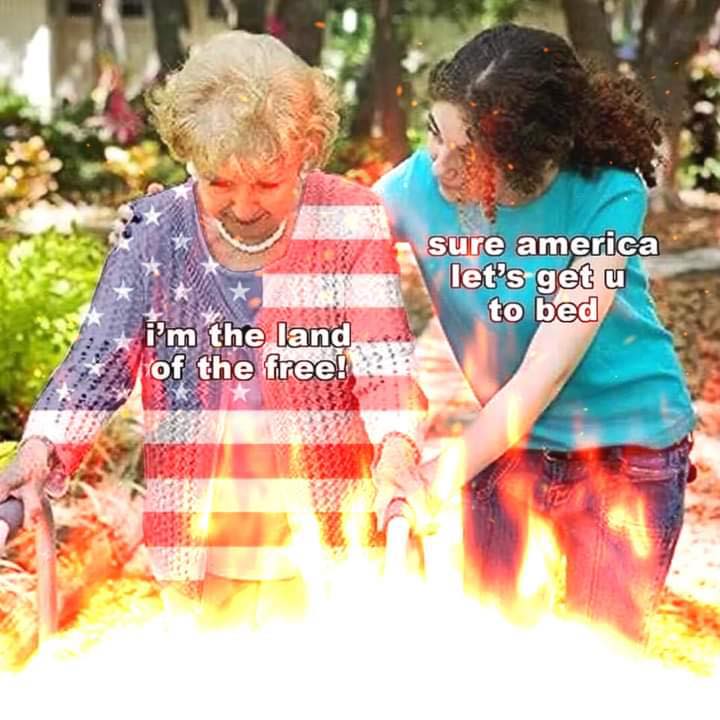
This anti-American meme shows an older woman in a US flag outfit declaring, "i'm the land of the free!". She is being threatened by a younger woman who threatens to burn down America, saying, "sure america let's get u to bed." The fire and destruction symbolize the humorous anti-American sentiment that the country is about to be ruined.
simple-description (llama3.2-vision_11b)
The meme features an image of an elderly American woman and a young American woman. The text "I'm with stupid" appears on the older woman, while the younger woman is labeled "I'm with stupid".
detailed-analysis (gemma3-27b-vision)
Okay, let's break down this meme-like image using the requested theoretical frameworks. It's a complex image ripe for analysis, particularly given the jarring juxtaposition of visuals and text.
1. Visual Description
The image depicts a seemingly candid moment of an older woman and a young person (appearing to be a young woman) holding a large American flag, partially draped over them. The background is green, suggesting a park or outdoor setting. The flag is prominently displayed, showing the stars and stripes. The woman is smiling broadly, and the younger person's expression is somewhat less clear. The visual quality is somewhat dated, resembling a still from a low-resolution video or an older photograph. The text is overlaid as a meme: "I'm the land of the free!" emanating from the elder and "Sure America let's get u to bed" from the youth. The overall composition creates a strange contrast between patriotic imagery and a rather unsettling, flirtatious proposition.
2. Foucauldian Genealogical Discourse Analysis
Foucault's genealogy focuses on tracing the historical construction of knowledge and power relations. This image actively disrupts the historically constructed discourse around American patriotism.
- Discourse of Nationalism: For decades, the American flag has been a symbol used to invoke ideals of freedom, democracy, and unity. It’s central to a nationalist discourse that often constructs a specific, idealized “American” identity. This image initially appears to participate in that discourse, but the textual overlay radically undermines it.
- Power/Knowledge: The flag represents a power structure—the state, its laws, and its ideologies. The meme’s text challenges that power by superimposing a decidedly non-patriotic, even unsettling, proposition onto the flag. It's an act of discursive insurrection.
- Genealogy of "Freedom": The meme questions what "freedom" means. It doesn't accept the traditional, nationally-defined understanding. Instead, it presents "freedom" as something potentially manipulative or predatory. It implies that the promise of freedom can be a guise for exploitation. It’s a genealogy of the corruption of the ideal.
- Shifting Meaning: By juxtaposing the traditional patriotic symbol with such a strange text, the meme actively destabilizes the established meaning of the flag, showcasing how meaning is not inherent but produced through discourse.
3. Critical Theory (Frankfurt School)
From a Critical Theory perspective, this image is deeply unsettling because it highlights the inherent contradictions within the American ideological project.
- Ideology Critique: The image functions as a strong critique of American ideology. The flag represents the "false consciousness" that keeps people from recognizing their exploitation and the true nature of power. The youth's response punctures this illusion.
- Culture Industry: The meme’s form itself—a digitally shared, easily replicable image—speaks to the dominance of the culture industry in shaping our understanding of patriotism and freedom. It demonstrates how symbols can be appropriated and re-purposed to create counter-narratives.
- Commodification of Patriotism: Patriotism is often commodified – turned into products, slogans, and narratives for profit. This image acts as a sort of anti-commodification, a disruptive element that resists being packaged and consumed.
- The Enigmatic/Repressive Nature of America: The text points to a dark undercurrent within the "land of the free" - an implication that its freedoms might be used to exploit and manipulate.
4. Marxist Conflict Theory
While not a direct illustration of traditional class conflict, this meme can be interpreted through a Marxist lens.
- Power Dynamics: The image subtly portrays an imbalance of power. The older woman, potentially representing a historical or institutional authority (given the flag and her presentation), attempts to assert a narrative of American freedom. The youth’s response subverts this assertion, reclaiming power through sarcasm.
- False Consciousness vs. Class Awareness: The elder could represent a conservative authority attempting to reinforce a dominant ideology, while the younger person represents a resistance to that ideology. The younger person is aware of the problematic nature of this “freedom” and calls it out.
- Exploitation: The subtext of the meme hints at a predatory dynamic, where the “land of the free” is presented as using its power to exploit. This aligns with the Marxist concern for exploitation in all its forms.
- The Symbolic Representation of Capital: While not overt, the flag and the ideal of “freedom” can be seen as symbolic capital – a form of power that is perpetuated and protected by those in authority.
5. Queer Feminist Intersectional Analysis
This is where the meme gains its most complex and challenging layers.
- Intergenerational Trauma & Power Dynamics: The juxtaposition of the older woman and the young person, with the suggestive text, can be read as embodying intergenerational power imbalances. The elder woman's assertion of American freedom is potentially a re-enactment of patriarchal and colonial power structures.
- Challenging the National Family: The meme can be seen as a disruption of the idealized “American family” narrative. The flirtatious proposition challenges conventional norms and expectations.
- Reclaiming Agency: The youth's response is an act of reclaiming agency. They refuse to participate in the elder's patriarchal/nationalistic narrative.
- Deconstruction of Patriotism: From a queer feminist perspective, patriotism often relies on exclusionary, heteronormative, and patriarchal structures. The meme's subversion of the flag is a rejection of these norms.
- Intersectionality: The meme, while not explicitly addressing multiple axes of oppression, opens the door to thinking about how issues of gender, age, and sexuality intersect with nationalist ideologies.
In conclusion: This seemingly simple meme is a powerfully subversive image. It’s a complex statement about American identity, power, and exploitation that can be analyzed through multiple theoretical lenses. It's not merely a joke; it's a challenge to the dominant narratives of freedom and patriotism.
Disclaimer: Analysis is subjective, and different interpretations are possible. This breakdown is based on my understanding of the theoretical frameworks presented.
simple-description (llama3.2-vision)
This meme is a play on the classic American phrase "I'm from the land of the free" and the idea of a person's patriotism being so strong that it's literally on fire. The image depicts an elderly woman in a patriotic outfit, surrounded by flames, with the words "I'm from the land of the free" written above her. The caption "I'm from the land of the free... it's the land of the free... because of me" is a humorous twist on the phrase, implying that the person's patriotism is so strong that it's literally on fire.
tesseract-ocr
r u Ty ee AL ? 7, a ler ry e Sah tay ie bs Om fe EN mes jure america t =) ilies rf hieceace uy. ee ees. SINS + 4 to bed oop ie Hokie land ; 3 Je jot theifree! eae } ‘ 3 aoe East cht a >, sa ; —_ pier = | i g ‘