First Seen
2023-05-10T21:03:32+00:00
simple-description (llama3.2-vision_11b)
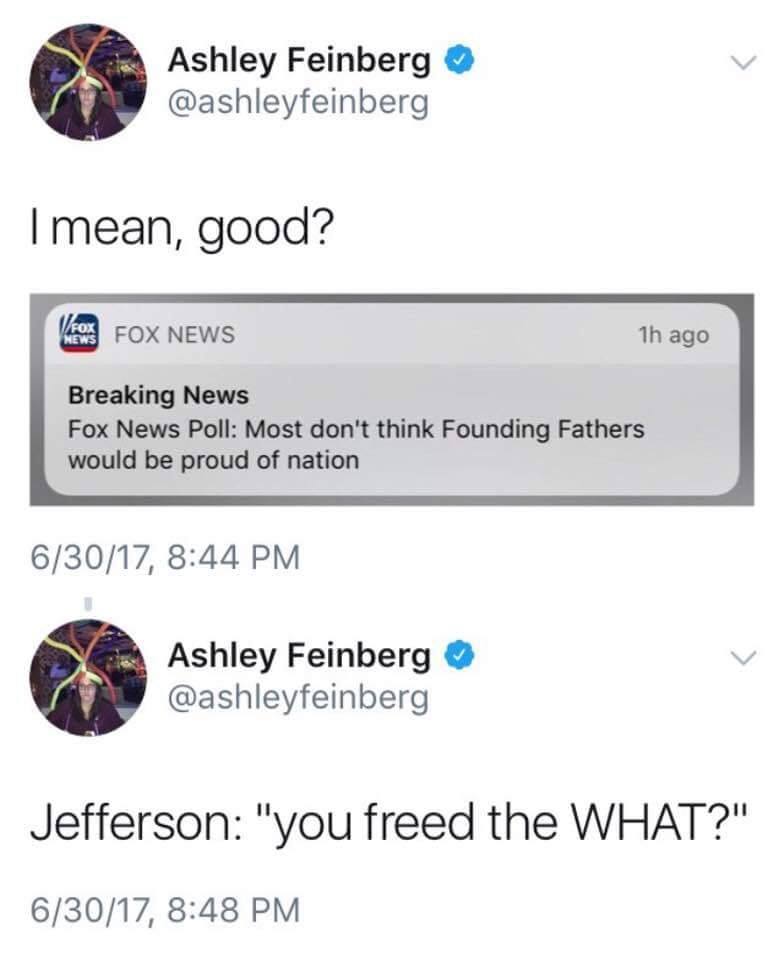
The meme is a screenshot of a Twitter conversation where someone asks "I mean, good?" and the response is "Jefferson: 'you freed the slaves, now what?'"
detailed-analysis (gemma3-27b-vision)
Okay, here's an analysis of the Twitter post using the requested theoretical frameworks. It's a nuanced post, so some frameworks will apply more heavily than others. I will indicate when a section isn't strongly applicable.
Visual Description
The image consists of three screenshots from Twitter.
- Top: Profile picture of @ashleyfeinberg (a swirling, colorful abstract design) followed by their username and a blue verified checkmark. Below that, they’ve posted a message that reads “I mean, good?”.
- Middle: A screenshot of a news headline from Fox News which reads “Breaking News: Fox News Poll: Most don’t think Founding Fathers would be proud of nation”. Time stamp: 6/30/17, 8:44 PM
- Bottom: Another post from @ashleyfeinberg that says “Jefferson: ‘you freed the WHAT?’”. Time stamp: 6/30/17, 8:48 PM
The presentation is quick and reactive, typical of Twitter. The juxtaposition of a poll result showing dissatisfaction with the current state of the US alongside a direct "voice" of Thomas Jefferson creates a satirical and critical commentary.
Foucauldian Genealogical Discourse Analysis
This post is highly amenable to a Foucauldian reading.
- Discourse and Power/Knowledge: The post engages with the discourse surrounding the "Founding Fathers" and American national identity. Foucault argued that discourses (ways of talking about things) aren't neutral; they produce knowledge, and that knowledge is inextricably linked to power. Feinberg's posts actively disrupt a conventional, often celebratory, discourse of the Founding Fathers. The implied question "you freed the WHAT?" highlights the contradictions inherent in the founding principles of the US (liberty, equality) in contrast with the realities of slavery and systemic injustice.
- Genealogy: A genealogical approach would look at the history of how the idea of the Founding Fathers has been constructed. Who has the power to define them? How has that definition changed over time? This post implies that the idealized version of the Founding Fathers is a historically contingent construct, not an objective truth. The fact that “most” (according to Fox News) would not approve of the current nation implies a break in this historical narrative.
- Archaeology of Knowledge: The post exposes the underlying assumptions and rules that govern the discourse surrounding the Founding Fathers. The incredulity of Jefferson's imagined response unearths the uncomfortable truths that have been suppressed or ignored in traditional narratives.
The post actively re-writes the narrative and challenges the dominant construction of "founding fathers" as inherently positive figures.
Critical Theory
This post engages with several key themes within Critical Theory, particularly those associated with the Frankfurt School.
- Ideology Critique: The post operates as a critique of the ideology of American exceptionalism and the uncritical veneration of the Founding Fathers. It points out the gap between the ideals professed by the nation and its actual history and present-day realities.
- Reason and Enlightenment Critique: While the Founding Fathers were figures of the Enlightenment, the post implicitly critiques the limits of Enlightenment rationality. It suggests that Enlightenment ideals were selectively applied, benefiting some groups while oppressing others. Jefferson’s imagined exclamation points to the contradictions within the enlightenment ideals that are foundational to the US.
- Mass Culture and Media: The reliance on a Fox News poll as source material is noteworthy. Fox News is a media outlet with a specific ideological agenda, and using its poll as a springboard for commentary highlights the role of media in shaping public perception and reinforcing or challenging dominant narratives.
Marxist Conflict Theory
A Marxist reading is applicable, though not as central as the Foucauldian or Critical Theory lenses.
- Class Struggle & Contradictions: While the post doesn't explicitly focus on class, it implies that the “freed” (the nation) has not liberated all people equally, indicating underlying class (and racial) tensions. The post hints at the inherent contradictions within the capitalist system that underpinned the development of the US.
- Ideology as False Consciousness: The veneration of the Founding Fathers can be seen as a form of ideology that obscures the exploitative and oppressive foundations of the nation. The post challenges this "false consciousness" by highlighting the inconsistencies between the nation's ideals and its realities.
Postmodernism
Postmodern themes are present in this post.
- Deconstruction of Grand Narratives: The post subtly deconstructs the “grand narrative” of American exceptionalism and the heroic Founding Fathers. It rejects the idea of a unified, coherent national identity and exposes the contradictions and inconsistencies within that narrative.
- Rejection of Universal Truths: The post implies that there is no single, objective truth about the Founding Fathers or the nation's history. Instead, interpretations are contingent, subjective, and shaped by power relations.
- Irony and Satire: The use of Jefferson’s imagined exclamation is inherently ironic and satirical. It disrupts the conventional reverence for the Founding Fathers and forces viewers to question their assumptions.
Queer Feminist Intersectional Analysis
This is where the analysis becomes particularly potent.
- Intersectional Critique: The post engages with the historical exclusion of marginalized groups (women, people of color, LGBTQ+ individuals) from the "nation" that was “freed”. Jefferson, a slave owner, is being held accountable (through satirical voice) for the inherent contradictions in his ideals and actions. The 'freed' did not include people who were enslaved, nor did it include any protection for people who were marginalized.
- Deconstruction of Patriarchy: Jefferson, as a central figure in US history, represents patriarchal power structures. The post challenges his authority and exposes the limits of his vision, particularly as it relates to the inclusion and liberation of marginalized groups.
- Queer Critique: While not explicitly queer-focused, the post's disruption of established narratives and challenges to dominant power structures align with queer theoretical principles. The post implies that the narrative of "freedom" is incomplete and must be expanded to include all people, regardless of their race, gender, or sexual orientation.
In essence, Feinberg's post is a concise, multi-layered critique of American history, ideology, and power relations. It is a powerful example of how social media can be used to challenge dominant narratives and promote critical thinking.
I hope this detailed analysis is helpful! Let me know if you'd like me to elaborate on any of these points.
simple-description (llama3.2-vision)
The meme is a screenshot of a Twitter conversation between Ashley Feinberg and a user named "Jeff" (whose name is not visible). The conversation appears to be a humorous exchange about a news headline, with Ashley responding to a question about the meaning of a headline about a Fox News poll about the Founding Fathers' views on the American Revolution.
tesseract-ocr
Ashley Feinberg @ @ashleyfeinberg | mean, good? FOX NEWS 1h ago Breaking News Fox News Poll: Most don't think Founding Fathers would be proud of nation 6/30/17, 8:44 PM Ashley Feinberg @ @ashleyfeinberg Jefferson: "you freed the WHAT?" 6/30/17, 8:48 PM