First Seen
2024-04-16T18:59:15.688119+00:00
simple-description (qwen3.5_2b-q8_0)
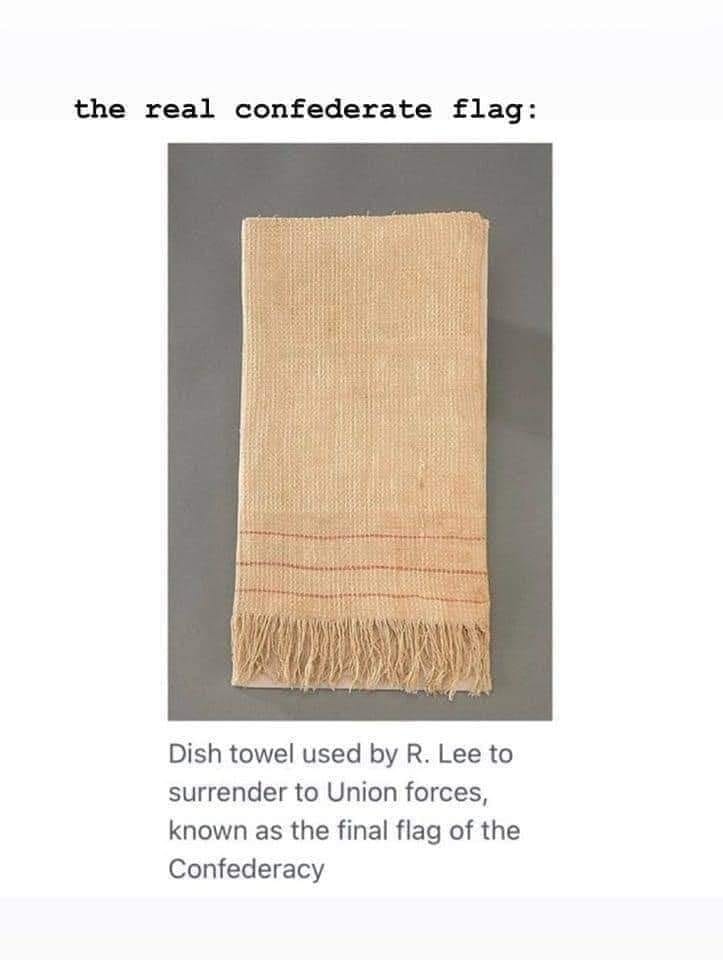
This anti-American joke trivializes the Confederate flag by suggesting the "real" flag was just a kitchen dish towel. The image shows a plain beige towel with fringes and displays the text: "Dish towel used by R. Lee to surrender to Union forces, known as the final flag of the Confederacy."
simple-description (llama3.2-vision_11b)
The meme is a joke about the American flag being replaced with a dish towel, implying that the country's values or ideals have been reduced to something mundane and insignificant. The text "the real Confederate flag" suggests that the dish towel is being used as a symbol of the Confederate flag, implying that the country's values have been reduced to something as mundane as a household item.
detailed-analysis (gemma3-27b-vision)
Okay, let's analyze the image with the requested theoretical frameworks. It's important to note the subversive nature of the presentation of this image – claiming a dish towel as "the final flag of the Confederacy" immediately throws traditional understandings of symbolism and history into disarray. This sets the stage for a fascinating, albeit unconventional, analysis.
Visual Description
The image presents a rectangular, beige-colored woven cloth. It appears to be a simple dish towel, with visible fringe along one of the short edges. The weave is rough and utilitarian. The cloth is hanging against a dark background, causing a high contrast. There is a visible crease running through the center of the cloth. The framing is quite simple, focusing entirely on the towel itself. There's a slight variation in the color, a darker band towards the bottom, possibly indicating wear or staining. It lacks any traditional Confederate imagery or design.
Foucauldian Genealogical Discourse Analysis
This image allows for a potent Foucauldian analysis precisely because it disrupts established discourses surrounding the Confederate flag. Foucault's genealogy traces the historical construction of power/knowledge systems. The claim that this towel is "the final flag" challenges the established discourse of Confederate symbolism.
- Power/Knowledge: The traditional Confederate flag derives its power from a constructed historical narrative. The flag represents rebellion, heritage (often selectively interpreted), and a romanticized vision of the South. This representation is intertwined with power structures that uphold white supremacy.
- Disruption: Presenting a humble dish towel as the “final flag” deconstructs this power/knowledge system by stripping away the symbolic weight typically assigned to a flag. It shifts the focus from grandiose imagery to a banal, everyday object. It questions what constitutes a flag, and how meaning is assigned to objects.
- Archaeology of Knowledge: We can consider the archaeological layers of meaning associated with the Confederate flag: initial purpose, its use during the Civil War, its re-emergence during the Civil Rights Movement, and its contemporary use as a symbol of hate. This towel, in contrast, bypasses all of those layers, suggesting that the end of the Confederacy wasn’t marked by a triumphant display of a battle flag but by a simple act of surrender.
- Discourse and Practice: The image invites us to examine the practice of flag-waving and its role in constructing narratives of nationhood and identity. By substituting the traditional flag with a dish towel, it disrupts this practice and forces us to reconsider the meanings it conveys.
Critical Theory
From a Critical Theory perspective, especially drawing from the Frankfurt School, the image functions as a critique of ideology.
- Ideology: The traditional Confederate flag functions as an ideology – a system of beliefs that justifies existing power structures, in this case, those rooted in racism and oppression. It masks the brutal reality of slavery and the Confederacy's commitment to preserving a hierarchical social order.
- Unmasking: The dish towel, as a non-flag, exposes the artificiality of the Confederate flag's symbolic power. It suggests that the flag is not an inherent symbol of heritage or pride, but a construction designed to serve specific political and social purposes.
- Domination and Resistance: The act of claiming this towel as the “final flag” can be seen as a form of resistance against the dominant ideology. It's a way of reclaiming the narrative and challenging the romanticized vision of the Confederacy.
- Culture Industry: One could also analyze this image as a piece of “counter-culture” interrupting the "culture industry", that perpetuates myths through the repetition of symbols like the Confederate flag.
Marxist Conflict Theory
A Marxist reading focuses on the class and power dynamics inherent in the historical context of the Confederacy and its symbols.
- Class Conflict: The Civil War was fundamentally a conflict rooted in economic differences and the preservation of a slave-based economy. The Confederacy represented the interests of a wealthy planter class.
- Hegemony: The Confederate flag became a symbol of Southern identity and a way to maintain the hegemony of the planter class after the war. It was used to justify social inequalities and resist efforts to achieve racial equality.
- Material Conditions: This dish towel subverts the symbolic weight of the flag by grounding it in the material conditions of everyday life. It's a humble object associated with domestic labor, highlighting the often-invisible work of enslaved people and the practical needs that sustained the Confederacy.
- False Consciousness: The traditional flag can be seen as contributing to a "false consciousness" among those who identify with it, obscuring the realities of slavery and its lasting consequences.
Postmodernism
A postmodern analysis highlights the constructed nature of reality, the instability of meaning, and the rejection of grand narratives.
- Deconstruction: The image directly deconstructs the notion of the “flag” as a fixed signifier. It destabilizes the traditional relationship between the symbol and the thing it represents.
- Simulacra and Simulation: The towel, as a "non-flag", can be seen as a simulacrum – a copy without an original. It's a representation that has become detached from reality, highlighting the artificiality of symbols.
- Rejection of Grand Narratives: The image challenges the grand narrative of the "Lost Cause" – the romanticized version of the Confederacy that seeks to downplay the role of slavery and present the Confederacy as a noble, if misguided, cause.
- Playfulness and Irony: The image embraces playfulness and irony, inviting us to question the meaning of symbols and the ways in which we construct our understanding of history.
Queer Feminist Intersectional Analysis
This lens analyzes the interplay of multiple identities and systems of oppression, and centers marginalized experiences.
- Interlocking Oppressions: The Confederacy represented interlocking systems of oppression – based on race, class, and gender. Enslaved people, particularly Black women, faced the most severe forms of exploitation and abuse.
- Silencing and Erasure: Traditional narratives of the Confederacy often silence the experiences of Black people and women, focusing instead on the exploits of white male leaders.
- Subversion of Masculinity: The image can be seen as subtly subverting traditional notions of Confederate masculinity. Replacing a battle flag with a domestic item like a dish towel deconstructs the image of the Confederate soldier as a heroic warrior.
- Reclaiming the Domestic: The dish towel, associated with domestic labor traditionally performed by women, can be seen as a reclaiming of space and a challenging of patriarchal power structures. Highlighting this "mundane" object underscores the invisible labor and contributions of marginalized groups.
Let me know if you'd like me to elaborate on any of these analyses!
simple-description (llama3.2-vision)
The meme is a humorous comparison between the actual Confederate flag and a dish towel with the same design. The text above the image reads "the real Confederate flag" in a sarcastic tone, implying that the dish towel is a more accurate representation of the flag's design. The image is meant to be ironic and humorous, poking fun at the idea that the Confederate flag is often associated with a specific design, when in reality it's more like a simple dish towel.
tesseract-ocr
the real confederate flag: HaVAaNiNnANE sulin WUAR OR ASK i) iM \\ hy PN Dish towel used by R. Lee to surrender to Union forces, known as the final flag of the Confederacy