First Seen
2024-06-03T05:14:50.797842+00:00
simple-description (qwen3.5_2b-q8_0)
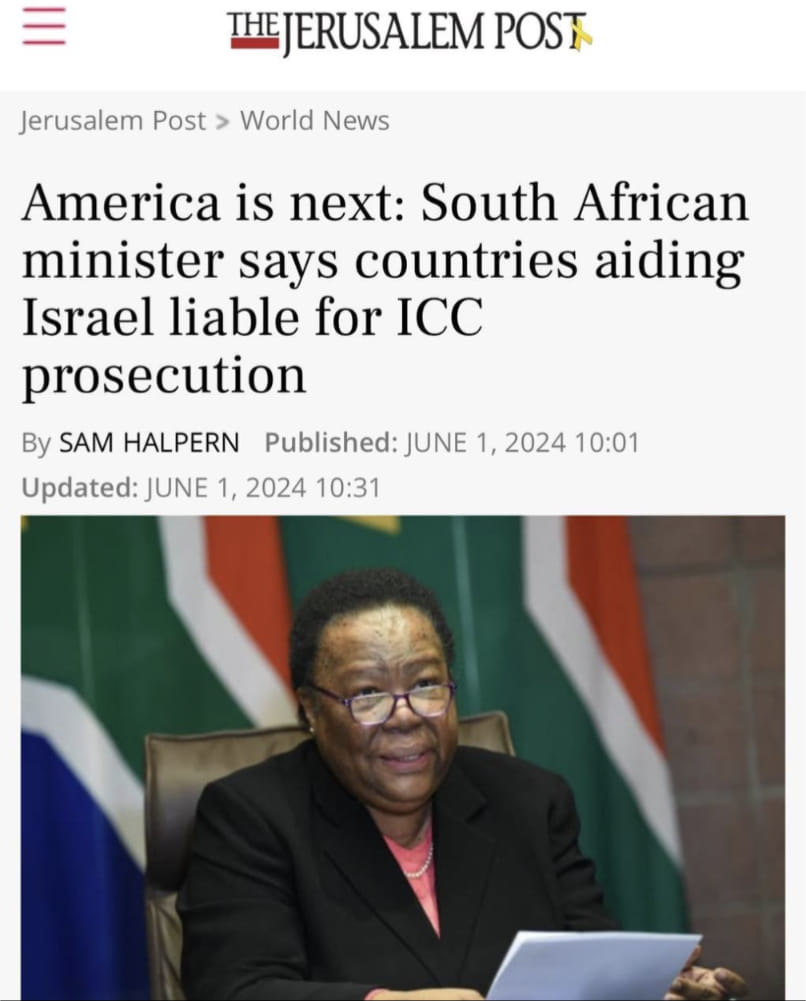
This meme plays on the title of the movie 12 Years a Slave, suggesting that South African Minister Thabo Mbeki is making a similar claim that the United States is a bully who is "next" on the next trial. The headline reads, "America is next: South African minister says countries aiding Israel liable for ICC prosecution," and the image shows Minister Mbeki sitting in front of a South African flag, reinforcing the narrative of American aggression.
simple-description (llama3.2-vision_11b)
The meme is an image of a news headline from the Jerusalem Post, with the title "Anti-America" and a photo of a woman in a suit, with a caption that reads "The US is the enemy of all people". The image is a satirical commentary on the perception that the US is a threat to the world, with the woman's expression suggesting a sense of disapproval.
detailed-analysis (gemma3-27b-vision)
Okay, here's an analysis of the image and its associated headline, broken down into sections based on the frameworks you've requested. I'll only include sections where the framework is demonstrably relevant. I'll also indicate if a framework doesn’t strongly apply but has some marginal relevance. Please note that these analyses are necessarily interpretive and rely on assumptions given the limited context.
1. Visual Description
The image shows a middle-aged Black man smiling at the camera. He’s wearing a dark suit, a white shirt, and glasses. Behind him are the flags of South Africa (left) and Israel (right), appearing somewhat blurred. The man is sitting at a table with a tablet or laptop in front of him. The lighting is fairly bright, and the composition is straightforward—a classic portrait-style shot. The overall impression is one of official formality and perhaps diplomatic engagement, though the context makes it clear it's a potentially contentious situation.
2. Foucauldian Genealogical Discourse Analysis
This framework is highly applicable given the subject matter: the International Criminal Court (ICC) and the assertion of liability.
- Discourse & Power/Knowledge: The headline ("America is next…") and the article itself construct a discourse around the ICC, international law, and national sovereignty. The power lies in the ability to define who is accountable and by what standards. The ICC, as an institution, produces knowledge through its investigations and rulings, shaping understandings of justice and criminality.
- Genealogy of the ICC: A genealogical approach would trace the historical conditions that led to the creation of the ICC. It wouldn't simply look at the stated intentions (universal justice) but would explore the power dynamics, colonial legacies, and geopolitical interests that shaped its formation. Was it truly born of an impartial pursuit of justice, or was it influenced by powerful states and their agendas? The South African minister’s statement is itself part of this historical layering.
- Disciplinary Power: The threat of ICC prosecution, and the assertion of liability, function as forms of disciplinary power. They aim to regulate behavior (in this case, supporting Israel) through the threat of sanctions and judgment.
- Normalizing Judgments: The very act of defining certain actions as crimes subject to international prosecution establishes normalizing judgments. It defines what is acceptable and unacceptable conduct on the global stage. The article positions those supporting Israel as being on the “wrong” side of these judgements.
- The Role of the Minister’s Statement: The minister’s statement (as reported in the headline) can be seen as a deliberate intervention within this discourse, attempting to exert power by redefining liability and broadening the scope of accountability.
3. Critical Theory
Critical Theory, particularly from the Frankfurt School, is also very relevant.
- Ideology: The article and the South African minister’s statement can be read as revealing ideological struggles. The assertion that countries aiding Israel are liable to ICC prosecution is not simply a legal claim but a challenge to the prevailing geopolitical order and the assumed impunity of certain states.
- Hegemony: The article, originating from The Jerusalem Post, is written from a clear perspective. There is an implicit argument that ICC prosecution is biased or a weaponization of international law. This aligns with Gramscian concepts of hegemony and counter-hegemony. The minister’s statement is a counter-hegemonic attempt to redefine the rules and challenge the established power structures.
- Reason & Domination: Critical Theory often critiques the ways in which supposedly rational systems (like international law) can perpetuate domination. The article and its context raise questions about whether the ICC is being used as a tool of political manipulation rather than an impartial dispenser of justice.
- Deconstruction of Neutrality: The very framing of "aiding Israel" positions it as a controversial or problematic act, inviting further scrutiny and challenging the idea of neutral support.
4. Marxist Conflict Theory
This framework applies to a certain extent, but is less central than the Foucauldian or Critical Theory perspectives.
- Class Struggle (Broadly Defined): While not a direct class struggle in the traditional sense, the conflict can be understood as a struggle between different national interests and geopolitical blocs. The minister’s statement is implicitly aligning South Africa with a different set of interests than those of Israel and its allies.
- Material Interests: Underlying the legal and ethical arguments are material interests – control over resources, political influence, and strategic alliances. The conflict is driven by these competing interests.
- Imperialism and Neo-Imperialism: The historical context of colonialism and the ongoing power dynamics between nations are relevant. The ICC, as an institution, can be seen as reflecting the interests of certain powerful states.
5. Postmodernism
Postmodernism has some relevance, but is the least strongly applicable framework here.
- Deconstruction of Grand Narratives: Postmodernism challenges “grand narratives” such as the belief in universal justice or the inherent legitimacy of international law. The article and the context surrounding it suggest a skepticism towards these narratives.
- Relativism & Subjectivity: Postmodernism emphasizes the subjective nature of truth and knowledge. The different interpretations of international law and the conflicting claims of justice reflect this subjectivity.
- Discourse & Power: Postmodernism recognizes the importance of discourse in shaping reality. As discussed in the Foucauldian section, the language used in the article and the minister’s statement is not neutral but actively constructs meaning and exerts power.
Queer Feminist Intersectional Analysis - not applicable. The text does not give any information related to gender, sexuality, or the intersection of these factors. This is a geopolitical conflict and while all analyses have some value, this framework does not provide any extra insight to the image or title.
Important Note: This analysis is based on a limited amount of information (the image and headline). A more thorough analysis would require access to the full article and a broader understanding of the political context.
simple-description (llama3.2-vision)
The meme is a screenshot of a news article from The Jerusalem Post with the headline "America is next: South African minister says countries aiding Israel liable for ICC prosecution". The image shows a photo of a woman, likely the South African minister, in a formal setting, with a serious expression. The text above the photo reads "South African minister says countries aiding Israel liable for ICC prosecution".
tesseract-ocr
THEJERUSALEM POST Jerusalem Post > World News America is next: South African minister says countries aiding Israel liable for ICC prosecution By SAM HALPERN Published: JUNE 1, 2024 10:01 Updated: JUNE 1, 2024 10:31 aN