First Seen
2025-04-01T00:11:13.593163+00:00
simple-description (qwen3.5_2b-q8_0)
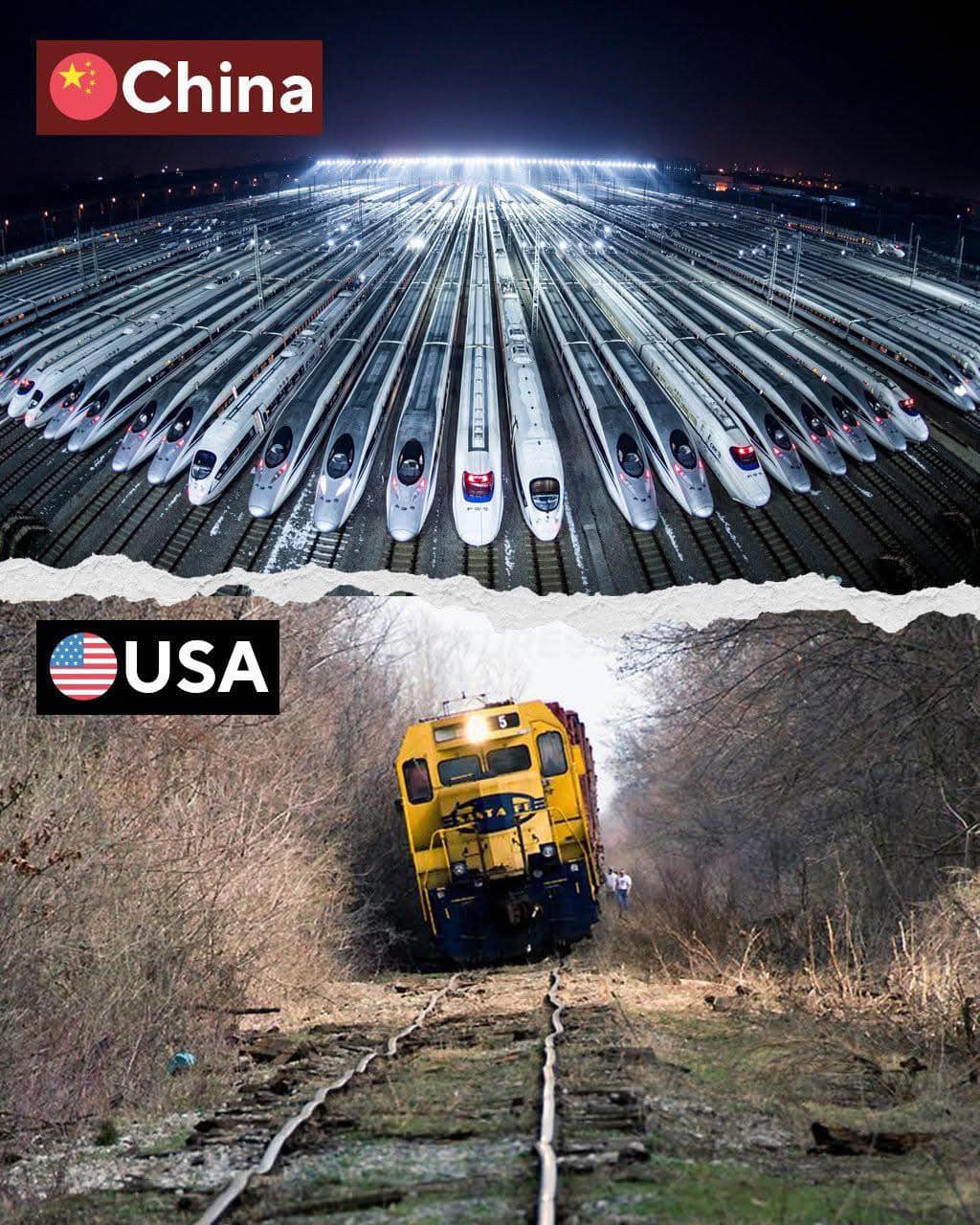
This "Anti-America" meme plays on the popular trope that the US rail system is aging and struggling, contrasting it with the massive, modern grid of high-speed trains in China. The image uses the American flag logo in the bottom left corner next to a yellow, solitary locomotive on a rusty track to suggest the United States has lost its infrastructure to the superior, well-organized network seen above. The top image is labeled "China," showing a massive array of high-speed trains at night, while the US section features an older, simpler diesel engine.
detailed-analysis (gemma3_27b-it-q8_0)
Okay, let's break down this meme from a distinctly "Anti-America" perspective, utilizing the requested theoretical frameworks where applicable. This analysis assumes the core premise of the category is a critique of US dominance, power structures, and perceived failings on the global stage.
Visual Description
The meme is a divided image contrasting infrastructure in China and the United States. The top panel, labeled "China" with a Chinese flag, depicts a vast, modern railway yard filled with gleaming high-speed trains. The composition is meticulously ordered, emphasizing scale and technological advancement. It’s bright, clean, and suggestive of efficiency and progress.
The bottom panel, labeled “USA” with the American flag, shows a single, older diesel locomotive chugging along a dilapidated, overgrown railway track. The setting appears neglected, almost abandoned, with rusty rails and untended vegetation. The overall impression is one of decay, obsolescence, and a lack of investment. The contrast is stark and deliberately jarring. The framing of the American train, isolated and almost swallowed by the wildness around it, emphasizes its vulnerability and insignificance.
Foucauldian Genealogical Discourse Analysis
From an Anti-American stance, the meme speaks to how discourses of national identity have been constructed and maintained. Foucault’s genealogical method asks us to examine the history of concepts (like "progress," "development," "modernity") and how they are tied to power.
The American image, through its depiction of decline, exposes a discourse of American exceptionalism as a fabrication. The narrative of the US as always being at the forefront of technology, innovation, and infrastructure is shattered. It reveals the historical practices that produced this state of decay: decades of prioritizing military spending over domestic infrastructure, a focus on short-term profits over long-term sustainability, and a devaluing of public goods. The image is not simply a statement about trains; it’s a statement about the values (or lack thereof) embedded within American governance and ideology.
The Chinese image, meanwhile, constructs a counter-discourse – a narrative of national ambition, long-term planning, and centralized control capable of achieving significant infrastructure projects. This counters the American narrative and reveals the historical conditions which allowed China to develop more efficiently in the realm of infrastructure.
Critical Theory
Applying Critical Theory, particularly the Frankfurt School's ideas, we can see the meme as a commentary on the culture industry and the reproduction of ideology. The American image exemplifies the “administered world” – a society where rationality is instrumentalized and focused on profit and control, leading to the neglect of fundamental human needs and the environment. The decay embodies the alienation and reification critiqued by Adorno and Horkheimer.
The meme implicitly accuses the US of perpetuating a system where “false consciousness” prevents citizens from recognizing the true state of affairs. The image is meant to wake people up to the systemic problems that have led to this infrastructural crisis.
The Chinese image offers an alternative – a vision of a society seemingly less driven by purely capitalist principles and more willing to invest in collective projects that benefit the populace.
Marxist Conflict Theory
From a Marxist perspective, the meme powerfully illustrates the contradictions within the capitalist mode of production. The US image demonstrates the inherent tendency of capitalism to prioritize private profit over social needs. Investment in infrastructure is costly and offers a delayed return, making it less attractive to private capital. The result is a deterioration of the means of production (the railway system) that ultimately hinders economic growth.
The Chinese image subtly suggests a different model—one where state control and long-term planning can overcome the short-sightedness of capitalism. This isn't to say China is free from capitalist elements, but that the state's role in guiding investment allows for infrastructural development that wouldn't occur under purely capitalist conditions. The meme reveals the class struggle between those who benefit from the status quo (capitalist investors) and those who suffer from its consequences (the public reliant on a failing infrastructure).
Postmodernism
A postmodern reading would focus on the deconstruction of grand narratives. The image challenges the American myth of continuous progress. It exposes the inherent instability and constructed nature of American identity. The American train is not simply “old”; it represents the failure of a specific historical narrative—a narrative that promised endless innovation and prosperity.
The meme itself could be seen as a postmodern “pastiche” – a juxtaposition of images that highlights the fragmentation of contemporary experience. It offers no easy solutions or overarching explanations. Its impact comes from the shock of contrast and its questioning of established norms. It rejects the idea of a singular "truth" and instead presents multiple, conflicting realities.
In conclusion, this meme, viewed through the lens of an "Anti-America" category, isn’t merely a comparison of train systems. It’s a scathing critique of US political, economic, and ideological structures, contrasted with a perceived alternative. It uses visual symbolism and draws on various theoretical frameworks to convey a message of decline, systemic failure, and the need for fundamental change. It is a visual argument that the American dream has been derailed.
simple-description (llama3.2-vision_11b)
The meme compares the high-speed rail systems of China and the United States. The top image shows a crowded and efficient Chinese high-speed rail network, while the bottom image shows a neglected and abandoned US rail system.
detailed-analysis (gemma3-27b-vision)
Okay, let's break down this image comparison of the Chinese and American railway systems through the lenses you've requested. It's important to remember that applying these theoretical frameworks involves interpretation, and the connections are not always perfectly straightforward.
Visual Description
The image presents a stark visual juxtaposition.
-
China: The top portion displays a vast network of high-speed trains, aligned in parallel rows on extensive, meticulously maintained tracks. The trains are sleek, modern, and white/blue, suggesting speed and technological advancement. The perspective is a long shot, emphasizing scale, order, and precision. Bright artificial lighting highlights the network.
-
USA: The bottom portion features a single, heavily-built, yellow and black freight locomotive moving on a single track through a barren, somewhat overgrown landscape. The setting is rural, with dry grass and sparse vegetation. The perspective suggests a focus on the individual train in a vast, often-untamed environment. The lighting is natural, diffused, and emphasizes the rugged setting.
The contrasting imagery immediately implies differences in infrastructure investment, technological focus (high-speed passenger vs. freight), and environmental priorities.
Foucauldian Genealogical Discourse Analysis
This comparison lends itself well to a Foucauldian analysis by looking at how the "discourse" around railways in each nation has shaped the construction of power/knowledge.
-
China: The image embodies a discourse of state control, centralized planning, and national ambition. The orderly arrangement of the high-speed trains represents a project of discipline and control over space and time, a visible manifestation of the government's investment in a comprehensive national network. The high-speed rail system isn't merely about transportation; it’s a tool for solidifying national unity, facilitating economic growth within a planned framework, and projecting a modern, technologically advanced image internationally. Historically, the development of railways in China was tightly linked to state-led industrialization and a vision of national rejuvenation.
-
USA: The image reflects a discourse of privatization, decentralization, and market-driven development. The single freight train traversing a vast landscape speaks to a system focused on commercial transportation, and perhaps a prioritization of industrial output over passenger convenience. The lack of widespread high-speed rail is not necessarily a technological failure, but a consequence of political choices favoring private companies, reliance on automobiles and a regulatory environment which has limited public investment in passenger rail. Historically, the American railway system developed largely through private enterprise and competition.
The genealogy would trace how these discourses (and the related power structures) emerged and evolved, shaping the development of each nation's railway infrastructure.
Critical Theory
Applying Critical Theory, specifically thinking about the Frankfurt School's concerns with instrumental reason and the "culture industry," reveals further layers of meaning.
-
China: The image can be seen as embodying a kind of "technological rationality" taken to an extreme. The scale and precision of the high-speed rail network might be viewed as a product of a top-down, efficiency-driven logic that prioritizes technological advancement over other social or environmental considerations. It’s a visual representation of a planned society, where infrastructure serves as a tool for maintaining social control and promoting economic growth – potentially at the expense of individual freedom or local autonomy.
-
USA: The image is suggestive of the effects of unchecked capitalism and consumerism. The focus on freight transport speaks to a system geared toward commodity production and distribution. The relatively underdeveloped passenger rail network highlights a reliance on individual automobile ownership, which has contributed to suburban sprawl, environmental degradation, and social isolation. The "culture industry" (media, advertising) has historically promoted car culture, thus shaping transportation choices.
The image embodies a critique of rationalization (China) and capitalist production/consumerism (USA).
Marxist Conflict Theory
From a Marxist perspective, the image highlights the material conditions and class relations underpinning each nation's railway system.
-
China: The high-speed rail network can be interpreted as a demonstration of state power and control over the means of production. It serves the interests of the ruling class by facilitating economic growth, consolidating political control, and projecting national power. The vast investment in infrastructure represents a redistribution of wealth, albeit directed by the state rather than the market. The railway system can also be seen as a way to address regional disparities and integrate different parts of the country into a unified economic system.
-
USA: The freight-focused railway system reflects the dominance of capital and the prioritization of profit over public good. The lack of investment in passenger rail can be seen as a consequence of the influence of powerful industries (oil, auto) that benefit from a car-dependent society. The system serves the interests of the capitalist class by facilitating the movement of goods and maximizing profits. The rural landscape also suggests the exploitation of resources and labor in marginalized communities.
The image illustrates class conflict and the unequal distribution of resources in each nation.
Postmodernism
A postmodern reading of the image would challenge grand narratives and emphasize the instability of meaning.
-
China: The image's portrayal of a highly organized, technologically advanced railway system can be seen as a constructed "hyperreality"—a simulation of progress and modernity that obscures underlying social and political complexities. The image may be viewed as a form of propaganda, designed to project a particular image of China to the world. The absence of individuals within the image reinforces the sense of the railway system as a machine—dehumanized and impersonal.
-
USA: The image represents a fragmented and decentralized railway system, reflecting the diversity and complexity of American society. The single freight train can be seen as a symbol of individualism and self-reliance—but also of isolation and detachment. The overgrown landscape reinforces the sense of decay and neglect—suggesting that the railway system is a relic of the past.
The image questions the notion of progress and the possibility of a unified national narrative.
Queer Feminist Intersectional Analysis
This is the most challenging theoretical framework to apply directly to the image, but we can find some points of connection.
- China: The very order and control embodied by the railway network can be viewed through a queer lens as a reinforcement of heteronormative structures and social norms. The emphasis on efficiency and conformity may suppress marginalized voices and identities. The massive scale of the project may also exacerbate existing gender inequalities, as construction work is traditionally dominated by men.
- USA: The dilapidated state of the railroad could be metaphorically viewed as symbolic of the marginalization of certain communities (particularly those in rural areas) and their limited access to resources. The focus on freight (commodities) rather than passengers could be seen as a reflection of a patriarchal system that prioritizes material production over human needs. The train, moving across vast distances, could be viewed as a symbol of displacement and migration – issues that often disproportionately affect women and LGBTQ+ individuals.
This analysis requires some abstract thinking and focuses on the social implications of the infrastructure rather than the imagery itself.
I hope this comprehensive breakdown, using multiple theoretical frameworks, offers a nuanced understanding of the image and its potential meanings. Remember that these interpretations are not definitive and depend on the specific assumptions and perspectives of the analyst.
simple-description (llama3.2-vision)
This meme is a visual comparison between China's high-speed rail network and the United States' lack of it. The top image shows a vast, well-lit, and organized rail yard in China, with many trains parked in rows. The bottom image shows a dilapidated, overgrown, and abandoned rail yard in the United States, with a single train stuck in the mud. The text "China" is in the top left corner, and "USA" is in the bottom left corner.