First Seen
2024-01-06T19:48:28+00:00
simple-description (qwen3.5_2b-q8_0)
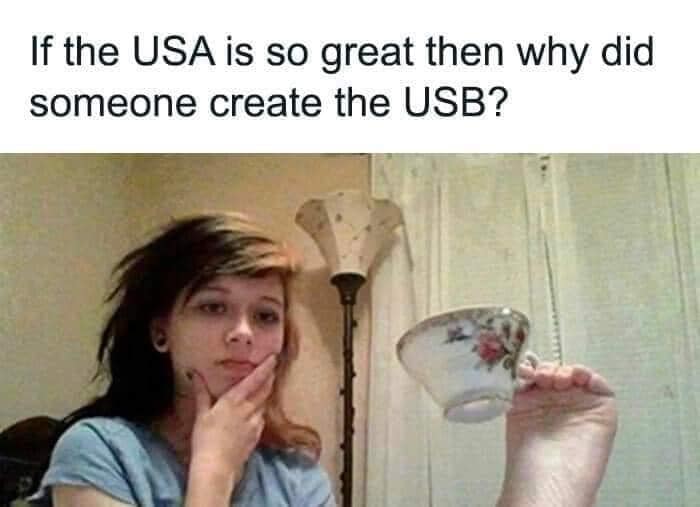
This meme uses a contemplative image of a person holding a teacup to joke about a small, simple technology like a USB drive. It humorously suggests that a tiny gadget doesn't deserve the power and massive success of the United States. The text reads, "If the USA is so great then why did someone create the USB?"
simple-description (llama3.2-vision_11b)
The meme is a humorous take on the stereotype that the United States is a technologically advanced country. The image depicts a person, likely a young woman, with a puzzled expression, holding a tea cup and saucer, and a caption that reads "If the US is so great, why did the first internet browser have to be called Mosaic?". The meme is poking fun at the idea that the US is supposed to be a leader in technology, but the first internet browser was actually developed in the UK.
detailed-analysis (gemma3-27b-vision)
Okay, let's break down this meme through the lenses of the requested theoretical frameworks.
Visual Description
The meme consists of an image of a young woman with a pensive expression. She is indoors, seemingly in a room with pale, faded green walls. She has layered hair, pierced ears, and is wearing a blue t-shirt. Her left hand is resting on her chin in a gesture of contemplation, while her right hand is holding a delicate, floral-patterned teacup. The teacup appears to be empty, creating a sense of fragility or loss. Behind her is a small table lamp with a frosted glass shade. The overall aesthetic suggests a slightly melancholic or ironic tone. Above the image is text asking "If the USA is so great then why did someone create the USB?".
Foucauldian Genealogical Discourse Analysis
This meme can be analyzed through Foucault’s lens by examining the discourse surrounding national greatness and technological innovation.
- Discourse and Power: The question "If the USA is so great then why did someone create the USB?" implicitly challenges the dominant discourse of American exceptionalism. It undermines the narrative that national greatness requires complete self-sufficiency or universal innovation. It subtly highlights a knowledge/power dynamic. The USA's proclaimed greatness relies on constructing itself as the origin of all things valuable. The USB's origin outside of the USA introduces a 'truth' that destabilizes that construction.
- Genealogy: A genealogical inquiry would trace the history of the concept of “national greatness,” examining how it came to be defined in terms of technological progress and innovation. It would explore the historical conditions that led to the association of a nation’s worth with its inventions.
- Episteme: The meme implies a shift in the 'episteme' – the underlying framework of knowledge – where questioning the absolute claims of national narratives is becoming more common. The meme's circulation signals a willingness to deconstruct previously accepted "truths". The USB becomes a symbol for technologies that are not invented in the USA, challenging the established idea that American greatness is tied to technological innovation.
Critical Theory
This meme embodies elements of Critical Theory through its implicit critique of ideological hegemony.
- Ideology and False Consciousness: The meme exposes the ideology that equates national identity with technological achievement. It suggests that Americans may be operating under a 'false consciousness,' accepting the idea that national greatness is directly tied to innovation without critical examination.
- Critique of Reason: The question doesn't necessarily attack "reason" directly, but it challenges the framework within which reason is deployed. It asks, "what counts as evidence of national greatness?" It questions the taken-for-granted assumptions that underpin the narrative of American exceptionalism.
- Emancipatory Potential: By raising the question, the meme creates a space for critical reflection. It subtly invites viewers to question the dominant narratives about national identity and technology.
Marxist Conflict Theory
While not overtly focused on class struggle, this meme can be interpreted through a Marxist lens by considering the economic implications of technological innovation and national competition.
- Competition and Innovation: The meme indirectly highlights the competitive nature of global capitalism. The fact that the USB was not invented in the USA suggests that other nations are also capable of innovation and technological advancement. This challenges the notion that the USA has a monopoly on progress.
- Capitalism and Ideology: The meme can be seen as a critique of the capitalist ideology that equates technological progress with national superiority. The focus on who invented something reinforces a competitive, nationalistic mindset within a capitalist system.
- Control of Means of Production: This is more subtle, but the meme indirectly questions control over technological development. The USB not being American-made suggests that the USA does not control all the "means of production" for technology.
Postmodernism
This meme strongly embodies several Postmodern tenets.
- Deconstruction of Grand Narratives: The meme is a prime example of deconstructing a 'grand narrative' – the idea of American exceptionalism and its inherent technological dominance. It asks a simple question that undermines the self-aggrandizing claims about the US.
- Irony and Parody: The meme’s use of a seemingly mundane object (the USB) to challenge a significant national narrative is inherently ironic. The woman holding the teacup adds to the ironic tone, suggesting a slightly detached, skeptical perspective.
- Fragmentation and Simulacra: The USB is a symbol of a complex network of global production and technological exchange. Its origin outside the USA disrupts the idea of a singular, coherent national identity. It points to a fragmented reality where technology transcends national borders.
Queer Feminist Intersectional Analysis
This framework is the least directly applicable, but some connections can be made:
- Decentering the Dominant Narrative: Queer and Feminist thought emphasize decentering dominant narratives and amplifying marginalized voices. The meme, by questioning the notion of American exceptionalism, implicitly challenges a dominant power structure.
- Challenging Power Dynamics: The meme subtly critiques the power dynamics inherent in nationalistic ideologies. Queer and feminist analyses often focus on how power operates within society, and this meme challenges a particularly pervasive form of power – national pride based on perceived technological superiority.
- Interconnectedness: While the meme doesn't explicitly deal with intersectional identities, it implicitly highlights the interconnectedness of global technology. The USB's non-American origin emphasizes that innovation isn't confined to one nation or group of people.
- The Image: The image of the woman with a skeptical expression and a delicate teacup can be interpreted as a subtle rejection of traditional power structures and a questioning of established norms.
I hope this detailed breakdown is helpful! Let me know if you'd like me to elaborate on any of these perspectives.
simple-description (llama3.2-vision)
This meme is a humorous take on the question "If the USA is so great, why did the person who invented the internet (or at least the TCP/IP protocol) in the USA, in 1983, use a British keyboard layout?" The image is of a person looking confused, with a caption of "If the USA is so great, why did the person who invented the internet (or at least the TCP/IP protocol) in 1983, use a British keyboard layout?". The meme is poking fun at the idea that the USA is so great, but the person who invented the internet (or at least the TCP/IP protocol) in 1983, used a British keyboard layout, which is a bit of a contradiction.
tesseract-ocr
If the USA is so great then why did someone create the USB?