First Seen
2024-05-08T14:50:27+00:00
simple-description (qwen3.5_2b-q8_0)
This image is a "Political Meme" image, a popular format on forums like Reddit where family photos are repurposed as nonsense political commentary. The family in the kitchen looks down at a table with drinks, a common backdrop for these absurd posts. The "Anti-Americana" explanation mocks this absurdity by treating the domestic family scene as serious political rhetoric, often making light of the internet culture that generates such images by pretending they are political statements.
simple-description (llama3.2-vision_11b)
The meme depicts a stereotypical 1950s American family, but with a twist: the father is wearing a "I'd rather be in Paris" t-shirt, a nod to the anti-American sentiment that was prevalent during the 1950s and 60s. The image is likely meant to be humorous and ironic, poking fun at the idea of American exceptionalism and the notion that Americans are always happy and content. The text "I'd rather be in Paris" is a playful reference to the French phrase "I'd rather be in Paris" which is often used to express a desire to be in a more exotic or culturally rich place.
detailed-analysis (gemma3-27b-vision)
Okay, let's break down this vintage illustration through various theoretical lenses. Given the image's strong cultural context and clear narrative elements, several lenses will be very applicable.
Visual Description
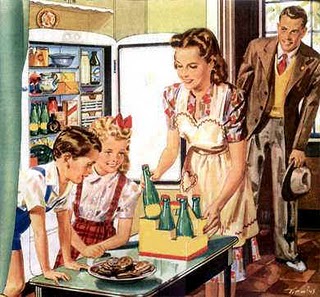
The illustration depicts a domestic scene, likely from the 1950s. A woman, dressed in a floral, somewhat conservative dress, is shown in front of an open refrigerator, reaching for bottles. Two young girls, similarly dressed in coordinated outfits, are excitedly gazing at the refrigerator, their hands on the counter. A man, in a suit and holding a briefcase, stands slightly behind, observing the scene.
The refrigerator is prominently featured, filled with a wide variety of food and beverages, symbolizing abundance. The lighting is bright and optimistic, highlighting the cleanliness and order of the kitchen. The overall aesthetic is highly polished and idealized, emphasizing the perfection of domestic life. The style is clearly illustrative, with smooth lines and a focus on idealized representations of people and objects. A plate of chocolate covered cookies sits on the counter as a focal point.
Foucauldian Genealogical Discourse Analysis
This image is ripe for a Foucauldian reading. The scene isn't simply a depiction of a family getting drinks, it constructs and reinforces discourses around gender, domesticity, and consumption.
- Discipline & Normalization: The woman's role is firmly within the domestic sphere – the 'natural' provider of refreshment. This reinforces a disciplinary regime around gender – women should be the caretakers, the organizers of home life. The matching outfits on the children can also be seen as a form of subtle discipline, aiming to create 'proper' subjects.
- The Panopticon of Domesticity: The open refrigerator, filled with goods, can be seen as a symbol of the consumerist society. The 'visibility' of the abundance within the refrigerator implies a pressure to have these goods, to perform the role of the 'good provider' or the 'successful homemaker'. The family is, in a sense, being 'watched' by the standards of ideal domestic life.
- Genealogy of the 'Nuclear Family': The image isn't a 'natural' representation of family, but a product of historical and social forces. The idea of the nuclear family as the norm, with clearly defined gender roles, is a historical construction – something that emerged and became dominant through specific discourses and power structures. The illustration helps perpetuate this construction.
Critical Theory
Looking at this image through the lens of Critical Theory (particularly drawing on the Frankfurt School), we see a reinforcement of societal control.
- Culture Industry: The image itself is a product of the 'culture industry' – mass-produced imagery that serves to standardize thought and behavior. It presents a highly idealized version of reality, masking the contradictions and inequalities of the broader social system.
- False Consciousness: The family in the illustration appears happy and content, but this could be argued to be a form of 'false consciousness.' They are presented as fulfilled by the consumerist lifestyle, unaware of the exploitative labor practices and social inequalities that make such abundance possible. The image promotes a sense of contentment with the status quo, obscuring deeper social problems.
- One-Dimensional Man: The focus on material consumption and the idealized domestic life contributes to a 'one-dimensional' existence – where critical thinking and alternative values are suppressed. The emphasis on acquiring goods and conforming to social norms stifles individual agency and the pursuit of genuine fulfillment.
Marxist Conflict Theory
From a Marxist perspective, the illustration highlights class dynamics and the perpetuation of capitalist ideology.
- Commodity Fetishism: The focus on the abundance within the refrigerator obscures the labor and exploitation that went into producing those goods. The focus is on the things themselves, rather than the social relations that create them. This is a classic example of commodity fetishism.
- Reinforcement of Bourgeois Values: The scene represents a middle-class lifestyle, emphasizing material comfort and social stability. This reinforces the values of the ruling class – those who benefit from the capitalist system. The illustration presents this lifestyle as desirable and normal, masking the inequalities that prevent others from achieving it.
- Ideology & False Needs: The family's happiness is tied to the acquisition of goods. This is a product of capitalist ideology, which creates 'false needs' – desires that are not essential for survival but are manufactured through advertising and consumer culture. The illustration promotes these false needs, reinforcing the cycle of consumption.
Postmodernism
A postmodern reading might focus on the surface of the image and its constructed nature.
- Simulacra & Simulation: The image isn't a 'true' representation of reality but a simulacrum – a copy without an original. It's a stylized and idealized representation of domestic life that has become detached from lived experience. The image is more about representing the idea of happiness than actually depicting it.
- Hyperreality: The abundance in the refrigerator could be seen as an example of 'hyperreality' – a simulation that is more real than the real thing. The idealized domestic life presented in the image has become a dominant cultural narrative, overshadowing the complexities and challenges of actual family life.
- Deconstruction of the 'Family Myth': While the image seems to reinforce the traditional family structure, a postmodern reading could also deconstruct it – revealing the inherent contradictions and power dynamics within the family. The idealized image masks the potential for conflict, inequality, and alienation.
Queer Feminist Intersectional Analysis
While the image doesn't explicitly depict queer or marginalized identities, a queer feminist intersectional analysis can reveal the absence and the assumptions embedded within it.
- Reinforcement of Heteronormativity: The image presents a rigidly defined nuclear family with traditional gender roles. This reinforces the idea that heterosexuality is the norm and that families should conform to this model.
- Silencing of Other Family Structures: The image doesn't acknowledge or represent alternative family structures – same-sex families, single-parent families, blended families, etc. This erasure contributes to the marginalization of those who don't fit the traditional mold.
- Gendered Division of Labor: The woman is positioned as the caretaker and provider of refreshment, while the man is the breadwinner. This reinforces a gendered division of labor that perpetuates inequality and limits women's opportunities.
- Intersection of Gender and Class: The idealized domestic scene is likely associated with a specific class position. The ability to afford a well-stocked refrigerator and a comfortable home is a privilege that is not available to everyone. This intersection of gender and class highlights the ways in which social inequalities are interconnected.
- Absence of Racial Diversity: The lack of racial diversity in the image also points to the dominant cultural norms and the marginalization of people of color.
Hopefully, this detailed analysis helps to illuminate the layers of meaning embedded within this seemingly simple illustration. Let me know if you'd like me to delve deeper into any of these perspectives or explore additional theoretical frameworks.
simple-description (llama3.2-vision)
This meme is an image of a 1940s-style illustration of a family in their kitchen. The image shows a mother, a father, and a young girl standing in front of a kitchen table, with a cake on it that says "Happy 18th Birthday" in icing. The mother is holding a tray with three bottles of beer, and the father is holding a hat and looking at the camera with a mischievous expression.
tesseract-ocr
oar 7 a i ar fh <iq U7 IK “‘ ; as A he ; 5 Wor: i} k i ee ey R A) 4 SS