First Seen
2023-11-26T03:40:53+00:00
simple-description (qwen3.5_2b-q8_0)
This image is a visual metaphor for the Anti-Americana movement, which argues that the United States is a dominant racial and cultural power. It humorously illustrates how the US is seen in Latin America as a cultural hegemony, placing the face of actor Clint Eastwood over nearly every country in the region to suggest that neighbors are "American" extensions of the US. The text "Argentina" and "Brazil" on the map highlights the specific nations involved in this geographic joke.
simple-description (llama3.2-vision_11b)
The meme is a photo of a map of the Americas with all the countries in South America and North America replaced with images of Nicolas Maduro, the President of Venezuela. The text "I can see Russia from my house" is written above Venezuela, referencing a 2012 joke about the US-Mexico border. The meme is a humorous commentary on the idea that the US-Mexico border is not secure, with the implication that it's easier to see Russia from Venezuela than from the US-Mexico border.
detailed-analysis (gemma3-27b-vision)
Okay, let's break down this image, applying the requested theoretical frameworks where appropriate.
Visual Description
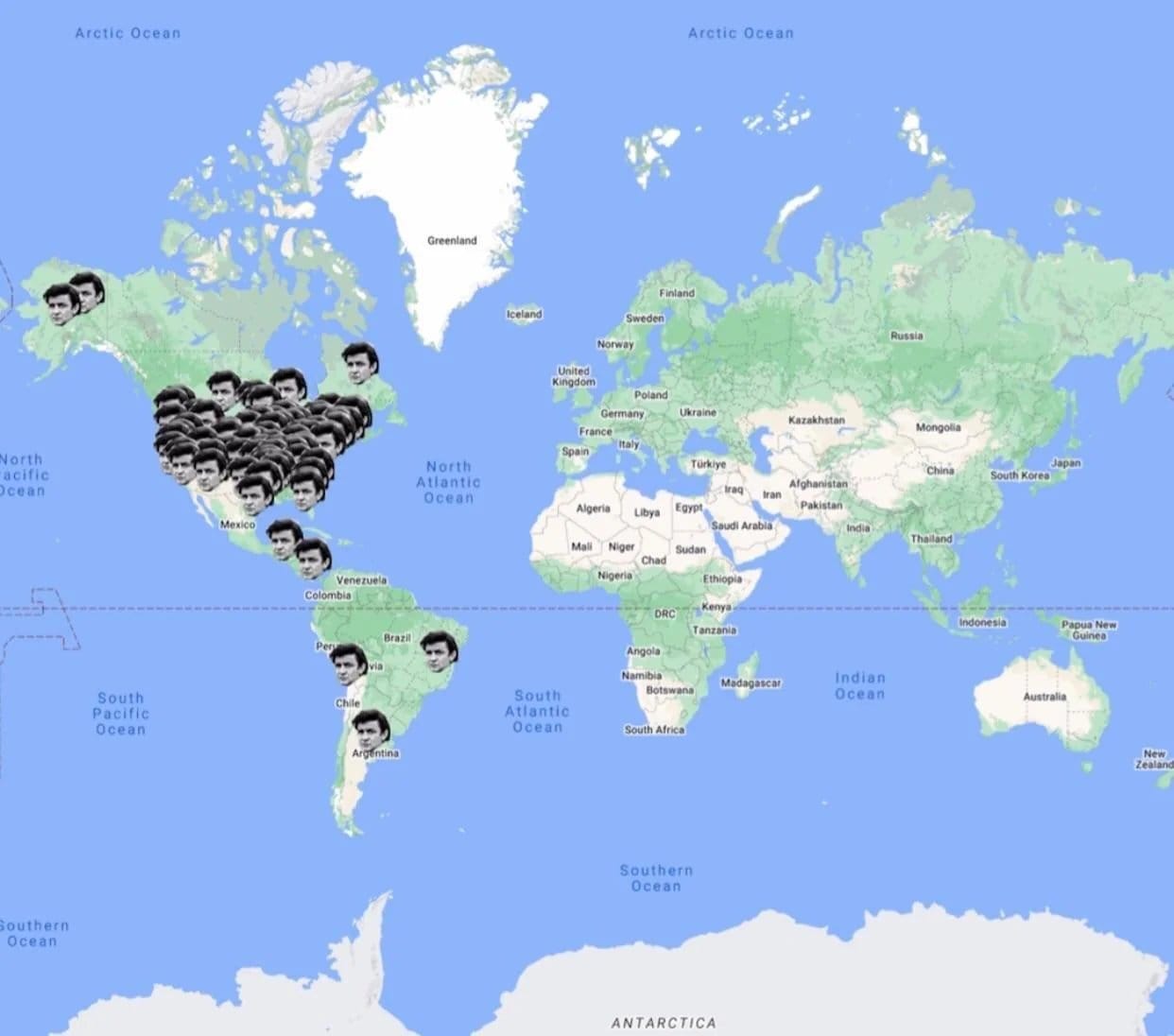
The image presents a world map, digitally altered. Overlaid on the map are numerous small images of actor Nicolas Cage's face. The concentration of these faces is overwhelmingly dense over North America (specifically the United States and Canada), creating a visual ‘cloud’ or swarm. Scattered, much less frequent, images of Cage’s face appear across South America (particularly Argentina), Africa (scattered) and a small number in Europe. The rest of the world is generally devoid of these overlaid images. The map itself is rendered in standard geographical colours, showing landmasses and oceans.
Postmodernism
This image resonates strongly with postmodern themes. The proliferation of Nicolas Cage’s face embodies the postmodern condition of hyperreality and the simulacrum. The original context of Cage's image (his films, public persona) is divorced from its origin and copied endlessly, creating a simulation of celebrity, divorced from any 'real' referent.
- Pastiche and Playfulness: The image doesn’t seem to be making a serious political or philosophical statement, but rather engaging in a form of visual play, bordering on absurdity. It echoes the postmodern embrace of irony, parody, and the blending of high and low culture.
- Loss of Grand Narratives: The random distribution suggests a rejection of overarching structures or meaning. There's no apparent logic, just a chaotic accumulation of images. This mirrors the postmodern skepticism towards universal truths or master narratives.
- The Spectacle: Nicolas Cage, as a celebrity, is part of the modern spectacle. The image reinforces this, multiplying his image to the point of saturation, highlighting the hyper-visibility of figures in mass media.
Foucauldian Genealogical Discourse Analysis
A Foucauldian analysis would look at how the image participates in a discourse around celebrity, fandom, and the construction of "Nicolas Cage" as a concept. It would trace the genealogy of this discourse – how has this "Nicolas Cage" come to be understood, and what power relations are embedded in that understanding?
- Power/Knowledge: The image reveals how power operates through knowledge. The proliferation of Cage’s image doesn’t just reflect fandom, but also the power of media, marketing, and the cultural industry to create and sustain celebrity. The act of copying and distributing the image contributes to this power dynamic.
- Discipline and Surveillance: While not directly related to discipline, the image indirectly reflects the increased visibility and surveillance characteristic of modern culture. The constant availability of images and information reinforces this state.
- Shifting Discourse: The image itself is a new discursive element. It alters the existing discourse around Nicolas Cage, perhaps introducing the concept of him as a meme, an object of ironic worship, or a symbol of something else entirely.
Critical Theory
Applying critical theory, we might see this image as a manifestation of the culture industry (drawing on Adorno and Horkheimer).
- Commodification of Culture: Nicolas Cage’s image, as part of the entertainment industry, is a commodity. The image reinforces the ways in which culture is produced, packaged, and consumed.
- The Loss of Aura: As described by Walter Benjamin, the reproduction of Cage’s image through this meme-like distribution erodes its original “aura” (its unique authenticity) and contributes to the alienation of the cultural product.
Marxist Conflict Theory
While less direct, a Marxist analysis could be applied by seeing the image as a reflection of the power dynamics inherent in the production and consumption of culture.
- Ideology: The image could be seen as a form of ideological reinforcement. The focus on a celebrity reinforces consumer culture and distracts from more pressing social and economic issues.
- Commodification: This image perpetuates the commodification of images, celebrity and popular culture – things that are exploited for profit.
Queer Feminist Intersectional Analysis
Applying a Queer Feminist Intersectional analysis is challenging, as the image isn’t inherently gendered or explicitly queer. However, we could consider the following:
- Spectatorship & The Male Gaze: The image, focusing on a male celebrity, implicitly reinforces the dominant power structures within the entertainment industry. The image, even in its absurdity, positions Cage as the object of attention, fitting into a broader pattern of male figures dominating visual culture.
- Reclaiming and Disrupting Meaning: While not explicitly feminist, the proliferation of the image could be seen as a form of subversive play, disrupting the established meaning of the celebrity image. Fandom communities have historically been sites of resistance and reimagining, potentially offering alternative readings of the celebrity figure.
- Intersectionality: The distribution and reception of the image may be shaped by the intersecting identities of those who engage with it (race, class, gender, sexuality). For example, different communities may interpret the image in different ways or attribute different meanings to it.
Important Note: It's crucial to remember that interpretations depend on the specific context and perspective. This is just one possible reading of the image through the lens of these theoretical frameworks.
simple-description (llama3.2-vision)
The meme is a map of the world with a large number of small images of a single person's face, presumably a celebrity or public figure, scattered across it. The text "I can see your face" is written at the top of the image, implying that the person's face is being seen everywhere. The image is likely a humorous commentary on the ubiquity of social media and the internet.
tesseract-ocr
Mos : hs Be | ey o yi oe. Pays! tf. \ * Y : r F J i‘ cea a | E, ij £s North on ; re ! ae