First Seen
2024-02-27T20:58:08.492100+00:00
simple-description (qwen3.5_2b-q8_0)
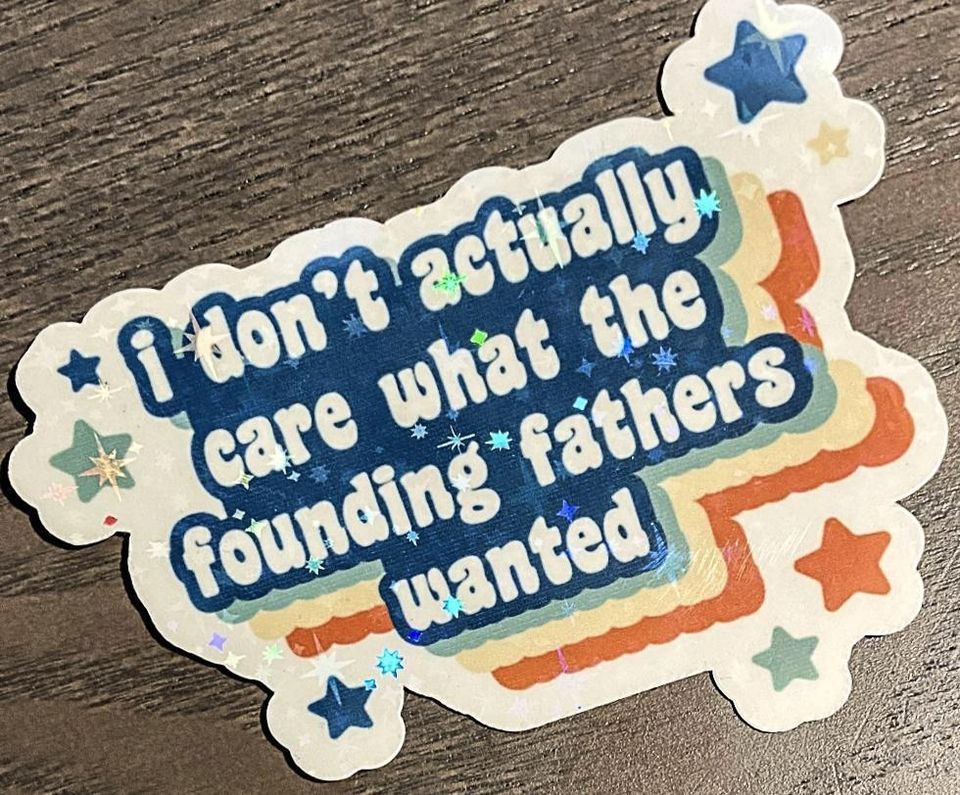
This sticker represents a popular piece of anti-Americana humor that mocks the idea of a singular, traditional American identity. The joke suggests that modern Americans often have no real interest in the specific founding documents or values the original leaders established. The text on the sticker reads, "i don't actually care what the founding fathers wanted."
simple-description (llama3.2-vision_11b)
The meme is a photo of a "I don't like America" sign with a caption that reads "I don't like America because...". The sign is likely in a public place, such as a protest or a demonstration, and is meant to be provocative and attention-grabbing. The meme is likely being shared to express a sense of frustration or disillusionment with American society or politics.
detailed-analysis (gemma3-27b-vision)
Okay, here's an analysis of the sticker, broken down into the requested sections. Keep in mind, these are interpretations, and a single image can support multiple readings.
Visual Description
The image is of a sticker, likely made of vinyl. It has a retro or vintage aesthetic, reminiscent of the 1970s or early 1980s. The background is a pale yellow or cream color. The text “I don’t actually care what the founding fathers wanted” is written in a stacked, bold, bubbly font with a blue base color and a secondary pink/red outlining. The text is overlaid on a wave-like, gradient pattern of orange and red. The sticker is bordered with a darker outline and decorated with small, sparkling stars in blue, silver, and teal. The color scheme is relatively bright and playful, but the message is pointedly counter-cultural.
Foucauldian Genealogical Discourse Analysis
This sticker is a powerful disruption of dominant historical narratives. Applying a Foucauldian lens, we can see the sticker as challenging the "discourse" surrounding the Founding Fathers. Foucault emphasized that knowledge isn't objective truth, but is produced through discourse, shaped by power relations.
- Power/Knowledge: The traditional discourse around the Founding Fathers constructs them as inherently wise, legitimate authorities. This gives power to certain interpretations of the Constitution and US history, legitimizing present-day power structures. The sticker deconstructs that authority, asserting a refusal to give weight to their intentions.
- Genealogy: A genealogical approach examines how concepts like "founding fathers" and “legitimacy” came to mean what they do, tracing their historical emergence and the power struggles that shaped them. The sticker acts as a rejection of this constructed history and a move toward re-evaluating the past, acknowledging its inherent biases.
- Disruption: The bold, declarative statement intentionally disrupts the normalized, often uncritical reverence for the Founding Fathers. It signals that their pronouncements are not inherently sacred or inviolable.
Critical Theory
From a Critical Theory perspective (drawing heavily from the Frankfurt School), the sticker critiques the ideological function of historical narratives.
- Ideology: The traditional celebration of the Founding Fathers often serves to legitimize existing social inequalities. By framing them as benevolent figures, it can obscure the ways in which their ideals and actions were tied to systems of oppression (like slavery, patriarchy, and colonial exploitation).
- Hegemony: The sticker challenges the hegemonic control of a specific interpretation of American history. Hegemony, in Gramsci’s terms, is the dominance of a ruling class’s worldview, presented as "common sense." This sticker actively resists that “common sense” and signals a refusal to accept the narratives dictated by those in power.
- Emancipation: The sticker, even in its small form, can be seen as a call for intellectual emancipation. It encourages critical thinking about history and rejects the uncritical acceptance of established authority.
Marxist Conflict Theory
From a Marxist lens, the sticker points towards a historical materialist understanding of power and ideology.
- Class Struggle: The "Founding Fathers" represent a specific class of landowners, merchants, and elites who shaped the early American state to serve their own interests. While not explicitly stated, the sticker implies a rejection of the structures that benefited this class at the expense of others.
- Superstructure & Base: Marxist theory posits that the "superstructure" (ideas, culture, law) arises from and reinforces the "base" (the economic system). The reverence for the Founding Fathers can be seen as part of the superstructure, reinforcing a capitalist system built upon their early decisions. The sticker questions the legitimacy of this whole structure.
- Historical Materialism: The sticker’s message implies that the intentions of the Founding Fathers, while historically significant, are not necessarily relevant to addressing contemporary social and economic problems. It suggests that material conditions—the realities of inequality, exploitation, and oppression—should take precedence over historical reverence.
Postmodernism
Postmodernism is evident in the sticker's rejection of meta-narratives and the assertion of subjective experience.
- Rejection of Meta-Narratives: The sticker challenges the grand narrative of American exceptionalism and the idea of a unified, coherent historical truth. It’s a declaration that one perspective (a refusal to care about the intentions of those in power) is valid, even if it clashes with the dominant historical account.
- Deconstruction: The message “I don’t actually care” deconstructs the assumed authority of the Founding Fathers. It questions the very foundation of their legitimacy and rejects the idea that their intentions should dictate present-day action.
- Subjectivity: The statement is highly personal (“I don’t actually care”), emphasizing subjective experience over objective truth. This aligns with the postmodern emphasis on the individual’s perspective and the recognition that knowledge is always situated.
Queer Feminist Intersectional Analysis
This sticker can be powerfully interpreted through a Queer Feminist Intersectional lens.
- Intersectionality: The Founding Fathers lived in a patriarchal society built on racial and economic exploitation. Their "intentions" were inevitably shaped by and reinforced these systems of oppression. Rejecting their authority is a rejection of the power structures that historically marginalized women, people of color, queer individuals, and other oppressed groups.
- Deconstruction of Patriarchy: The sticker is inherently anti-patriarchal, since the "Founding Fathers" were overwhelmingly white, male elites who established a system of power that privileged their own interests.
- Queer Resistance: The assertion of “I don’t care” can be read as an act of queer resistance, a refusal to conform to expectations of reverence for historical figures who actively oppressed marginalized communities. It’s a reclaiming of agency and a rejection of normative historical narratives that silence or erase the experiences of those who were excluded.
- Reimagining History: The sticker implicitly calls for a reimagining of history that centers the experiences of those who were historically marginalized. It suggests that a truly just and equitable future requires us to move beyond the legacies of the Founding Fathers and embrace a more inclusive and liberatory vision.
Let me know if you would like me to delve deeper into any of these interpretations!
simple-description (llama3.2-vision)
The meme is a humorous image that pokes fun at the idea of being a "cool" or "fun" parent. The text on the image reads: "I don't actually care what the founding fathers wanted." The image is likely a playful way to express a sense of rebellion or nonconformity, implying that the speaker doesn't care about following traditional or historical norms.
tesseract-ocr
—. 3 O NC a TS EN Te dk , 0 \ ¥ $2 5 care ery gn ps ee ee KY eo A Pe eee on eee Onee Mi Oran e Ap uateteaad ls: 77 Ge oe