First Seen
2024-06-27T20:08:21.540092+00:00
simple-description (qwen3.5_2b-q8_0)
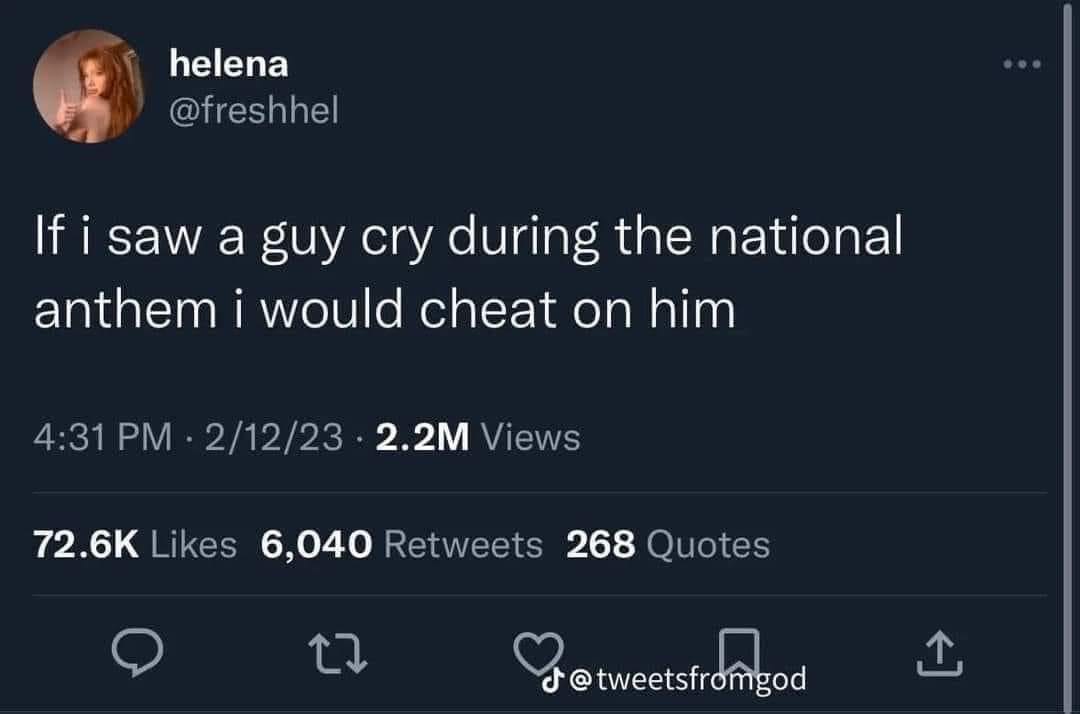
This is a classic example of Anti-Americana satire, which mocks the absurdity of claiming to care about one's country while ignoring reality. The tweet states, "If i saw a guy cry during the national anthem i would cheat on him." By retweeting it, the user "helena" is ironically admitting that her own indifference to the anthem is the true betrayal, effectively mocking the hypocrisy of American patriotism.
simple-description (llama3.2-vision_11b)
This meme is from the Anti-Americana category, which often features humorous and satirical content. The meme is a screenshot of a tweet that says "if i saw a guy crying during the national anthem i would cheat on him" in a playful and sarcastic tone, implying that the speaker would rather cheat on their partner than comfort someone in a vulnerable moment.
detailed-analysis (gemma3-27b-vision)
Okay, let's break down this Twitter post using the requested theoretical frameworks.
Visual Description
The image is a screenshot of a Twitter post. The background is black, typical of Twitter's dark mode. At the top, there's a profile picture of a woman with brown hair, next to the username "@freshhel" and the name "helena". Below that is the tweet itself, a short sentence: "If i saw a guy cry during the national anthem i would cheat on him." Underneath the tweet are the statistics of the post: 72.6k likes, 6,040 retweets, and 268 quotes. At the very bottom are the standard Twitter interaction icons (comment, retweet, like, share) with one tagged user (@tweetsfromgod). The timestamp reads 4:31 PM, February 12, 2023, and it indicates 2.2 million views.
Foucauldian Genealogical Discourse Analysis
This tweet provides a fertile ground for a Foucauldian analysis because it reveals power dynamics operating through discourses around masculinity, patriotism, and acceptable emotional expression.
- Discipline & Normalization: The statement implies a "correct" way for men to behave during patriotic performances – stoicism, strength, and an absence of emotional display. Crying, considered a vulnerable emotion, is positioned as a transgression, a violation of this norm. The threat of cheating functions as a disciplinary mechanism – a punishment (social ostracization, loss of relationship) for deviating from the expected masculine performance.
- Genealogy of Emotionality & Masculinity: A genealogical approach would investigate how the association of stoicism with masculinity developed historically. It would trace how emotional expression has been pathologized or relegated to the feminine sphere, and how these constructions have served power structures. The tweet reflects this historical power dynamic.
- Power/Knowledge: The author’s assertion is presented as a personal preference, but it actually enacts a power dynamic by defining the boundaries of acceptable behavior. The knowledge that "men shouldn't cry" is inextricably linked to the power to judge and punish those who do. The author positions themself as an enforcer of this knowledge.
Critical Theory
This tweet lends itself to a Critical Theory reading through its exposure of underlying social power structures.
- Ideology: The statement implicitly endorses a specific, dominant ideology surrounding gender roles and national identity. It suggests that national pride (symbolized by the anthem) should be accompanied by a certain performance of masculine strength. Any deviation is considered a betrayal, and therefore worthy of punishment.
- Domination & Oppression: The tweet reveals how norms surrounding masculinity can be oppressive. By implying that emotional vulnerability is unacceptable in men, it reinforces a system where men are discouraged from expressing their feelings, potentially leading to psychological harm. The threat of cheating functions as a tool of control.
- False Consciousness: The author appears to believe they are simply expressing a personal preference, but they are, in fact, reproducing a harmful ideology that perpetuates gender inequality and reinforces narrow definitions of masculinity.
Marxist Conflict Theory
While not directly dealing with economic class, this tweet can be interpreted through a lens of conflict, expanding the idea of 'class' to social groups.
- Power Dynamics: The post reveals a power dynamic between those who enforce norms (the author) and those who are subjected to them (men expected to adhere to stoic expectations).
- Ideological Control: The tweet is a small example of how dominant ideologies (regarding masculinity and patriotism) are maintained through social control. The author's statement is a form of subtle social pressure to conform.
- 'Culture Wars': The post can be seen as a microcosm of the larger "culture wars" where competing ideologies clash. The author positions themselves on the side of a particular (traditional, hyper-masculine) view of national identity and gender roles.
Postmodernism
A postmodern reading would focus on the instability of meaning and the deconstruction of grand narratives.
- Deconstruction of "Authenticity": The tweet questions the very notion of "authentic" emotional expression. The author's reaction isn’t based on genuine emotion, but on a socially constructed expectation. The idea of an "authentic" man is shattered, replaced with a performance.
- Relativism and Subjectivity: The tweet highlights the subjective nature of morality and personal preferences. The author's reaction is presented as a matter of personal taste, but this obscures the underlying power dynamics at play.
- Simulation and Hyperreality: The national anthem itself, and the emotions it’s intended to evoke, can be viewed as a “simulation” of genuine patriotism. The author’s reaction is a reaction to the simulation, further blurring the line between reality and representation.
Queer Feminist Intersectional Analysis
This is where the analysis becomes particularly potent.
- Toxic Masculinity: The statement is a perfect example of toxic masculinity – the harmful pressures placed on men to conform to narrow definitions of strength, stoicism, and dominance. The author's response penalizes vulnerability, reinforcing a damaging expectation.
- Patriarchy & Gender Roles: The tweet is deeply embedded in patriarchal structures. It’s an expression of power over a man, based on his perceived failure to perform masculinity "correctly."
- Intersectionality: The analysis could be extended by considering how race, class, and other identities intersect with gender. The pressure to perform stoicism might be particularly acute for men of color who are already facing societal pressures related to their race. The tweet can also be viewed in terms of heteronormativity; the author assumes a heterosexual relationship and enforces a certain standard of masculinity within it.
- Emotional Labor & Performance: The tweet points to the emotional labor placed on men to suppress their feelings and perform a certain image.
Important Note: This is an interpretive analysis, and other readings are possible. The goal is to demonstrate how different theoretical frameworks can illuminate the hidden meanings and power dynamics within a seemingly simple Twitter post.
simple-description (llama3.2-vision)
This meme is a screenshot of a tweet that reads: "If i saw a guy crying during the national anthem i would cheat on him." The tweet is likely a joke or a sarcastic comment, implying that the speaker would be so upset by a man's emotional display during the national anthem that they would consider cheating on him.