First Seen
2023-05-10T21:03:32+00:00
simple-description (llama3.2-vision_11b)
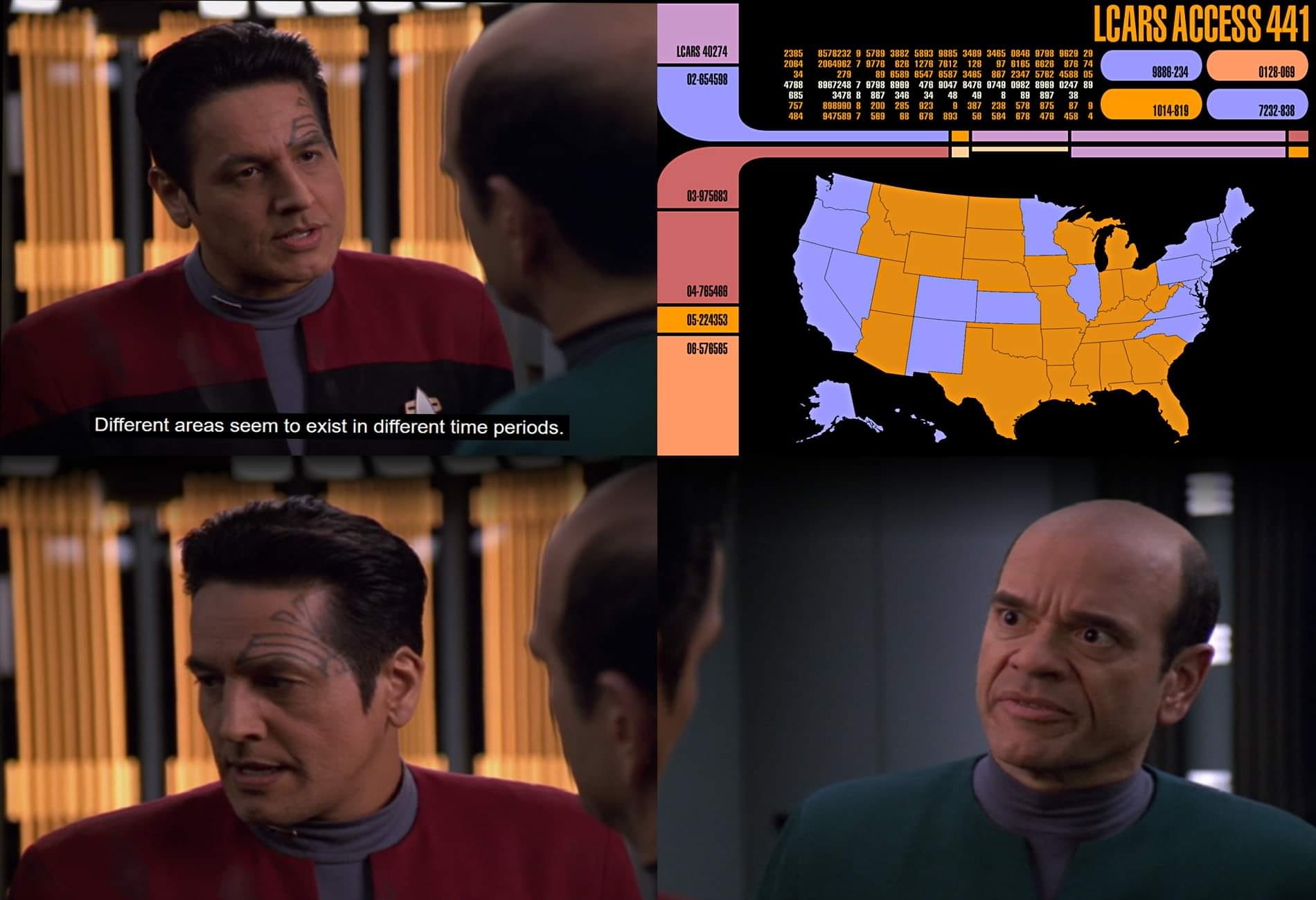
This meme is a still image from the TV show Star Trek: The Next Generation, featuring the character Data. The image is of Data's face with a shocked expression, and the text "I am... confused" is overlaid on top. The meme is a humorous take on the character's confusion, implying that he is struggling to understand a situation.
detailed-analysis (gemma3-27b-vision)
Okay, here's an analysis of the image, broken down into relevant sections based on your requested theoretical frameworks. Given the image’s content (a scene from Star Trek: Voyager, featuring a holographic representation of the United States and diverse characters), several frameworks are highly relevant.
Visual Description
The image is a screenshot from a scene on the Star Trek: Voyager spacecraft. The primary visual focus is a large, holographic projection of a map of the United States of America. The map is rendered in blue, with state boundaries clearly visible. Surrounding the map are complex panels displaying numerical data in varying shades of green and red, suggesting technical or monitoring information.
Three figures are present in the scene. One is a dark-haired man in a Starfleet uniform, appearing to be the main focus. To his left and right are two more men, also in uniforms, slightly more distant. The men are looking at the holographic map. The background displays the metallic interior of a spaceship. The scene’s lighting is cool, predominantly blue, emanating from the holographic display and the ship's internal illumination. The composition suggests that the characters are analyzing information related to the United States, likely as part of a mission or analysis. The holographic projection’s clarity is high, and there is attention to detail in the rendering of the US map and numerical displays.
Foucauldian Genealogical Discourse Analysis
This image offers a rich field for Foucauldian analysis, particularly regarding power/knowledge. The holographic representation of the United States is not a neutral map; it is a discourse – a system of thought, language, and practice that constructs meaning.
- Archaeology of Knowledge: The projection implies a past knowledge system (cartography, geopolitics, US history) being deployed in the present. The data panels surrounding the map suggest an attempt to measure, categorize, and therefore control elements within that geographical and historical discourse. What data is chosen to be displayed and how it's represented is crucial.
- Genealogy of Power: The holographic display isn't just about knowing the US; it's about exercising power over it. The characters are analyzing it, potentially to intervene, to manipulate, or to understand it within a larger strategy. The fact that this analysis occurs from a distant spaceship raises questions about external surveillance and the exercise of power from a position of technological superiority.
- Disciplinary Power: The surrounding numerical displays could represent a system of metrics used to track, assess, and ultimately normalize aspects of the United States. This aligns with Foucault’s idea of disciplinary power, where knowledge is used to regulate and control populations.
- The Absence of the "Other": Notably, the scene focuses on the US map itself, a nation historically built on colonial and imperial practices. The scene raises questions about who is defining the parameters of this analysis, and whose perspectives are being excluded.
Critical Theory (Frankfurt School)
This image resonates with critical theory's concerns about the relationship between technology, power, and reason.
- Instrumental Reason: The holographic projection and data displays exemplify instrumental reason – the application of logic and efficiency for a specific purpose. While seemingly objective, this technology is deployed within a particular context, potentially serving dominant ideologies.
- The Culture Industry: One could argue that the holographic representation of the US is a form of commodified “reality,” similar to how the Frankfurt School critiqued mass media. The US is reduced to data points and a visual spectacle, losing its complexities and lived experiences.
- Technological Rationality and Domination: The scene hints at the potential for technology to be used for domination, rather than emancipation. The distant spaceship and the analytical gaze of the characters suggest a power imbalance. What is the purpose of this analysis? Is it to understand or to control?
- Loss of Authenticity: By reducing the US to a holographic projection, the image suggests a detachment from the “real” US, a loss of authenticity and a move towards a simulated reality.
Marxist Conflict Theory
From a Marxist perspective, the image can be interpreted as a visualization of global power dynamics and potential conflicts.
- Imperialism and Hegemony: The holographic projection of the US, analyzed from a distant spaceship, can be seen as a metaphor for external scrutiny of US power and influence. The scene implies a power imbalance between the analyzing party and the US.
- Capital and Technology: The technological sophistication of the spaceship and the holographic display represent the material forces of production. This technology could be used to further economic or political interests.
- Class Struggle (Indirectly): While not directly depicted, the analysis of the US could relate to economic or political competition. The analyzing party might be seeking to exploit weaknesses or challenge the US's dominance.
- Ideology: The way the US is represented on the holographic map is not neutral. It could reinforce or challenge dominant ideologies about the country's role in the world. Is the map accurate, or is it a selective representation designed to serve a particular agenda?
Postmodernism
The image encapsulates several key themes of postmodern thought.
- Simulacra and Simulation: The holographic projection is a simulacrum – a copy without an original. The US is not physically present but is represented as a simulation. This challenges the notion of a "real" US and raises questions about the nature of reality itself.
- Hyperreality: The holographic projection creates a hyperreality – a reality that is more real than real. The data panels and analytical gaze of the characters contribute to this sense of constructed reality.
- Deconstruction of Grand Narratives: The scene challenges the idea of a unified US identity or national story. The holographic map is just one representation among many, and it is subject to interpretation and deconstruction.
- Fragmentation and Loss of Meaning: The complex data panels and the analytical focus of the characters contribute to a sense of fragmentation and a loss of meaning. The US is reduced to data points, losing its cultural and historical context.
Queer Feminist Intersectional Analysis
This analysis requires a bit more speculative linking given the visual content. However, the image allows for considerations of power, representation, and marginalization.
- Representation and the Gaze: The absence of diverse representation within the holographic map and the characters observing it (all male) signals a potential erasure of marginalized voices. Whose history and experiences are being mapped and analyzed, and whose are missing?
- Power Dynamics: The scene’s power imbalance (the spaceship analysts, the map) can be connected to intersecting systems of oppression. The map’s representation of the US history is linked to historical power structures that marginalized women, people of color, and LGBTQ+ individuals.
- Surveillance and Control: The technological apparatus of the spaceship and the holographic map can be read as a form of surveillance and control, potentially reinforcing existing power structures and oppressing marginalized groups. Who benefits from the knowledge generated by this analysis?
- Intersectionality of Space & Power: Space (the spaceship, the holographic projection) is not neutral. It is a space of power, with certain individuals and groups having greater access and control. The absence of diverse representation in this space reinforces existing inequalities.
I hope this breakdown provides a comprehensive and nuanced analysis of the image from multiple theoretical perspectives. Let me know if you'd like me to expand on any specific aspect or theoretical framework.
simple-description (llama3.2-vision)
This meme is a humorous image that combines a scene from the Star Trek: The Next Generation episode "The Last Ship" with a map of the United States. The image shows a character, T.J. , looking confused and saying "I don't understand the concept of time zones", with a map of the US in the background. The text at the top of the image reads "I don't understand the concept of time zones".
tesseract-ocr
, a = , AAR Px a po eee ee ee 34 POA ee Om nd 0128-069 02-654508 CMe ft os ory Ca 1014-619 7282-838 ae Fe ees ’ ~ a 03-075089 | . , E ee y - } F ,— 7 ti 7 = | (a : y ii =| >» \ > ae | ; 04 705488 a es | Leg a S7A585 | ieee oon a ‘wna Different areas seem to exist in different time periods. - ee ia f a i - ‘ ‘J Se) — ‘ —S cd Ras > PS (a ‘ te * “ sf y & R) ar i. ail A ’ ad