First Seen
2023-05-10T21:03:32+00:00
simple-description (llama3.2-vision_11b)
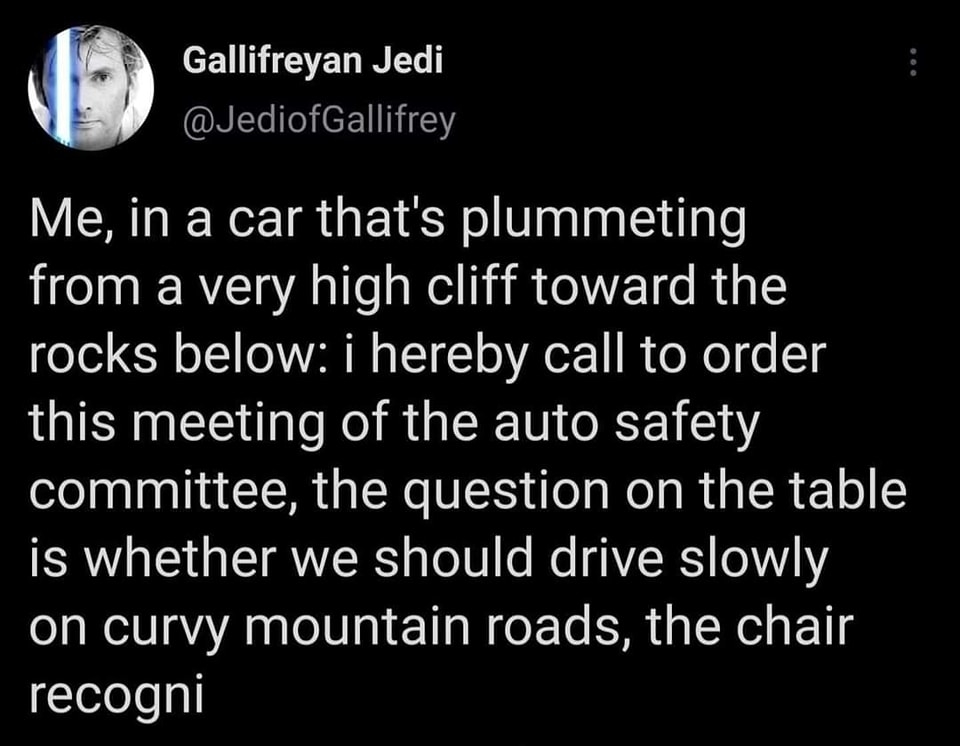
The meme is a humorous take on the frustration of being stuck in a car that's stuck on a steep, rocky road, where the driver is about to give up and just want to get out of the situation. The text reads: "Me, in a car that's stuck on a steep, rocky road, where I'm about to give up and just want to get out of the situation. I'm about to give up and just want to get out of the situation."
detailed-analysis (gemma3-27b-vision)
Okay, let's break down this darkly humorous tweet through the lenses you've requested. It's ripe for analysis, given its absurd juxtaposition!
Visual Description
The image is a Twitter post, a simple profile picture of a figure identified as "Gallifreyan Jedi" (@JediOfGallifrey) accompanied by a text-based tweet. The profile picture is a close-up, filtered image, appearing as a historical or slightly faded portrait, with a vaguely Victorian or Edwardian aesthetic. The tweet itself is the primary element, a narrative statement describing a ludicrous situation. The visual is understated, and the humor relies almost entirely on the textual content.
Foucauldian Genealogical Discourse Analysis
This tweet is saturated with opportunities for Foucauldian analysis.
- Discourse & Power/Knowledge: The speaker immediately establishes a discourse of bureaucracy ("I hereby call to order… the auto safety committee"). This discourse functions as an assertion of power, even in the face of imminent annihilation. The very act of imposing a procedural structure on the moment is a way of attempting to control the uncontrollable, a means of re-establishing order. The question debated (“whether we should drive slowly on curvy mountain roads”) is a banality—a deeply embedded and seemingly neutral “common sense” rule—that obscures the far more fundamental power dynamics at play (the forces of gravity, the failure of driver oversight, perhaps a systemic flaw in vehicle construction). The question’s normalcy hides the fact that a discussion about preventative measures is profoundly useless at this moment.
- Genealogy: We can trace the “genealogy” of this impulse to proceduralize. It points to the rise of regulatory bodies, the growth of bureaucratic systems, and the deeply ingrained Western belief that everything can be managed and controlled through rules and committees. This tweet brilliantly satirizes this tendency, exposing its absurdity when applied to situations beyond its scope. The obsession with rules as a means to control risk and uncertainty is a historical development, not a natural state of being.
- Panopticism (potential): While not explicitly present, one could argue that the "auto safety committee" represents a broader system of surveillance and control. The expectation of safety and adherence to rules (even when futile) can be seen as a form of internalized self-regulation.
Critical Theory
This tweet exemplifies core tenets of Critical Theory, particularly the Frankfurt School’s focus on the “dialectic of enlightenment.”
- Reason & Domination: The speaker’s insistence on procedural correctness (“I hereby call to order…”) represents a perversion of rational thought. The impulse to organize and analyze even as one falls to one's death highlights how “reason,” when divorced from lived experience and practical necessity, can become a tool of self-deception. It's a caricature of the Enlightenment project, where the pursuit of knowledge and order becomes detached from the realities of human existence.
- False Consciousness: The focus on such a mundane question (“whether we should drive slowly…”) could be interpreted as a manifestation of “false consciousness.” The speaker is distracted by a superficial issue, ignoring the fundamental, immediate cause of their predicament. The system of bureaucratic thinking has blinded them to the true nature of their situation.
- Critique of Instrumental Reason: The speaker isn’t concerned with the why of the situation (the mechanical failure, the reckless driving, etc.), but solely with the how – the correct procedure for discussing it. This embodies a critique of “instrumental reason,” where logic and efficiency are prioritized over ethics and meaning.
Marxist Conflict Theory
While not the most obvious lens, a Marxist reading is possible:
- Alienation: The speaker is alienated not just from the vehicle and the cliff, but from the very meaning of their own actions. Their adherence to bureaucratic ritual is a form of self-alienation, a detachment from the urgent, existential crisis they face. They are reduced to a functionary within a system, even in their final moments.
- Ideology: The auto safety committee itself, and the unquestioned assumption that such a body should exist and discuss such questions, can be seen as an ideological construct. It’s a means of maintaining the status quo, obscuring the underlying power structures that lead to accidents and systemic failures.
- Class (potential): One could imagine the auto safety committee as representing the interests of a specific class—perhaps the car manufacturers or the insurance companies—who benefit from the maintenance of this bureaucratic structure.
Postmodernism
This tweet is highly postmodern in its qualities:
- Irony & Parody: The entire premise is based on extreme irony and parody. The speaker deliberately subverts expectations by applying a bureaucratic framework to an utterly absurd situation.
- Deconstruction: The tweet deconstructs the concept of “safety” and “regulation.” By exposing the futility of procedural correctness in the face of immediate danger, it undermines the very notion that such systems can truly protect us.
- Hyperreality: The tweet borders on hyperreality. The obsession with the mundane is so exaggerated that it feels more “real” than reality itself. The focus on the question of speed is a simulacrum of actual safety measures.
- Loss of Grand Narratives: The tweet implicitly rejects the idea that there are any overarching, meaningful narratives that can explain or control our fate. We are adrift in a chaotic world where even the most well-intentioned systems can fail us.
Queer Feminist Intersectional Analysis
This is the most challenging lens to apply, but possible with some stretching.
- Disruption of Norms: The tweet disrupts the “normative” expectation that people should prioritize survival in a crisis. The speaker’s insistence on procedure is a rejection of “natural” responses to danger. This can be seen as a queer act of defiance against the expected.
- Systemic Failure: The situation (a car plummeting off a cliff) could be interpreted as a metaphor for systemic failures that disproportionately affect marginalized groups. While not explicitly stated, the accident could be the result of inadequate infrastructure, biased regulations, or discriminatory practices.
- Power Dynamics (potential): One could imagine the auto safety committee as representing a patriarchal or otherwise oppressive power structure that prioritizes control and order over human well-being.
In conclusion: This seemingly simple tweet is a rich tapestry of meaning, offering a biting commentary on modern society, power, ideology, and the absurdity of human existence. It is a masterful example of how humor can be used to expose deep-seated social and political issues.
simple-description (llama3.2-vision)
This meme is a humorous example of a person's response to a question about whether they should drive slowly on curvy mountain roads. The text reads: "Me, in a car that's plummeting from a very high cliff toward the rocks below: I hereby call to order this meeting of the auto safety committee, the question on the table is whether we should drive slowly on curvy mountain roads, the chair recognizes."
tesseract-ocr
7) eric Lr] 5 @JediofGallifrey Me, in a car that's plummeting from a very high cliff toward the rocks below: i hereby call to order this meeting of the auto safety committee, the question on the table is whether we should drive slowly on curvy mountain roads, the chair recogni