First Seen
2023-07-20T04:16:07+00:00
simple-description (qwen3.5_2b-q8_0)
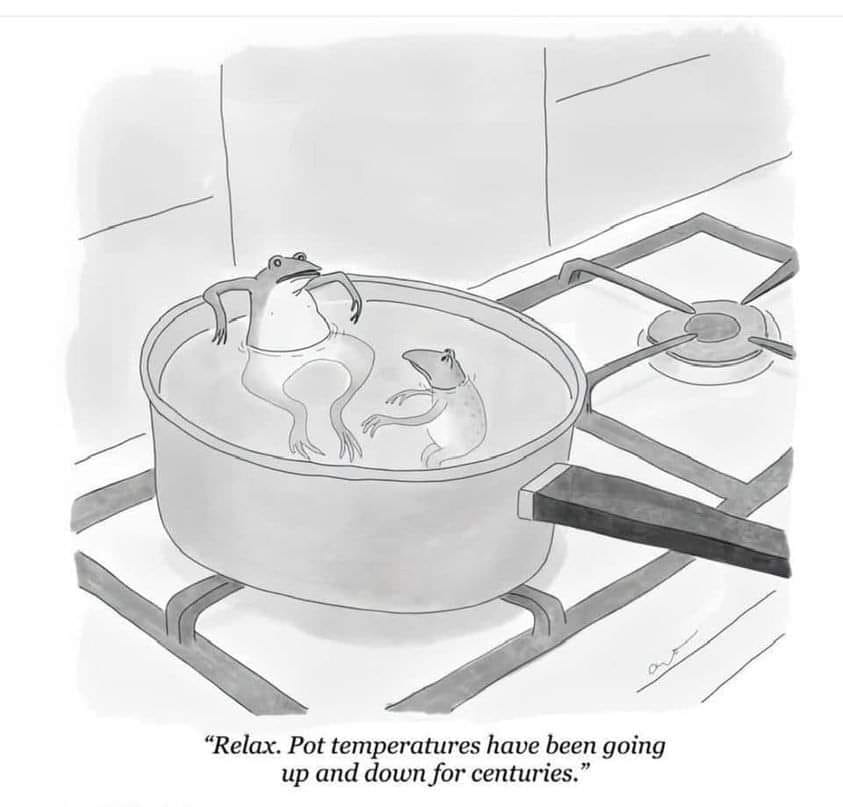
This dry humor meme depicts two frogs relaxing inside a pot of water that is heating up on a gas stove. The text "Relax. Pot temperatures have been going up and down for centuries" implies that while the water is currently hot, historical temperature fluctuations have been equally extreme. This fits the "Anti-Anti-Climate Change" category because it uses a nonsensical historical argument to dismiss the reality of dangerous, boiling water.
simple-description (llama3.2-vision_11b)
The meme is a play on the phrase "It's not easy being green" from the classic song "It's Not Easy Being Green" by Kermit the Frog. The image depicts two frogs sitting in a pot of boiling water, with a caption that reads: "It's not easy being green... or a frog in a pot of boiling water." The meme is poking fun at the idea that frogs are not easily adaptable to changing environments, and that even a simple change in temperature can be catastrophic for them.
detailed-analysis (gemma3-27b-vision)
Okay, here's an analysis of the cartoon based on the requested theoretical frameworks. It's worth noting that applying these frameworks can sometimes feel like fitting a square peg into a round hole, as cartoons are often simpler than the complexity of these theories. I'll indicate where the connection is strong and where it's more of a stretch.
Visual Description
The cartoon depicts a New Yorker-style single-panel drawing. Two frogs are relaxing in a pot of water on a gas stove burner. The burner is turned on, though the flame is not explicitly visible, and the water is clearly heated. One frog is reclining horizontally, looking relatively content. The other is sitting upright, seemingly more relaxed. The caption reads: "Relax. Pot temperatures have been going up and down for centuries." The style is characterized by simple lines and a somewhat detached, ironic aesthetic typical of The New Yorker.
Foucauldian Genealogical Discourse Analysis
This cartoon provides a strong entry point for Foucault’s concepts of power, discourse, and normalization.
- Discourse of Control: The pot of water represents a disciplinary environment – a system of control. The frogs' acceptance of their situation – their “relaxation” despite the increasing temperature – signifies normalization. They've been conditioned to accept the slow creep of danger as simply a natural, enduring state ("centuries of fluctuation"). This acceptance internalizes the power dynamic.
- Power/Knowledge: The seemingly benign statement (“pot temperatures have been going up and down for centuries”) represents a specific discourse about power. It’s a way of justifying and naturalizing the increasing threat (the heat) by framing it as historical inevitability. Those who control the temperature – those who set the conditions – also define what is “normal” and acceptable.
- Genealogy: A genealogical tracing of this "discourse of the pot" might explore how this acceptance of incremental danger becomes ingrained. Where did the idea that it’s "just the way things are" come from? The cartoon subtly suggests a long history of this acceptance, implying that resistance is difficult or even impossible because it’s been so thoroughly internalized.
Critical Theory
The cartoon is relevant to Critical Theory, particularly around the themes of ideology and false consciousness.
- Ideology: The frogs’ acceptance of their increasingly dangerous situation illustrates how ideology can operate. They’ve been conditioned to accept a reality (the heating water) as natural and unavoidable, preventing them from recognizing it as a potential threat that demands action.
- False Consciousness: The frogs seem to lack awareness of their own precarious situation, a condition that mirrors the Marxist concept of false consciousness. The frogs are unaware that they are being gradually boiled, accepting the threat as something "normal" that they cannot change. This prevents them from taking action to protect themselves.
- Habermas and Communicative Rationality: The cartoon implicitly critiques the lack of genuine communication. There's no discussion of the rising temperature, no attempt to assess the risk or find a solution. The conversation is about the history of temperature fluctuations, not the current danger.
Marxist Conflict Theory
The connection to Marxist Conflict Theory is present, but less strong.
- Power Dynamics: The cartoon could be interpreted as representing a power imbalance. The "cook" (unseen) holds the power over the frogs’ fate. The frogs are subject to this power without agency.
- Class (loosely): One could extend the metaphor to see the frogs as a metaphor for a working class, passively accepting deteriorating conditions (the heat) while the “cook” (the ruling class) controls the means of their destruction. However, this is a rather stretched interpretation.
- Alienation: The frogs' apathy and passive acceptance of their fate could be seen as a form of alienation, where they are disconnected from their own agency and their ability to alter their circumstances.
Postmodernism
The cartoon exhibits elements relevant to Postmodern thought, particularly around the idea of simulation and the destabilization of meaning.
- Simulation/Hyperreality: The frog’s nonchalant attitude in a dangerous situation can be interpreted as a reflection of a world saturated with simulation. The danger is real, but the frogs seem to be living in a detached, ironic state where even the obvious is questioned.
- The Death of Grand Narratives: The "centuries of fluctuation" could be seen as a rejection of the idea that history has a linear trajectory or a purposeful direction. It's a statement that things simply are, without meaning or progress.
- Ironic Detachment: The cartoon’s humor relies on a certain ironic distance. It points to a contradiction – the frogs' complacency in the face of danger – but does so without offering any clear solution or moral judgment. This is characteristic of postmodern irony.
Queer Feminist Intersectional Analysis
This is where the connection is weakest, and relies on significant interpretive stretching. However, with some effort:
- Normalization of Precarity: One could argue that the frogs’ acceptance of their gradually worsening situation mirrors the ways in which marginalized groups are often socialized to accept precariousness and danger as normal.
- Internalized Oppression: The frogs’ passivity can be seen as a metaphor for internalized oppression, where individuals come to believe that their suffering is inevitable or deserved.
- The Limits of "Relaxation": The cartoon could be read as critiquing the demand that marginalized groups “relax” or “not overreact” in the face of systemic oppression. The frogs’ “relaxation” is not a sign of strength, but a symptom of their powerlessness. However, this is a tenuous connection and relies on a very specific reading.
Let me know if you'd like me to elaborate on any of these analyses, or if you'd like me to approach the cartoon from a different theoretical perspective.
simple-description (llama3.2-vision)
The meme is a cartoon illustration of two frogs sitting in a pot on a stovetop. The text at the bottom of the image reads: "Relax. Pot temperatures have been going up and down for centuries." The image is a humorous take on the common phrase "the pot has been boiling" and the idea that frogs are often associated with being in a "hot" situation.
tesseract-ocr
< A AX gm _ be A e > 3 —. gg U] s “Relax. Pot temperatures have been going up and down for centuries.”