First Seen
2023-05-10T21:03:32+00:00
simple-description (llama3.2-vision_11b)
This meme is a commentary on the perceived hypocrisy of anti-communist groups, specifically the online community. The image shows a quote from Marx's Das Kapital, "The proletarians have nothing to lose, and the world to gain," juxtaposed with a screenshot of a Reddit thread discussing the "proletariat" and "world to gain" in a way that is ironic or satirical. The meme is poking fun at the idea that some people claim to be anti-communist, but their actions and words are actually pro-communist.
detailed-analysis (gemma3-27b-vision)
Okay, let's break down this meme with the requested theoretical frameworks. This is quite a layered image (literally!), so we'll see how each lens can illuminate its meaning.
Visual Description
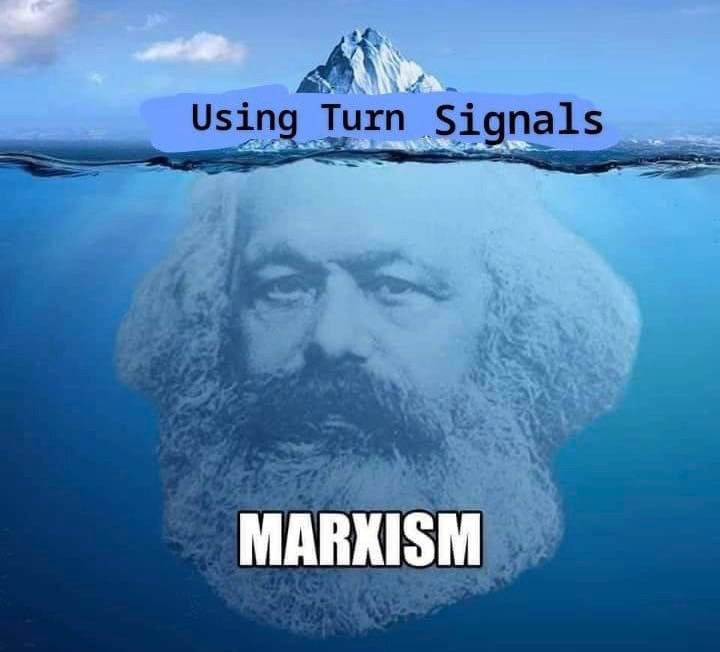
The image depicts an iceberg, the vast majority of which is submerged underwater. Above the surface, a small sliver is labeled "Using Turn Signals." Beneath the water, the iceberg takes the shape of Karl Marx’s face, with the text “Marxism” boldly displayed at the bottom. The lighting and color palette primarily consist of shades of blue, evoking a sense of depth and immensity. The contrast between the visible, ostensibly "polite" act of using turn signals and the massive, foundational presence of Marxism beneath the surface suggests a disconnect or hidden connection.
Marxist Conflict Theory
This meme is deeply rooted in Marxist conflict theory. The iceberg metaphor is central to understanding the power dynamics at play.
- Base and Superstructure: The submerged Marx and the label "Marxism" represent the base—the underlying economic and societal structures that shape everything else. "Using Turn Signals" represents a superficial aspect of the superstructure (social norms, laws, culture). It's a seemingly innocuous act that masks the deeper, often invisible, forces that truly govern society.
- Ideology & False Consciousness: The meme suggests that "using turn signals" (politeness, adherence to traffic laws) is presented as a neutral or positive behavior, masking the inherent class struggles and exploitative systems that Marxism analyzes. The iceberg implies that this politeness is just the tip of a vast system of power and control. It promotes the idea that mainstream understandings of social order are often ideologically constructed to obscure real conflicts and inequalities.
- Class Struggle: The meme subtly hints that even seemingly simple social conventions are intertwined with deeper struggles for power. By juxtaposing the banal act of signaling with the weighty figure of Marx, it suggests that underlying these everyday actions are the tensions and contradictions of class conflict.
Foucauldian Genealogical Discourse Analysis
From a Foucauldian perspective, the image illustrates how power operates through discourse and normalization.
- Power/Knowledge: The meme presents "using turn signals" as a normalized behavior, constructed through discourses of safety, politeness, and social order. Foucault would argue that this "politeness" is not inherently good but a product of power relations. The act itself is not neutral; it reinforces certain norms and disciplines.
- Discipline and Surveillance: Traffic laws and their enforcement (like signaling) are mechanisms of discipline and surveillance. They categorize individuals, regulate their behavior, and create a system of visibility and accountability.
- Genealogy: A genealogical analysis would trace the historical development of traffic laws and the discourse surrounding them. It would reveal how these norms emerged, were contested, and were tied to broader social and political agendas (control, order, efficiency). The iceberg image then suggests that those seemingly benign modern rules came from much deeper historical and societal roots.
Critical Theory
The meme aligns with many principles of the Frankfurt School’s Critical Theory:
- Critique of Culture Industry: The “using turn signals” act can be seen as a trivial element of the "culture industry" – the mass production of cultural products that reinforce dominant ideologies. It's a spectacle that distracts from more significant societal issues.
- Domination and Emancipation: Critical theorists aim to expose forms of domination and work toward emancipation. The meme suggests that even seemingly innocuous behaviors are tied to systems of power, and understanding those connections is a step toward liberation.
- Rationality and Instrumental Reason: The emphasis on order (signaling) could be seen as a manifestation of “instrumental reason,” where rationality is used to achieve specific goals (efficient traffic flow) without questioning the underlying values or consequences.
Postmodernism
A postmodern reading of the meme could focus on deconstruction and the questioning of grand narratives.
- Deconstructing "Politeness": Postmodernism would challenge the notion that "politeness" is a neutral or universally positive concept. It would examine how the meaning of politeness is constructed, contested, and varies across cultures and contexts.
- Rejection of Meta-narratives: Postmodernism generally rejects grand narratives (like Marxism, but also liberalism or religion). However, this meme uses Marxism as a vehicle to critique seemingly benign social norms, suggesting that even those norms are undergirded by a system that Marxism seeks to understand.
- Simulation & Hyperreality: One could argue that the presentation of "politeness" as a virtue is a simulation, masking the underlying power dynamics.
Queer Feminist Intersectional Analysis
While the meme doesn’t explicitly address gender or sexuality, an intersectional reading can still be applied:
- Normalization & Conformity: The emphasis on conforming to traffic rules (signaling) can be seen as a demand for conformity that disproportionately affects marginalized groups. Those who deviate from norms (e.g., cyclists, pedestrians, individuals with disabilities) may face increased scrutiny, harassment, or violence.
- Power Dynamics & Control: The structure of traffic laws and enforcement often reflects and reinforces existing power imbalances. For example, traffic stops can be racialized and gendered, leading to discriminatory outcomes.
- Hidden Structures of Oppression: Just as Marxism analyzes class structures, an intersectional analysis would explore how traffic systems contribute to broader patterns of oppression, such as limiting access to mobility for low-income communities or creating unsafe environments for women and LGBTQ+ individuals.
Let me know if you’d like me to delve into any of these perspectives in more detail!
simple-description (llama3.2-vision)
This meme is a play on the concept of the " iceberg" metaphor, where the majority of something is hidden beneath the surface. The image depicts a cartoon of Karl Marx, a famous philosopher and economist, with his head submerged underwater. The text "Marxism" is written above the waterline, while "Marxism" is written below the waterline, with the phrase "Using Turn Signals" written above the waterline, implying that Marx's true ideology is actually about using turn signals, rather than his philosophical ideas.
tesseract-ocr
At — Using Turn Signals — - - —_ = ae = on a es ye ‘ke — : 7 He AS, 4 ‘i WY US li