First Seen
2024-03-17T04:25:52.995663+00:00
simple-description (qwen3.5_2b-q8_0)
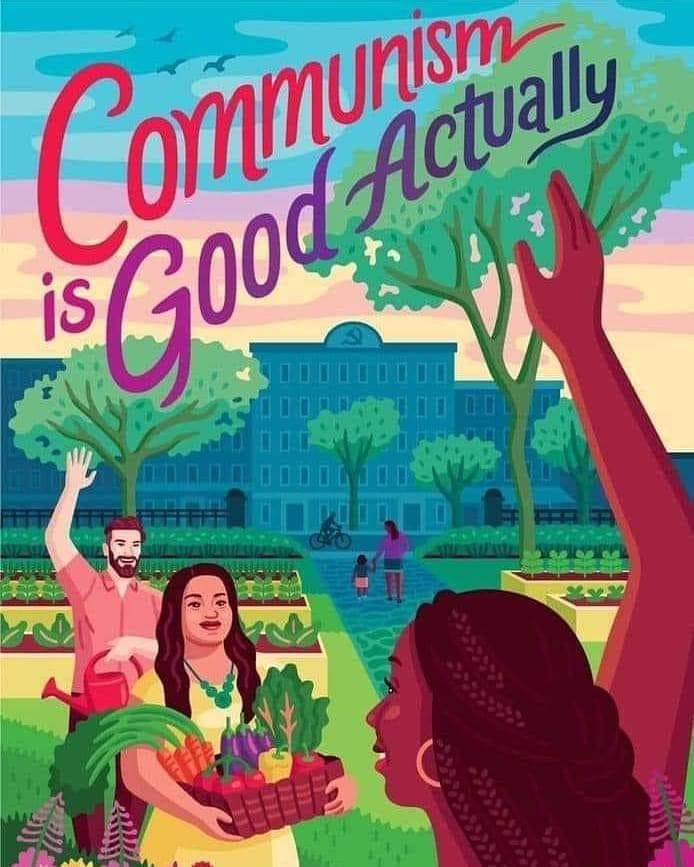
Based on the visual content, this is an illustration for the phrase "Communism is Good Actually."
The text appears at the top in colorful, playful fonts. Below the text, a man and a woman are depicted harvesting fresh vegetables, such as carrots and peppers, from a garden. They are set against a sunny, green background featuring trees and a large, blue building (resembling a government or institutional building) in the distance. Another person's arm is raised high on the right side of the image.
The joke is a play on the phrase "Anti-Communism" by stating that Communism is "Good Actually," suggesting it is benevolent and helpful rather than destructive.
simple-description (llama3.2-vision_11b)
The meme is a play on the classic "anti-communist" propaganda image, but with a twist. It features a person holding a basket of vegetables and a sign that says "Communism is Good". The text is overlaid on a background of a cityscape with a red star, symbolizing communism. The meme is poking fun at the idea that communism is good, which is a satirical take on the typical anti-communist propaganda that often portrays communism as evil.
detailed-analysis (gemma3-27b-vision)
Okay, let's analyze the image based on your requested frameworks.
Visual Description
The image is a vibrant, digitally-illustrated poster with a strong ideological message: “Communism is Actually Good.” The artwork presents a utopian vision of a communal garden or agricultural space.
- Composition: The scene is set outdoors, with a large, detailed garden in the foreground and a classical-style building (possibly a university or governmental building) in the background. A raised, large hand reaching toward the sky dominates the right side. The composition uses a "low angle" perspective with the hand coming towards the viewer.
- Characters: Visible within the garden are diverse individuals engaged in agricultural activities—gardening, harvesting, and cycling. The individuals are stylized with strong, graphic forms. The individuals have different skin tones and hair textures.
- Color Palette: The palette is rich and saturated, employing bright greens, reds, oranges, blues and yellows. The overall effect is cheerful and optimistic.
- Style: The artwork blends aspects of illustration and graphic design. The simplified forms and bold colors evoke poster art traditions, while the detailed depiction of the garden suggests a sense of realism.
- Text: The prominent text "Communism is Actually Good" is in a flowing, handwritten-style font, in a bold red color. This font suggests passion and perhaps a direct personal expression.
Marxist Conflict Theory
This image is deeply rooted in Marxist ideas, specifically as a visual argument against the dominant narratives surrounding communism.
- Class Struggle Implied: While not explicitly depicted, the image implies a move away from capitalist structures. A communal garden fundamentally challenges the private ownership of land and resources – a central tenet of Marxist critique. It suggests collective labor and the equitable distribution of the fruits of that labor. The garden stands in contrast to, and perhaps as a replacement for, industrialized agricultural systems.
- Ideology and False Consciousness: The poster actively combats the "false consciousness" propagated by capitalist ideology. For decades, communism has been largely demonized in Western discourse. The image attempts to reclaim the term and present an alternative, positive vision. It’s a direct counter-narrative to the association of communism with authoritarianism or economic failure.
- Utopian Vision: The image embodies a utopian aspiration, a vision of a classless society where people work together harmoniously to meet their needs. While utopian visions are often criticized as unrealistic, they serve as a powerful motivating force for social change.
- Labor and Production: The image centers on productive labor – gardening and harvesting. In Marxist terms, this is a positive emphasis, highlighting the dignity of work and the creation of value through collective effort.
Foucauldian Genealogical Discourse Analysis
Foucault's genealogical approach would focus on the historical construction of the idea of "communism" as a negative concept.
- Power/Knowledge: The image is a direct challenge to the established “power/knowledge” relationship surrounding communism. For decades, the discourse around communism has been dominated by specific narratives originating from political and economic elites. The poster attempts to destabilize that discourse by offering an alternative representation.
- Discursive Formation: The image seeks to re-form the discourse around communism. It doesn't attempt to define communism in a traditional, abstract way. Instead, it shows what a "good" communism could look like – a communal, sustainable, and equitable society.
- Archaeology of Ideas: A Foucauldian analysis would trace the historical evolution of the concept of "communism," examining how it has been defined, used, and contested over time. The image can be understood as an attempt to "excavate" the positive potential that has been obscured by negative framing.
- Contingency of Meaning: Foucault would argue that the meaning of "communism" is not fixed or essential. It is contingent on historical, social, and political factors. The image demonstrates that there are multiple ways to imagine and represent communism.
Critical Theory
From a Critical Theory perspective, the image can be seen as an attempt to challenge dominant societal norms and power structures.
- Emancipation: The image’s utopian vision is ultimately about emancipation – freeing people from oppressive social, economic, and political conditions. The communal garden symbolizes a move towards a more just and equitable society.
- Ideology Critique: The image critiques the pervasive ideology of individualism and consumerism that characterizes many modern societies. The communal garden emphasizes collective action, cooperation, and sustainability.
- Reification: Critical Theory would point out how capitalist systems often reify social relations, treating them as fixed and natural when they are actually constructed. The image attempts to de-reify these relations by presenting an alternative model based on cooperation and shared resources.
- Social Transformation: The image is not merely a descriptive representation of a “good” communism. It is a call to action, an invitation to imagine and build a more just and sustainable society.
Postmodernism
A Postmodern analysis would focus on the image's self-awareness and deconstruction of grand narratives.
- Deconstruction of "Communism": The image doesn't offer a definitive definition of communism. Instead, it presents a visual representation, a subjective interpretation. This aligns with the postmodern emphasis on challenging fixed meanings and embracing ambiguity.
- Rejection of Metanarratives: Postmodernism is skeptical of grand, universalizing narratives (like the traditional Marxist vision of historical progress). The image doesn't necessarily claim that communism is the only path to a better future. It simply offers it as one possibility.
- Emphasis on Representation: Postmodernism highlights the role of representation in shaping our understanding of reality. The image is not "truth" about communism, but a representation of a particular vision.
- Subjectivity and Interpretation: Postmodernism emphasizes the role of the viewer in interpreting meaning. The image invites the viewer to engage with its message and form their own conclusions.
Queer Feminist Intersectional Analysis
While the image does not explicitly depict queer or feminist themes, a queer feminist intersectional analysis can be applied:
- Challenging Hierarchies: Communal living and shared resources inherently challenge hierarchical structures—including those based on gender, sexuality, race, and class.
- Collective Care & Mutual Aid: The garden symbolizes collective care, cooperation, and mutual aid – values central to queer and feminist movements.
- Intersectional Potential: The diversity of figures within the image implies an intersectional approach. A truly "good" communism would need to actively address the intersecting forms of oppression faced by marginalized communities.
- Decentering the Individual: A move away from individual property and towards communal ownership aligns with feminist critiques of patriarchal individualism.
Let me know if you would like me to expand on any of these analyses or focus on a specific theoretical framework in more detail.
simple-description (llama3.2-vision)
This meme is a humorous take on the idea that communism is a utopian ideal that is often misunderstood. The image shows a idyllic scene of people living in harmony, with the text "Communism is good" written above it, but the punchline is that it's actually "Communism is good... actually" with a wink, implying that the ideal is not actually good, but rather a tongue-in-cheek acknowledgment of the irony that the concept of communism is often misunderstood.
tesseract-ocr
nisi Con act S(qreeN , a, } i th