First Seen
2023-05-10T21:03:32+00:00
simple-description (llama3.2-vision_11b)
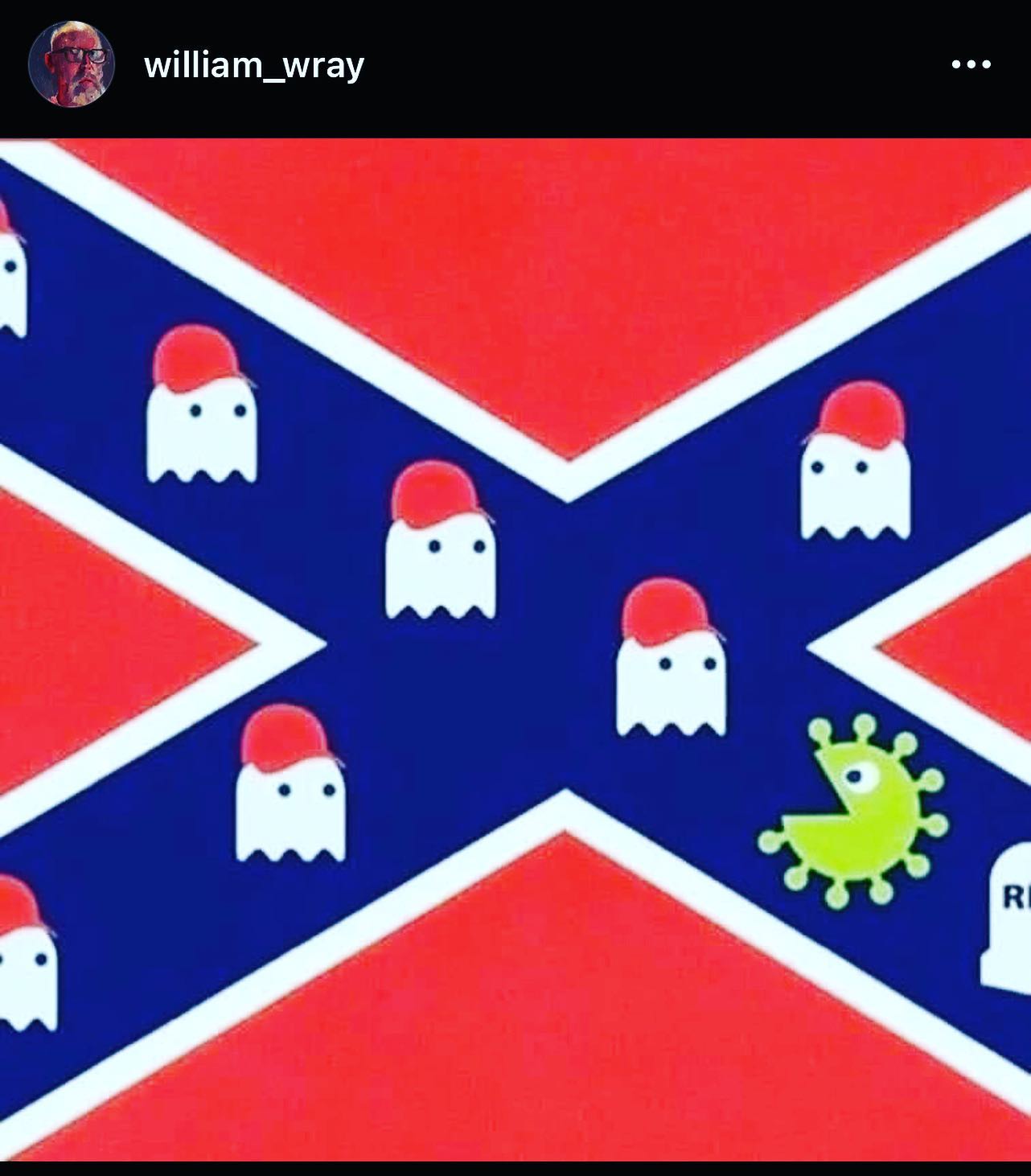
The meme features a modified Confederate flag, a symbol of the American Civil War, with a twist: it's filled with cartoon ghosts wearing coronavirus masks, and a COVID-19 virus itself is shown. The image likely implies that the virus is an enemy of the traditional Southern culture and that the ghosts are fighting it. The text "Anti-Anti-Coronavirus" is likely a joke, implying that the person is anti-anti-coronavirus, which is a contradictory statement.
detailed-analysis (gemma3-27b-vision)
Here's an analysis of the image, broken down into the requested theoretical frameworks, only including those that are relevant and providing nuanced interpretations where appropriate.
Visual Description
The image is a digital rendition of the Confederate Battle Flag, but modified with playful, digitally added elements. Instead of stars, the blue diagonal crosses contain stylized cartoon ghosts from the video game Pac-Man, each wearing a red hat. A bright green cartoon depiction of a coronavirus molecule appears near the right edge of the flag, adjacent to a blurred out item. The username "william_wray" is visible at the top left. The color scheme is consistent with the original Confederate flag: dark blue, red, and white. The combination of these elements introduces a layer of visual dissonance.
Foucauldian Genealogical Discourse Analysis
This image immediately lends itself to a Foucauldian analysis. The Confederate flag is not an inherent symbol of rebellion or heritage, but a discourse constructed through historical power dynamics. Tracing the "genealogy" of this symbol (its historical development) reveals a shift in meaning. Originally intended to represent the Confederacy, it became a symbol of resistance to Reconstruction, then a symbol of white supremacy and racial segregation during the Jim Crow era, and in contemporary times a symbol of states' rights, Southern identity, or increasingly, often a subtle or overt endorsement of racist ideologies.
The image disrupts this genealogy by adding the Pac-Man ghosts and the Coronavirus. It's a "playful" distortion that doesn’t negate the original meanings of the flag, but layers new, seemingly incongruous meanings onto it. The ghosts, themselves iconic symbols of consumption and pursuit, can be read as representing those "haunted" by the legacy of the Confederacy, or as a metaphor for a past that continues to "consume" the present. The Coronavirus symbol might represent a present-day crisis that the image’s creator associates with the flag and its historical context – perhaps a perceived link between ideologies of resistance to authority and refusal to mitigate the health crisis.
Importantly, the image recirculates the discourse of the flag, even while attempting to alter it. It forces a re-evaluation of its meaning, but it also gives the symbol continued visibility and, by “playing” with it, may normalize it. This is consistent with Foucault's view that power operates through discourse—it isn't simply repressive but productive.
Critical Theory
This image is ripe for analysis through a Critical Theory lens, particularly focusing on the concept of ideology. The Confederate flag, historically and presently, is deeply intertwined with the maintenance of power structures based on racial hierarchy. The flag isn’t merely a representation of a historical event; it functions ideologically to reinforce white supremacist narratives, even when presented as innocuous “Southern heritage.”
The addition of the Pac-Man ghosts and the Coronavirus disrupts this ideological function. The playful nature of the additions attempts to dismantle the flag's inherent seriousness and potentially render it less threatening or intimidating. This could be interpreted as a deliberate attempt to “de-ideologize” the symbol, to strip it of its power to enforce racial domination. However, this disruption could also be seen as a co-option of resistance aesthetics. In other words, the image's playful distortion doesn't necessarily negate the flag’s underlying ideological power—it may instead mask it or repackage it in a way that makes it more palatable to a wider audience.
Marxist Conflict Theory
From a Marxist perspective, the Confederate flag is a symbol of a defeated ruling class—the Southern plantation owners—and the social order they sought to maintain: slavery and a rigidly hierarchical society. The flag represents a historical conflict between the bourgeoisie (Southern landowners) and the proletariat (enslaved African Americans), as well as the ensuing class and racial conflicts of the Reconstruction and Jim Crow eras.
The image subverts this historical context by introducing elements that are seemingly unconnected to class struggle—Pac-Man ghosts and the Coronavirus. However, this disruption could be seen as a reflection of the fragmentation and displacement of class consciousness in contemporary society. The introduction of playful elements might distract from the underlying economic and political forces that shaped the history of the Confederacy, effectively obscuring the flag’s connection to exploitation and oppression. This could be a deliberate attempt to neutralize the flag’s historical association with class conflict, or a manifestation of the broader tendency of consumer culture to commodify and depoliticize symbols of resistance.
Postmodernism
This image embodies several key tenets of postmodernism. The deliberate mixing of symbols (Confederate flag, Pac-Man, Coronavirus) exemplifies the postmodern rejection of grand narratives and fixed meanings. The flag, traditionally a symbol with a specific (and contested) historical context, is deconstructed and recontextualized in a playful and ironic manner.
The image also embraces the postmodern emphasis on simulation and hyperreality. The flag is no longer presented as a straightforward representation of history, but as a simulated representation of a representation—a digital image that distorts and reconfigures the original symbol. This creates a sense of ambiguity and uncertainty, challenging viewers to question the authenticity and authority of any given representation.
Finally, the image is imbued with irony and self-reflexivity. It acknowledges the problematic history of the flag, but simultaneously attempts to dismantle its power through playful distortion. This playful approach suggests a skepticism towards traditional modes of political expression, and a preference for more ambiguous and ironic forms of communication.
Note: Analyzing an image like this is open to multiple interpretations. The meaning depends on the intent of the artist/poster, the context in which it's shared, and the individual perspectives of the viewer. These analyses are intended to provide a nuanced understanding of the image through various theoretical lenses.
simple-description (llama3.2-vision)
The meme is a humorous image that combines elements of the Confederate flag with popular culture. The image features the Confederate flag's design, but with the stars and bars replaced with Pac-Man characters, and the flag's center is a ghost wearing a red hat. The text "I can explain" appears above the image.
tesseract-ocr
~~ a WE Tea mie) A oo