First Seen
2023-10-03T08:51:35+00:00
simple-description (qwen3.5_2b-q8_0)
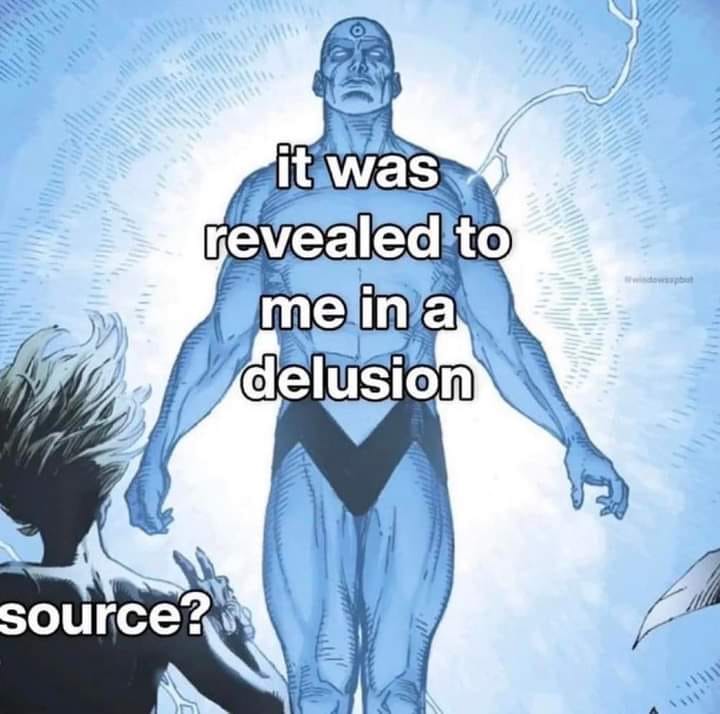
This meme features the glowing superhero Doctor Midnite, accompanied by text that denies the reality of the image. The caption reads "it was / revealed to me in a / delusion" followed by "source?", implying that the glowing figure was merely a hallucination or trick of the light, and the final question suggests the truth remains unknown or that the appearance was entirely fake.
simple-description (llama3.2-vision_11b)
The meme features a panel from the comic book series "Watchmen" where Rorschach, a character known for his extreme anti-authoritarian views, is shown with a caption "It's not a lie if you believe it". The meme is an example of anti-anti-intellectualism, which refers to the rejection of the rejection of intellectualism and critical thinking. In this case, the meme pokes fun at the idea that some people will believe anything as long as it's said with conviction.
detailed-analysis (gemma3-27b-vision)
Okay, let's break down this image, a popular meme format, through the lenses you've provided. It's important to note that the image is heavily layered with internet culture and relies on pre-existing understanding of the source material (often a comic book panel featuring the character Blue Beetle). I'll try to be thorough, but some sections will be more applicable than others.
Visual Description
The image features a digitally manipulated comic book panel. The central figure is a muscular, blue-skinned character, clearly inspired by the DC Comics character Blue Beetle. He's depicted in a dramatic, heroic pose – standing upright with arms slightly outstretched. The lighting creates a sense of divinity or power. The background is a washed-out, bright white with some blurry lines suggesting a divine or otherworldly setting.
Overlaid on the image is text in a basic, white font. The words "it was revealed to me in a delusion" are prominently displayed, and the word "source?" appears at the bottom left. The image is stylized with a "meme" aesthetic, suggesting it’s meant for ironic or humorous circulation online. The quality of the image is somewhat degraded, typical of meme formats.
Foucauldian Genealogical Discourse Analysis
This image lends itself well to a Foucauldian analysis. The phrase "it was revealed to me in a delusion" establishes a discourse of revelation and knowledge formation, but crucially, it decenters the authority of that revelation. Traditionally, "revelations" are associated with divine or legitimate sources of power. By explicitly identifying the source as a “delusion,” the image disrupts that authority.
A genealogical approach would trace the history of this particular discourse. How has the idea of "revelation" been constructed and utilized throughout history? (e.g., religious institutions, political ideologies, even advertising). What power structures have relied on the validation of “revelations”? The image undermines these structures by suggesting that such "revelations" are not necessarily anchored in any objective truth, but can emerge from subjective, potentially unstable, inner experience.
The use of the comic book character is also important. Comic book universes often construct elaborate mythologies and origin stories. The meme format highlights the constructedness of these narratives, questioning the authority of the "source" (the comic book, the creators, the mythos itself). It implies that even "established" narratives are ultimately forms of delusion or constructed meaning.
Critical Theory
From a Critical Theory perspective, this image can be interpreted as a critique of power and knowledge. The phrase "it was revealed to me in a delusion" challenges the notion of objective truth. It suggests that what is presented as knowledge is often simply a subjective interpretation or a construction of power.
The image subverts the traditional relationship between the “seer” and the “revealed” truth. Normally, the seer is seen as the conduit of a higher power, delivering authoritative knowledge. Here, the seer admits the source of their knowledge is unstable (a delusion). This destabilizes the authority of the message and forces the viewer to question the foundations of any claimed knowledge.
The use of a superhero figure, traditionally associated with upholding a certain moral order, is also interesting. The image hints that even those presented as paragons of truth and justice may be operating on the basis of subjective, unstable beliefs.
Marxist Conflict Theory
While not immediately obvious, a Marxist lens can be applied, although it requires some reaching. The idea of a “revelation” can be seen as a form of ideology. Ideology, in Marxist terms, is a set of beliefs that serve to legitimize and maintain existing power structures.
The image challenges this. It suggests that these “revelations” are not necessarily grounded in material reality, but are constructed (delusional). This potentially undermines the legitimacy of any ideology built upon such foundations.
You could argue the "source" being questioned is the capitalist structure that feeds on the production of heroes and myths, and the meme's self-awareness reveals the inherent artifice.
Postmodernism
This image is deeply rooted in postmodern sensibility. The core tenets of postmodernism—skepticism toward grand narratives, rejection of objective truth, emphasis on subjectivity and fragmentation—are all present.
The phrase "it was revealed to me in a delusion" is a quintessential postmodern statement. It rejects the idea of a singular, authoritative truth and embraces the ambiguity and instability of subjective experience.
The meme format itself is a postmodern gesture. It’s self-referential, ironic, and relies on a shared understanding of internet culture. It dismantles the traditional notion of authorship and originality by appropriating and remixing existing cultural materials. The image acknowledges its own constructedness, highlighting the illusory nature of meaning.
Queer Feminist Intersectional Analysis
This is where it gets more nuanced. On the surface, the image doesn’t explicitly address issues of gender, sexuality, or race. However, a Queer Feminist Intersectional approach can explore the subversion of dominant narratives and the challenge to established power structures that it embodies.
The destabilization of truth claims through the acknowledgment of a "delusion" can be seen as a metaphorical rejection of dominant (often patriarchal and heteronormative) ideologies that seek to control and define reality. Acknowledging the “delusional” nature of any seemingly authoritative "source" can be read as an act of resistance against oppressive systems of knowledge.
The meme format’s inherent playfulness and irony can be seen as a strategy for reclaiming agency and challenging the seriousness of dominant narratives. This can be particularly resonant for marginalized groups who have historically been denied agency and whose experiences have been silenced or distorted.
In this context, the “source” could be viewed as the source of societal norms that dictate acceptable ways of being, and the acknowledgment of delusion allows for the imagination of alternative ways of understanding the world.
Disclaimer: This analysis is based on interpretation, and there are multiple valid readings of the image. The application of these theoretical frameworks can be complex and nuanced.
simple-description (llama3.2-vision)
This meme is a play on the phrase "it was revealed to me in a delusion" and is a reference to a popular internet meme. The image depicts a character from the Marvel Comics universe, Doctor Strange, and the text "it was revealed to me in a delusion" is overlaid on his face. The meme is a humorous take on the idea that sometimes we can't trust our own perceptions.
tesseract-ocr
RS LOD fy (Biwes a) revealed'to jy, 4 JO TAVERS Ky. (eersten = \ YS ‘ . i | I “y ToS li \ EES ee —