First Seen
2024-11-10T23:38:08.449565+00:00
simple-description (qwen3.5_2b-q8_0)
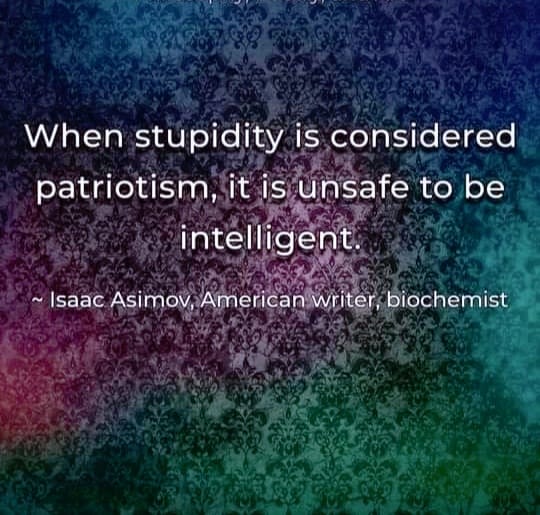
This meme falls under the "Anti-Anti-Intellectualism" category by arguing that intelligence is a dangerous trait when the alternative is seen as patriotic. The text states: "When stupidity is considered patriotism, it is unsafe to be intelligent." It mocks the historical term "the informant," suggesting that supporting an ignorant regime is a virtue, and that therefore, the act of being an "informed" citizen is considered unsafe.
detailed-analysis (gemma3_27b-it-q8_0)
Okay, let's analyze this meme through the lens of "Anti-Anti-Intellectualism," employing the requested theoretical frameworks where applicable.
Meme Description:
The image is a text-based meme featuring a quote by Isaac Asimov: “When stupidity is considered patriotism, it is unsafe to be intelligent.” The quote is white text on a darkly colored background with an ornate, almost baroque, floral pattern. Underneath the quote is the attribution "Isaac Asimov, American writer, biochemist."
Overall Context & Anti-Anti-Intellectualism:
This meme is squarely within the "Anti-Anti-Intellectualism" category. It directly critiques a trend where rejecting knowledge, critical thinking, and expertise is valorized – often under the guise of national loyalty ("patriotism"). The core of anti-anti-intellectualism is the defense of reason, evidence-based inquiry, and the value of education in the face of rising hostility towards these things. The meme's power lies in the stark and provocative statement suggesting that prioritizing ignorance can create a dangerous environment, potentially suppressing critical thought.
Foucauldian Genealogical Discourse Analysis:
This framework is highly relevant. Michel Foucault's work emphasizes how power operates through discourse – the systems of thought, language, and practices that shape our understanding of the world.
- Genealogy of Patriotism: Foucault would ask us to trace the historical development of "patriotism" to see how it’s come to be linked to certain behaviors and values. The meme points to a specific, troubling shift: patriotism defined by and rewarding anti-intellectualism. This is not inherent to the idea of patriotism, but a historically contingent construction.
- Power/Knowledge: Foucault's concept of power/knowledge is crucial. The meme highlights how a new form of power is created by equating ignorance with virtue. Those who embrace "stupidity as patriotism" gain a certain social and political power (e.g., being seen as "true Americans"), while those who rely on intelligence are potentially marginalized and rendered vulnerable (“unsafe”).
- Disciplinary Power: The meme suggests a form of disciplinary power, where adhering to a certain level of “patriotic” ignorance is enforced through social pressure and potential ostracization. It's a chilling thought: intelligence itself becomes a risk, implying a desire to regulate not just actions but thought itself.
Critical Theory:
Critical Theory, particularly in the Frankfurt School tradition, examines how power structures maintain themselves through the manipulation of culture and ideology.
- The Culture Industry: The meme resonates with the Frankfurt School's critique of the "culture industry." If a culture can be molded to prioritize emotion over reason, or to demonize expertise, it becomes more susceptible to manipulation by those in power. This prioritisation of emotion and devaluing of evidence can foster conformity and stifle dissent.
- Instrumental Reason: Critical Theorists like Max Horkheimer and Theodor Adorno worried about the rise of “instrumental reason” – reason employed solely to achieve a specific goal, without ethical considerations. Here, "patriotism" becomes the goal, and intelligence is discarded if it doesn't serve that aim.
- False Consciousness: The meme hints at the possibility of “false consciousness.” People who believe that ignorance is patriotic might be unwittingly serving the interests of those in power, and failing to recognize their own subjugation.
Marxist Conflict Theory:
While not the primary lens, Marxist Conflict Theory can provide a supporting framework.
- Ideology and the Ruling Class: A Marxist perspective would suggest that the idea of "stupidity as patriotism" might be an ideology deliberately promoted by a ruling class seeking to maintain control. An uncritical populace is easier to govern.
- Hegemony: Antonio Gramsci's concept of hegemony is relevant. The ruling class doesn't just use force to maintain power; it also seeks to establish cultural dominance – to make its worldview seem "natural" and common sense. The meme suggests that a form of hegemony is at play, where ignorance is becoming normalized and even celebrated.
- Class Division: This meme is also applicable to class divisions, where an intelligent person could be seen as "out of touch" or elitist, further reinforcing the narrative of valuing ignorance.
Postmodernism:
Postmodernism challenges grand narratives and emphasizes the subjective nature of truth.
- Deconstruction of Patriotism: A postmodernist approach would deconstruct the concept of "patriotism" itself, exposing its internal contradictions and questioning its inherent value. The meme does this implicitly by demonstrating how patriotism can be twisted to serve destructive ends.
- Rejection of Universal Truth: Postmodernism challenges the idea of objective truth. This isn't to say that all truths are equal, but that we must be aware of the power dynamics that shape what we consider to be "true." The meme implies that the assertion that "stupidity is patriotism" is not a self-evident truth, but a constructed belief.
- Meta-Narrative Critique: This meme is a critique of the meta-narrative of "national unity," suggesting that such unity can be based on harmful premises.
Queer Feminist Intersectional Analysis:
This application requires some nuance. While the meme doesn't explicitly address issues of gender, sexuality, or intersectionality, we can still make connections:
- Marginalized Voices: Historically, those who challenge dominant narratives (including women, people of color, and LGBTQ+ individuals) are often labeled as "unpatriotic" or "outsiders." The meme points to a broader pattern of silencing dissenting voices.
- Interlocking Systems of Oppression: The meme could be applied to understand how intelligence is devalued in specific communities because of factors like race or socioeconomic status. A system that privileges ignorance is likely to exacerbate existing inequalities.
- Epistemic Injustice: Miranda Fricker’s work on epistemic injustice is relevant. This refers to the ways in which marginalized individuals are unfairly discredited as knowledge-bearers. The meme suggests that valuing ignorance creates an environment where those who possess knowledge are less likely to be believed or taken seriously, particularly if they are already marginalized.
In conclusion:
This meme is a powerful statement that resonates deeply with the "Anti-Anti-Intellectualism" category. It can be analyzed through a variety of theoretical frameworks—Foucauldian discourse analysis, Critical Theory, Marxist Conflict Theory, and Postmodernism—to reveal the complex power dynamics at play when ignorance is celebrated as a virtue. It's a warning against the dangers of prioritizing ideology over reason, and a call for the defense of critical thinking.
simple-description (llama3.2-vision_11b)
This meme is a satirical commentary on the anti-intellectualism that often comes with a "patriotism" that is overly focused on national pride and ignores the importance of critical thinking and intellectual discourse. The meme uses a quote from science fiction author Isaac Asimov to highlight the absurdity of prioritizing patriotism over intellectualism. The image is likely a photo of a person with a patriotic symbol or a patriotic-themed background, with the quote overlaid in a bold, modern font.
detailed-analysis (gemma3-27b-vision)
Here's an analysis of the image, broken down by the requested theoretical frameworks. Note that some frameworks will be more applicable than others, and I will state if a section isn’t directly relevant.
Visual Description
The image presents a quote by Isaac Asimov, an American writer and biochemist, overlaid on a textured, colorful background. The quote reads: "When stupidity is considered patriotism, it is unsafe to be intelligent." The background is a swirling blend of purples, blues, and greens, creating an almost paisley-like, ornate pattern. The text is white and appears to be a sans-serif font, centrally aligned. The quote is clearly the focal point, while the background serves as a decorative, if slightly busy, element. The contrast between the text and background is sufficient to ensure readability.
Foucauldian Genealogical Discourse Analysis
This quote is fertile ground for a Foucauldian analysis. It speaks directly to the construction of "patriotism" as a discourse – a system of thought, language, and practice that creates truth and power relations.
- Power/Knowledge: Asimov's statement demonstrates how power operates through knowledge (or the suppression of it). When 'stupidity' is equated to 'patriotism,' it's not merely a change in belief. It’s a power move to discredit reason, critical thinking, and expertise. Those who challenge this equation (the 'intelligent') are then positioned as outsiders and potentially threats.
- Discursive Formation: The equation of stupidity and patriotism is a discursive formation – a set of rules and practices that determine what can be said, thought, and done in relation to the concept of patriotism. It establishes boundaries for acceptable discourse and marginalizes alternative perspectives.
- Genealogy: A genealogical exploration would trace the historical development of this discourse. How did the association of uncritical acceptance of beliefs with national loyalty emerge? What historical conditions allowed for the prioritization of blind faith over rational inquiry in the name of patriotism?
- Surveillance & Discipline: The statement implies a disciplinary mechanism: those who display intelligence, and thus question or critique the established “patriotic” norms, face a risk to their safety. This speaks to how discourse can function as a subtle form of surveillance and social control.
Critical Theory
From a Critical Theory perspective, the quote illuminates the ways in which ideology functions to maintain existing power structures.
- Ideology & False Consciousness: The equation of "stupidity" with "patriotism" is a form of ideological manipulation. It serves to mask the underlying interests of those in power by presenting a distorted view of reality. It can lead to a 'false consciousness' among those who accept this equation, preventing them from recognizing their own exploitation or oppression.
- Dominant Narrative: The quote challenges a dominant narrative that equates unquestioning loyalty with virtue. It suggests that those who prioritize critical thinking and intellectual honesty may be seen as subversive or unpatriotic, highlighting a tension between intellectual freedom and political conformity.
- Emancipation: The quote implicitly calls for an emancipation from ideological constraints. It suggests that true patriotism should be based on informed judgment and critical engagement, rather than blind obedience or willful ignorance.
Marxist Conflict Theory
The quote can be examined through a Marxist lens by considering the role of ideology in maintaining class dominance.
- Ideology as a Tool of Domination: The equation of stupidity with patriotism serves the interests of those who benefit from the status quo. It prevents critical analysis of social inequalities and maintains the power of the ruling class. By discouraging intellectual curiosity, it keeps the masses docile and compliant.
- False Consciousness & Class Struggle: The "false consciousness" fostered by this ideology hinders the development of class consciousness. It prevents the working class from recognizing their shared interests and uniting against their oppressors.
- Hegemony: The acceptance of this equation demonstrates the power of the ruling class to establish hegemony – the cultural and ideological dominance that shapes the beliefs and values of society.
Postmodernism
From a Postmodern perspective, the quote challenges the idea of objective truth and highlights the socially constructed nature of meaning.
- Deconstruction of Grand Narratives: The quote deconstructs the “grand narrative” of patriotism, revealing it to be a fluid and contested concept. It suggests that patriotism is not a fixed and universal value, but rather a socially constructed ideology that can be manipulated and abused.
- Relativity of Truth: The statement implies that truth is relative and depends on the prevailing power relations. What is considered “intelligent” or “patriotic” is not determined by objective criteria, but rather by the dominant discourse and the interests of those who control it.
- Fragmentation of Meaning: The equation of stupidity and patriotism demonstrates how meaning can be fragmented and distorted by ideology. It highlights the dangers of accepting simplistic or unchallenged narratives.
Queer Feminist Intersectional Analysis
While the quote does not directly address gender or sexuality, a Queer Feminist Intersectional approach can shed light on how this equation of stupidity with patriotism exacerbates existing inequalities.
- Silencing Marginalized Voices: Those who deviate from normative expectations—whether based on gender, sexuality, race, or class—are already vulnerable to being labelled as “unpatriotic” or “other.” Equating patriotism with ignorance further marginalizes these groups by reinforcing the idea that dissent is disloyalty.
- Intersectionality & Power: The dangers associated with being "intelligent" are likely disproportionately felt by marginalized groups. For example, Black women, queer individuals, or disabled people who challenge dominant narratives may face even greater risks of violence or discrimination.
- Challenging Normative Patriotism: A Queer Feminist analysis would advocate for a more inclusive and critical understanding of patriotism—one that values diversity, challenges oppression, and prioritizes social justice.
In summary, this quote, while concise, is rich in implications and can be analyzed through multiple theoretical frameworks to reveal its broader social and political significance. It speaks to the dangers of uncritical thinking, the power of ideology, and the importance of intellectual freedom.
simple-description (llama3.2-vision)
This meme features a quote from Isaac Asimov, a renowned American author and scientist, on the topic of patriotism and intelligence. The quote reads: "When I was young and I was not so young, I was not so young and I was not so young and I was not so young and I was not so young." The quote is a humorous and satirical take on the idea that being young and not knowing everything is a good thing.