First Seen
2023-05-10T21:03:32+00:00
simple-description (llama3.2-vision_11b)
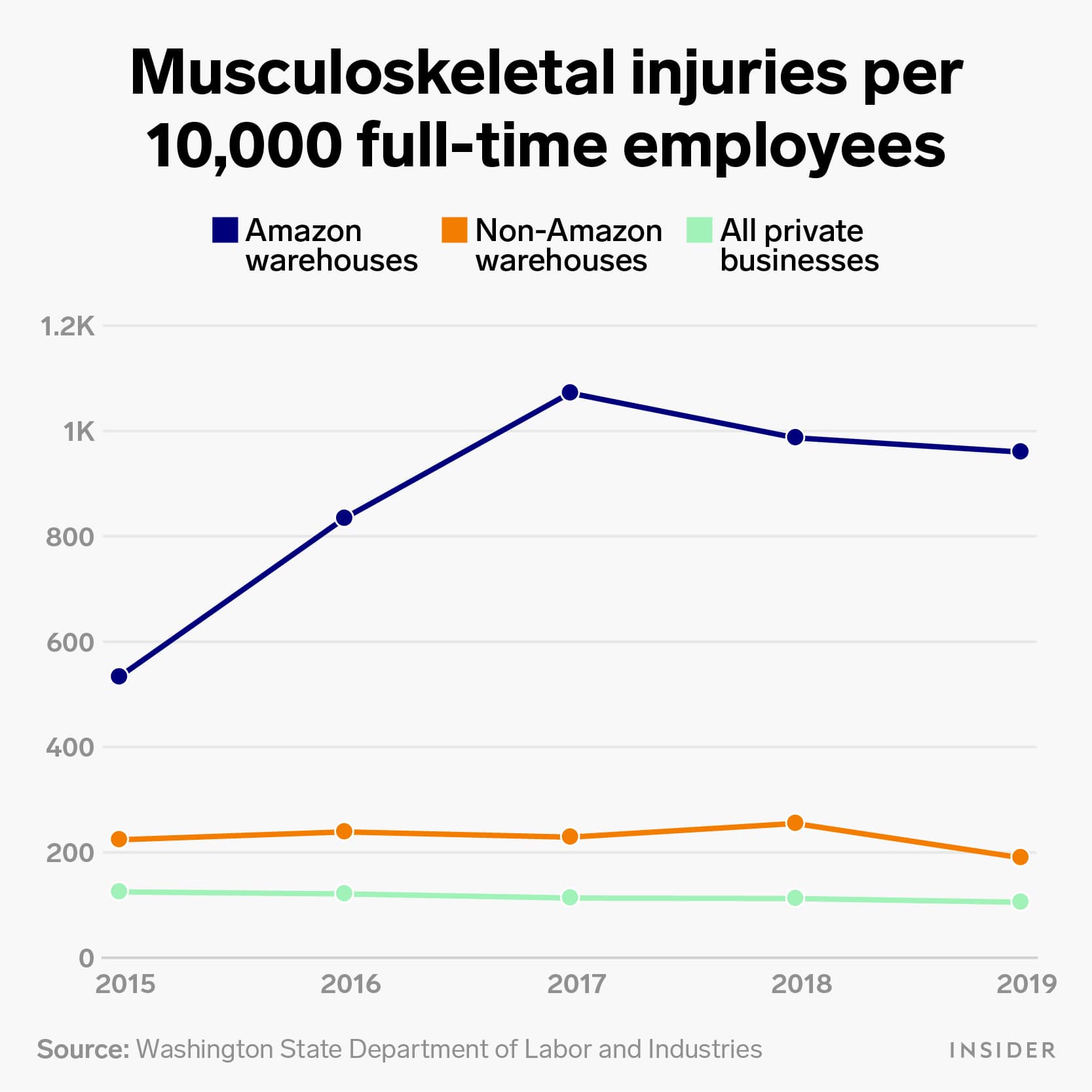
The meme depicts a graph showing the number of workplace injuries per 100,000 employees at Amazon warehouses versus non-Amazon warehouses. The graph is intentionally misleading, with the x-axis labeled "Years" and the y-axis labeled "Injuries per 100,000". The text at the top reads "Anti-Anti-Union: 'We're not anti-union, we're just really anti-union'". The meme is a satirical commentary on the anti-union movement at Amazon, implying that the company is not actually anti-union, but rather anti-union.
detailed-analysis (gemma3-27b-vision)
Okay, here's an analysis of the provided graph of musculoskeletal injuries, broken down into the requested theoretical lenses. Note that some lenses (like Queer Feminist Intersectional Analysis) are less directly applicable to the core data presented, but I'll provide analyses where they make sense, drawing connections to broader contexts.
Visual Description
The graph displays musculoskeletal injury rates (per 10,000 full-time employees) between 2015 and 2019, comparing Amazon warehouses to non-Amazon warehouses and all private businesses.
- Lines: There are three lines representing each category. The blue line representing Amazon warehouses demonstrates a sharp increase in injury rates from 2015 to 2017, peaking at around 1,100 injuries per 10,000 employees. From 2017-2019, injury rates plateu, but remain high. The orange line, representing non-Amazon warehouses, stays relatively stable and significantly lower than Amazon’s, hovering around 300 injuries per 10,000 employees. The green line, representing all private businesses, is the lowest and flattest, starting around 200 injuries per 10,000 employees and decreasing over time.
- Y-Axis: Represents injury rates, measured in units from 0 to 1200.
- X-Axis: Represents years from 2015 to 2019.
- Source: Data from the Washington State Department of Labor and Industries.
- Overall Impression: The graph immediately highlights a significant disparity in musculoskeletal injury rates between Amazon warehouses and other workplaces. Amazon's injury rate is markedly higher and increasing while other workplace injuries are low and decreasing.
Marxist Conflict Theory
This graph serves as stark evidence of the inherent contradictions within a capitalist system, specifically regarding the exploitation of labor for profit.
- Class Struggle: The data points to a clear power imbalance between Amazon (as the employer) and its warehouse workers. Amazon’s drive to maximize efficiency and profitability (accumulation of capital) has led to working conditions that demonstrably harm its workforce. The high injury rates are a direct consequence of prioritizing speed and production targets over worker safety.
- Alienation: Workers in Amazon warehouses may experience alienation from the production process. The emphasis on metrics and speed may reduce workers to mere cogs in a machine, diminishing their sense of control over their labor and well-being.
- Exploitation: The injuries represent a form of “hidden” exploitation. While wages are paid, the cost of injuries (physical pain, medical expenses, lost productivity) is largely borne by the worker, representing an unpaid cost of production.
- Potential for Revolution: While the data doesn't explicitly show worker resistance, it can be seen as a breeding ground for potential collective action. Increased awareness of these exploitative conditions can fuel worker organizing and demand for improved safety measures and working conditions.
Foucauldian Genealogical Discourse Analysis
This chart presents data that can be analyzed through Foucault's concepts of power, knowledge, and discourse, revealing how "truth" about worker safety is constructed and maintained.
- Power/Knowledge: The data itself is a form of knowledge, but that knowledge is produced through specific power relations. The Washington State Department of Labor and Industries’ collection and reporting of this data exert a form of surveillance over workplaces. Amazon, as a corporation, also generates its own knowledge about worker performance and safety (likely differing from the state data).
- Discipline: The high injury rates in Amazon warehouses can be seen as a consequence of a “disciplinary” regime. The relentless focus on efficiency, monitoring of employee movements, and strict performance metrics create a system of control that prioritizes output over worker well-being.
- Normalization: The fact that these injury rates are considered acceptable (at least in terms of not leading to immediate intervention) highlights a normalization of risk and harm within this particular industrial context. This normalization obscures the inherent dangers of the work.
- Genealogy: Tracing the historical development of warehouse labor practices, combined with the rise of e-commerce and logistical systems, could reveal how specific technologies and management strategies have contributed to these injury rates. It’s not an inherent flaw of warehouse work, but a product of a specific historical trajectory.
Critical Theory
This graph can be interpreted through the lens of Critical Theory, particularly focusing on the critique of rationality and the domination of instrumental reason.
- Instrumental Reason: The relentless pursuit of efficiency and profit maximization by Amazon exemplifies “instrumental reason.” Everything is evaluated based on its usefulness in achieving a specific goal (e.g., faster delivery times, increased sales). Worker safety is often seen as a cost to be minimized, rather than a fundamental ethical consideration.
- Domination: The high injury rates represent a form of domination, where the needs of the corporation supersede the well-being of its workforce. The pursuit of profit has led to a system where workers are subjected to hazardous conditions.
- Critique of Progress: The graph challenges the notion of “progress” inherent in the e-commerce model. While consumers benefit from convenient and fast delivery, that convenience is built on the backs of workers who are disproportionately injured.
- Emancipation: A critical theoretical response would call for a re-evaluation of the values that prioritize profit over human well-being, and for the development of alternative models of production and distribution that prioritize worker safety and dignity.
Postmodernism
While not as directly applicable as the previous analyses, postmodern thought can offer some insightful framing.
- Deconstruction of “Efficiency”: Postmodernism would challenge the very concept of “efficiency” as an objective truth. What is defined as “efficient” is socially constructed, and the prioritization of efficiency often masks underlying power relations and ethical concerns.
- Rejection of Grand Narratives: The graph undermines the "grand narrative" of technological progress and economic growth. It shows that the pursuit of these goals can have negative consequences for individuals and communities.
- Focus on Local Knowledge: Postmodernism would emphasize the importance of listening to the experiences of the workers themselves, recognizing that their lived realities offer valuable insights that are often overlooked by corporate management and policymakers.
Queer Feminist Intersectional Analysis (More contextual, not directly about the graph data)
This theory analyzes the intersection of multiple forms of oppression and marginalization. While the graph doesn't present data specifically broken down by gender, race, or other categories, we can consider how these factors might intersect to exacerbate the risk of injury in Amazon warehouses.
- Gendered Labor: Warehouse work is often dominated by men, but women are increasingly represented in the workforce. Women may experience different types of injuries due to differences in physical strength or ergonomic adaptations of equipment.
- Racial Disparities: Workers of color may be disproportionately employed in the most physically demanding or hazardous roles within the warehouse, leading to higher injury rates.
- Immigration Status: Immigrant workers may be more vulnerable to exploitation and less likely to report injuries due to fear of deportation or job loss.
- Intersectionality: The most vulnerable workers are likely those who experience multiple forms of marginalization (e.g., a woman of color who is an immigrant). Their experiences are shaped by the complex interplay of these factors.
I hope this detailed breakdown is helpful. Let me know if you'd like me to elaborate on any of these theoretical lenses or apply them in more specific ways.
simple-description (llama3.2-vision)
The meme is a graph showing the number of workplace injuries per 100,000 employees for various types of workplaces in the United States. The graph shows that Amazon warehouses have a higher rate of workplace injuries compared to other types of workplaces. The text at the top of the graph reads "Amazon warehouses: where the 'just' in 'just in time' is 'just' get hurt".
tesseract-ocr
Musculoskeletal injuries per 10,000 full-time employees Amazon MNon-Amazon _ All private warehouses — warehouses businesses . rn 99 i _,