First Seen
2023-05-10T21:03:32+00:00
simple-description (llama3.2-vision_11b)
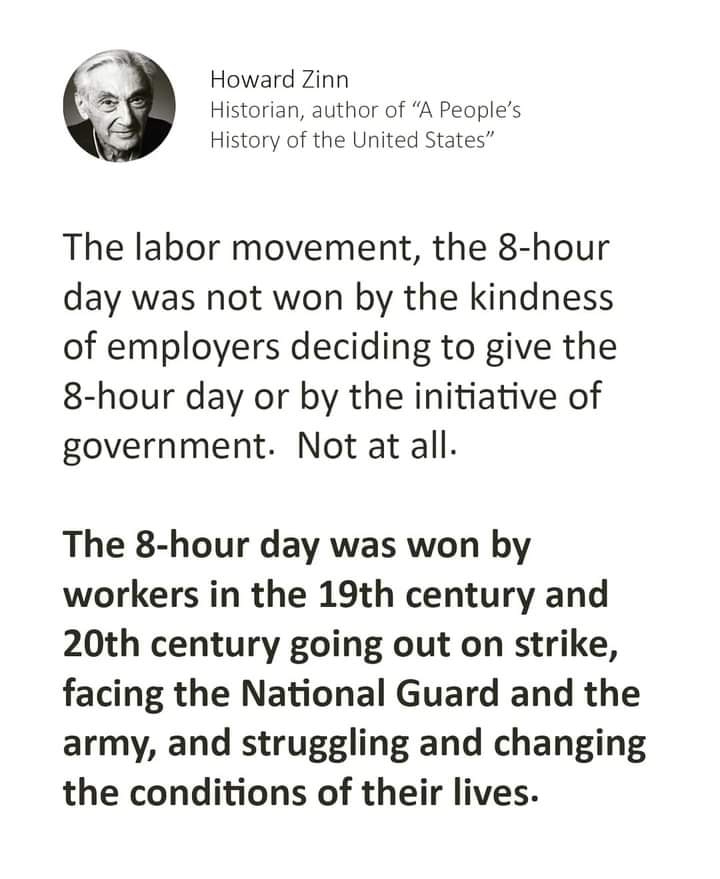
The meme is a satirical commentary on the 8-hour workday, a labor movement achievement that was meant to improve workers' lives. The image shows a quote from a book by Howard Zinn, "A People's History of the United States", where he criticizes the 8-hour workday as a failure because it didn't change the lives of workers, instead making them more efficient and productive, making them more valuable to their employers.
detailed-analysis (gemma3-27b-vision)
Okay, let's analyze the provided text and image through the requested theoretical lenses. I'll skip any categories that don't meaningfully apply.
1. Visual Description
The image features a black-and-white portrait of Howard Zinn, a prominent American historian known for A People's History of the United States. He appears as an older man, with a kind but determined expression. The image is formal, though not overly so, and the contrast highlights his features. Below the portrait are two paragraphs of text which outline how the 8-hour workday was won.
2. Marxist Conflict Theory
This is the most directly applicable framework. The text explicitly presents a conflict-based explanation for the achievement of the eight-hour workday.
- Class Struggle: The core of Marxist theory is class struggle, and the statement frames the eight-hour day not as a gift from benevolent employers or the state, but as a result of workers actively fighting for it. This emphasizes the inherent conflict between the capitalist class (employers) and the proletariat (workers).
- Material Conditions: The fight for the eight-hour day is about altering material conditions – the length of the workday directly affects workers’ lives, their ability to rest, their health, and their potential for other activities. Marxism emphasizes that material conditions shape consciousness and social relations.
- Agency of the Proletariat: The text asserts that workers were not passive recipients of change, but active agents in creating it. This aligns with the Marxist belief in the revolutionary potential of the working class.
- Conflict as a Driver of Change: The specific mention of striking, facing the National Guard and army, highlights the conflict inherent in social change. Marxists see conflict not as a disruption, but as the engine of progress.
3. Foucauldian Genealogical Discourse Analysis
While not immediately obvious, a Foucauldian reading can illuminate the power dynamics at play.
- Power/Knowledge: The statement implicitly challenges the dominant discourse surrounding the history of labor. The conventional narrative might emphasize the benevolence of employers or the role of enlightened legislation. Zinn's statement disrupts this discourse, exposing the power relations that underpin it.
- Genealogy: A genealogical analysis would trace the historical development of the "workday" as a concept. How did the idea of a long workday become normalized? What specific practices and institutions (factories, legal systems, etc.) contributed to this? Zinn's statement suggests that the eight-hour day wasn't a natural outcome, but a constructed one, won through struggle.
- Discipline & Biopower: The long workday, historically, was a form of discipline, controlling workers' bodies and time. The fight for the eight-hour day is a fight for greater control over one's own body and life – a challenge to biopower (the power to regulate life).
4. Critical Theory
Critical theory, a broad school of thought, aligns with many of the above points.
- Challenging Dominant Narratives: Like the Foucauldian approach, Critical Theory emphasizes the importance of critically examining dominant narratives (in this case, the story of how the eight-hour day came to be). It asks, "Who benefits from this story?" and "What is silenced or marginalized?"
- Social Justice: The statement implicitly advocates for social justice by highlighting the agency of marginalized workers.
- Critique of Power Structures: It exposes the ways in which power structures (employers, the state) historically exploited workers.
Sections Not Applicable
- Postmodernism: While there's a hint of disrupting dominant narratives, the text isn't sufficiently deconstructive or relativistic to warrant a postmodern analysis.
- Queer Feminist Intersectional Analysis: The text doesn't explicitly address issues of gender, sexuality, or intersectionality, so this lens is not relevant here.
Let me know if you'd like me to elaborate on any of these analyses or apply other theoretical frameworks.
simple-description (llama3.2-vision)
The meme is a humorous comparison between the 8-hour workday and the 8-hour workday of World War I soldiers. The text reads: "The 8-hour day was invented by the workers of the 1917 Russian Revolution, not by the kind employers of the time. The 8-hour day was invented by the workers of the 1917 Russian Revolution, not by the kind employers of the time."
tesseract-ocr
“4 Howard Zinn @ Historian, author of “A People’s History of the United States” The labor movement, the 8-hour day was not won by the kindness of employers deciding to give the 8-hour day or by the initiative of government. Not at all. The 8-hour day was won by workers in the 19th century and 20th century going out on strike, facing the National Guard and the army, and struggling and changing the conditions of their lives.