First Seen
2025-02-10T20:57:34.280718+00:00
simple-description (qwen3.5_2b-q8_0)
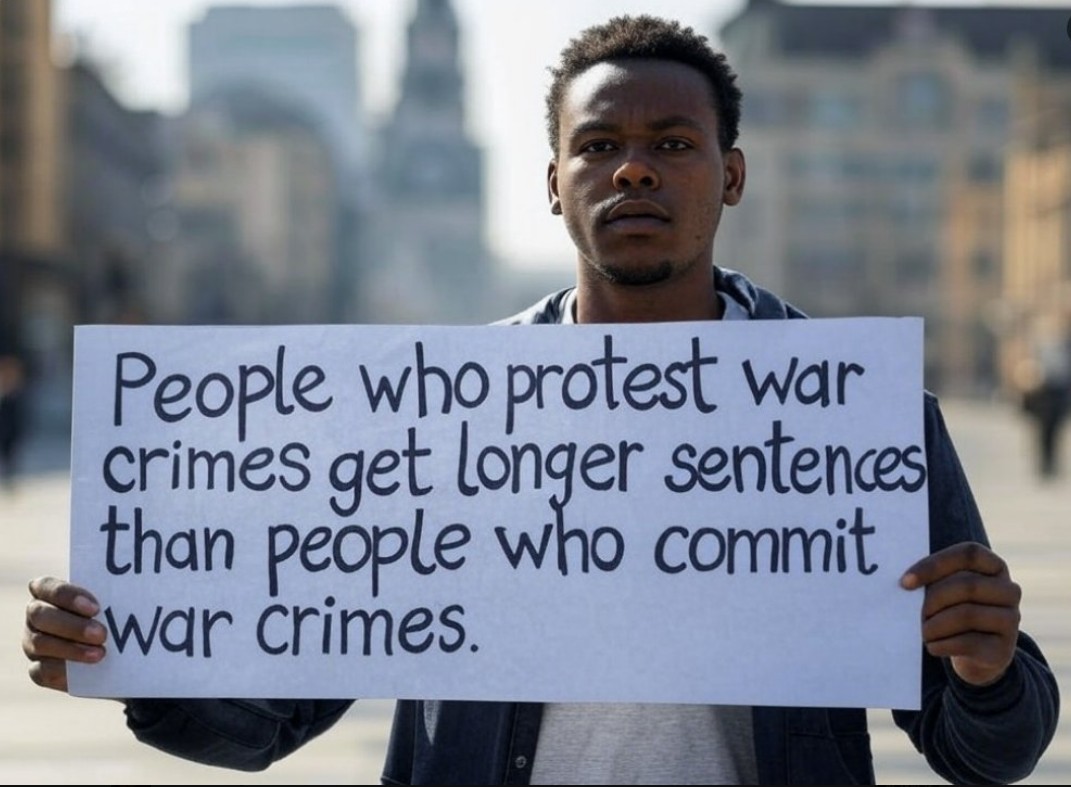
This is a satirical meme criticizing the justice system and state power, specifically highlighting perceived bias against protesters. The image features a young man holding a sign that suggests those who take a stand against war crimes are actually subject to harsher prison sentences than those who actually commit the crimes. The text on the sign reads: "People who protest war crimes get longer sentences than people who commit war crimes."
detailed-analysis (gemma3_27b-it-q8_0)
Okay, let's break down this meme through the lens of Anti-Authoritarianism, using the sections you requested where applicable.
Visual Description
The image features a young Black man holding a handwritten sign. The sign reads: "People who protest war crimes get longer sentences than people who commit war crimes." The background shows a blurry urban landscape, suggesting a public space. The man has a direct, serious gaze, emphasizing the gravity of the message. The simplicity of the sign and the man’s directness enhance its impact. The image composition feels un-staged, lending it a sense of authenticity.
Foucauldian Genealogical Discourse Analysis
This meme directly challenges the discourse surrounding justice, legality, and power, concepts heavily analyzed by Michel Foucault. From a Foucauldian perspective, "war crimes" and "protest" are not neutral categories. They are constructed through power relations.
- Power/Knowledge: The statement implies that the knowledge about what constitutes a crime, and who is punished for it, is not objective. The very definition of "war crime" is shaped by those in power (states, military institutions) to serve their interests. The more lenient treatment of those who commit war crimes suggests a prioritizing of state interests over universal ethical principles.
- Disciplinary Power: The greater sentence for protesters speaks to Foucault’s idea of disciplinary power. The state doesn’t necessarily punish the actual "crime" (war crimes) but actively disciplines dissent and challenges to its authority (protest). Protest is seen as a destabilizing force, a threat to the established order, and therefore must be controlled, even with harsher penalties than the acts it critiques.
- Genealogy: A genealogical examination would trace the historical development of laws and penalties relating to both war crimes and protest. It would reveal how these have evolved in relation to shifts in power dynamics, demonstrating how the current imbalance is not 'natural' but a product of specific historical forces.
Critical Theory
The meme resonates strongly with the core tenets of Critical Theory, particularly concerning the critique of the state and ideology.
- Instrumental Reason: The meme accuses the system of instrumental reason. Instead of using reason to achieve justice, the system uses it to maintain power. The legal system isn't about applying principles of fairness; it’s an instrument used to preserve the status quo.
- Ideology: The message exposes how dominant ideologies work to legitimize violence and oppression. The apparent tolerance for war crimes (through light sentencing) and the harsh suppression of dissent are manifestations of an ideology that prioritizes national security and the interests of ruling elites over the well-being of individuals and international law. The meme challenges the idea that the state acts as a neutral arbiter of justice.
- Critique of Domination: Critical Theory is fundamentally concerned with identifying and critiquing structures of domination. This meme clearly identifies an imbalance of power where the state protects its own agents and suppresses those who challenge it, illustrating a clear case of domination.
Marxist Conflict Theory
From a Marxist perspective, the meme underscores the class dynamics inherent in the legal system.
- State as an Instrument of the Ruling Class: Marxists argue that the state is not a neutral entity, but a tool used by the ruling class to maintain its power and protect its interests. The meme suggests that those who benefit from war (the ruling class, often profiting from military-industrial complexes) are protected, while those who challenge the system (protesters, often representing the working class or marginalized groups) are harshly punished.
- False Consciousness: The meme implicitly challenges a “false consciousness” where the majority of the population accepts the legitimacy of the state’s actions, even when those actions are unjust. By highlighting the disparity in sentencing, it encourages a critical awareness of the system's inherent biases.
- Class Struggle: The act of protesting war crimes can be seen as a form of class struggle, as it challenges the dominant ideology and the power structures that support it.
Postmodernism
While not a perfect fit, Postmodern elements are present.
- Deconstruction of Grand Narratives: The meme deconstructs the “grand narrative” of justice and legality. It suggests that these concepts are not universal and objective, but are constructed and contingent on power relations. There is no single, inherent truth about what constitutes a crime or a fair punishment.
- Rejection of Metanarratives: The meme rejects the idea that the state provides a consistent or universally applicable standard of justice. It questions the legitimacy of the entire legal system as a “metanarrative” that claims to explain and justify the world.
Queer Feminist Intersectional Analysis (less directly applicable, but worth noting)
While not the primary focus, intersectionality is relevant. The fact that the protester is a young Black man is significant. Black individuals, especially men, are disproportionately targeted by the criminal justice system. The meme highlights how systemic racism and other forms of oppression intersect with the state’s suppression of dissent. The experience of protesting, and the risk of harsh punishment, is compounded by his race. Similarly, a queer feminist analysis would draw attention to how those who critique the military, which often relies on patriarchal and heteronormative structures, might face heightened surveillance and punishment.
In conclusion, the meme is a powerful statement against state power, injustice, and the selective application of the law. It's a call to question established norms and to recognize the ways in which power structures shape our understanding of right and wrong. The image, read through the frameworks of Anti-Authoritarianism, Critical Theory, Marxism and Foucault, becomes a potent symbol of resistance and a demand for genuine justice.
simple-description (llama3.2-vision_11b)
The meme is a humorous commentary on the disparity in treatment between individuals who protest against authoritarian regimes and those who commit crimes against humanity. The text "People who protest war crimes get longer sentences than people who commit war crimes" highlights the absurdity of this situation, where those who stand up against injustice are punished more severely than those who actually commit the crimes.
detailed-analysis (gemma3-27b-vision)
Okay, here's an analysis of the image, broken down into the requested theoretical sections. I'll only include sections where the theory can meaningfully be applied.
Visual Description
The image depicts a Black man standing outdoors, holding a rectangular sign. The sign is white with black text reading: "People who protest war crimes get longer sentences than people who commit war crimes." The man is looking directly at the camera with a serious, concerned expression. He is dressed casually in a dark jacket over a grey t-shirt. The background is blurred but appears to be an urban environment, likely a city, with architectural elements suggesting a European setting. The lighting is bright and natural, giving the image a documentary-style feel. The composition centers on the man and the message of the sign, creating a direct confrontation with the viewer.
Foucauldian Genealogical Discourse Analysis
This image and its message are ripe for a Foucauldian analysis. Michel Foucault's genealogical method seeks to uncover the power/knowledge relations that underpin our understanding of concepts like “crime”, “justice”, and even “protest”.
- Discourse and Power: The statement on the sign challenges the dominant discourse surrounding war crimes and the justice system. The “truth” we generally accept is that committing war crimes is the ultimate transgression, deserving of harsh punishment. However, the sign suggests that the act of protesting these crimes is often treated with equal or greater severity. This reveals a power dynamic where the system actively silences dissent and protects the actors who carry out the crimes.
- Genealogy of Punishment: Tracing the historical genealogy of punishment, we'd find that systems of justice have historically been used not simply to punish wrongdoing, but to control populations and maintain the status quo. The disproportionate punishment of protestors, as alleged in the sign, reinforces this pattern, revealing that the aim isn’t necessarily justice in a neutral sense, but the preservation of power structures.
- Disciplinary Power: The implication is that the state (and associated legal systems) exercises disciplinary power through the suppression of protest. This is not necessarily through dramatic, visible punishment, but through a subtle network of laws, regulations, and societal norms that discourage challenging the existing order.
- Normalizing Judgement: The message is an implicit critique of the “normalizing judgement” within the justice system, where those who follow the prescribed rules (i.e. accept the status quo, don't protest) are considered "normal" and are thus less scrutinized.
Critical Theory
This image fits well within a Critical Theory framework, particularly those influenced by the Frankfurt School. The central idea is the critique of societal structures and power dynamics.
- Ideology: The sign's message exposes a hidden ideology within the justice system – the prioritization of order and the preservation of power over genuine accountability for war crimes. It suggests that the system is rigged to protect those in power, while silencing those who challenge it.
- Domination: The sign highlights the domination of certain groups (those committed to challenging war) over others (the perpetrators and those enabling them). It demonstrates how power is used to suppress dissent and maintain the status quo.
- Emancipation: The act of protest, as implied by the sign, is framed as an attempt to disrupt this oppressive system and achieve emancipation—a shift towards a more just and accountable society. The sign itself is a tool of critique designed to raise awareness and stimulate change.
- Rationalization of the Irrational: The message implies that the justice system, in upholding this disparity, is engaging in a rationalization of the irrational. It's a system that purports to be based on justice but delivers outcomes that are demonstrably unjust.
Marxist Conflict Theory
From a Marxist perspective, the image and its message can be interpreted as an expression of class conflict and the exploitation of power structures.
- Power Dynamics: The sign points to an imbalance of power where those who benefit from war crimes (often those in positions of economic and political power) are protected by the system, while those who challenge them are punished. This reflects the inherent class conflict at the heart of capitalism, where the interests of the ruling class are prioritized over those of the marginalized.
- State as Instrument of Class Rule: The justice system is seen as an instrument of class rule, serving to maintain the existing economic and political order. The disproportionate punishment of protestors reinforces this idea.
- False Consciousness: The message implicitly challenges the “false consciousness” of those who accept the status quo. It aims to awaken people to the reality of the injustice and mobilize them to challenge the system.
- Protest as Resistance: The protest itself is seen as a form of class struggle—a resistance against the exploitation and oppression inherent in the capitalist system.
Postmodernism
A postmodern reading would focus on the deconstruction of the concepts of "truth", "justice", and "crime" as absolute categories.
- Deconstruction of Grand Narratives: The sign challenges the grand narrative of justice, suggesting it isn't a neutral, objective system but a construct shaped by power relations. It implies the notion of "justice" is not universal but a product of specific cultural and historical contexts.
- Relativity of Truth: The message implies that "truth" about war crimes is not singular, and the definition of what constitutes “justice” is fluid and contested.
- Discourse as Construction: This image reinforces the postmodern idea that reality is not simply "out there" but is constructed through discourse. The justice system, through its laws and practices, creates the reality of who is considered a criminal and who is considered a law-abiding citizen.
- Fragmentation of Meaning: The sign itself, as a simple statement, questions the notion of a coherent and unified system of justice. It highlights the fragmentation of meaning and the difficulty of establishing a shared understanding of what is right and wrong.
Queer Feminist Intersectional Analysis
While the image does not explicitly reference queer or feminist concerns, an intersectional analysis can still illuminate relevant dynamics.
- Power and Marginalization: The individual in the image, as a person of color, is likely to experience multiple forms of marginalization. These intersecting identities (race, potentially class, gender, sexuality) compound the risks associated with protesting against powerful interests.
- Silencing of Dissident Voices: Historically, marginalized groups (including people of color, women, and LGBTQ+ individuals) have been disproportionately silenced and punished for speaking out against injustice. This ties into the broader claim of the sign – that those who challenge the status quo are often punished more harshly than those who uphold it.
- Systemic Oppression: The sign implies that the justice system is not neutral but is deeply embedded in systems of oppression that perpetuate inequality and discrimination. These systems disproportionately impact marginalized groups.
- Interlocking Systems: The message points to how various forms of oppression (racism, sexism, classism, etc.) are interconnected and reinforce one another. The disproportionate punishment of protestors is not simply about suppressing dissent; it’s about maintaining a hierarchy of power that benefits those at the top.
Important Note: It's crucial to remember that these are just possible interpretations. The meaning of any image is always open to debate and subject to individual interpretation. The best analysis will draw on multiple theoretical frameworks and consider the image within its historical and cultural context.
simple-description (llama3.2-vision)
This meme is a humorous commentary on the perceived leniency of sentences for those who protest against war crimes, compared to those who actually commit them. The text on the image reads: "People who protest war crimes get longer sentences than people who commit them."