First Seen
2025-02-10T20:57:25.645960+00:00
simple-description (qwen3.5_2b-q8_0)
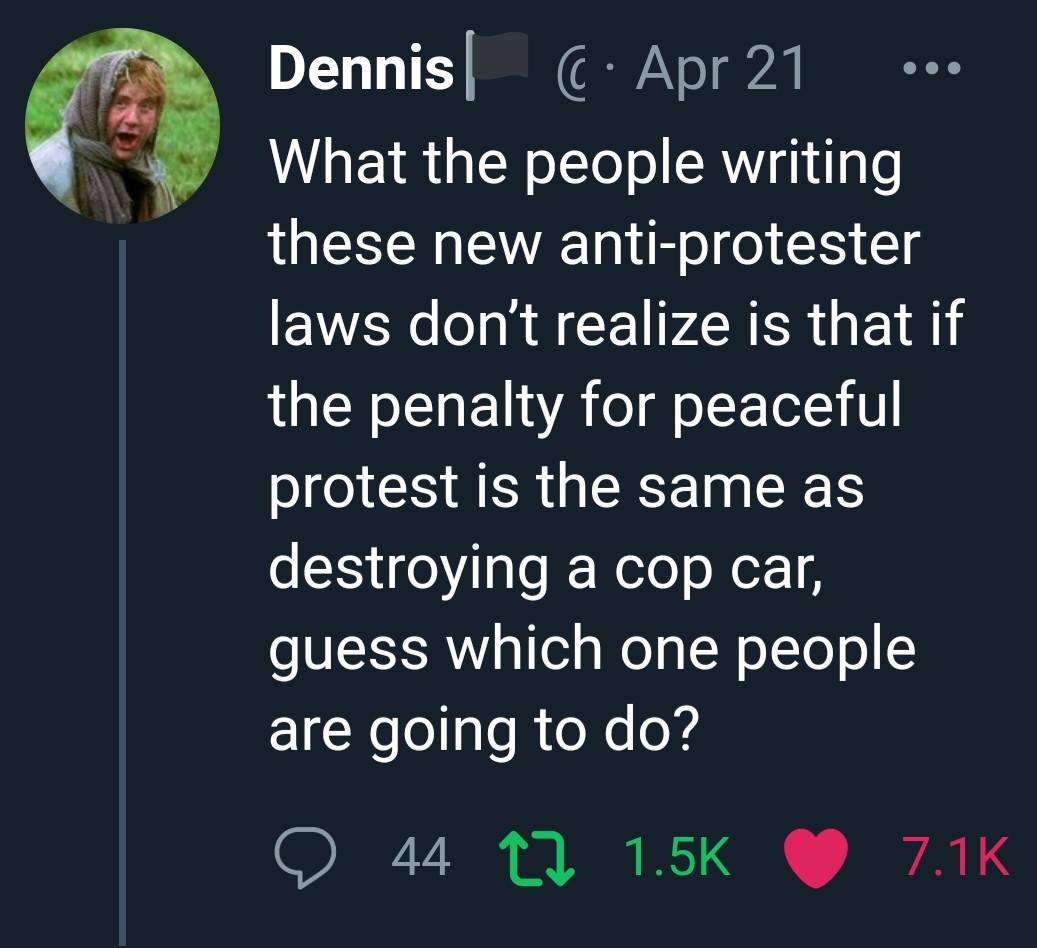
This is a political joke suggesting that strict anti-protest laws will eventually backfire because the public will break the law to demand freedom. The text implies that just as the public breaks laws to protest, the police will break their law in a fit of rage.
Text from image:
'What the people writing these new anti-protester laws don't realize is that if the penalty for peaceful protest is the same as destroying a cop car, guess which one people are going to do?'"
detailed-analysis (gemma3_27b-it-q8_0)
Okay, let's break down this tweet/meme through the lens of Anti-Authoritarianism, incorporating applicable theoretical frameworks.
Overall Context: The meme's core argument – that laws increasingly equate peaceful protest with property destruction (specifically targeting police property) – directly resonates with anti-authoritarian thought. Anti-authoritarianism fundamentally challenges hierarchical power structures and the legitimacy of state authority. This tweet highlights a perceived tactic by the state to criminalize dissent and suppress any form of opposition, regardless of its tactics. It isn’t necessarily an endorsement of property destruction, but an observation that the state is attempting to force a false equivalence to chill protest activity.
Visual Description
The tweet is accompanied by a headshot of Dennis Kucinich, a former U.S. Representative known for his progressive and anti-war stances, and sometimes seen as a figure representing more left-leaning populism. The use of his image here is interesting. Kucinich's political career was often about challenging power structures within the establishment, but perhaps the choice here is meant to emphasize the extremity of the situation to the point that even a more mainstream figure would recognize the imbalance. The image isn’t inherently integral to the argument but adds a layer of ironic framing.
Foucauldian Genealogical Discourse Analysis
This is where the meme really hits its stride within an anti-authoritarian framework. Michel Foucault's work on power and discourse is highly relevant here.
- Power/Knowledge: Foucault argued that power isn't simply repressive, but productive. It operates through discourse – the ways we talk about and understand the world – to create knowledge and define what is "normal" and "deviant". The creation of laws equating peaceful protest with property destruction is a prime example of this. The state is actively shaping the discourse around protest to define it as inherently violent and therefore illegitimate.
- Genealogy: A Foucauldian genealogy would trace the historical emergence of these laws. It would ask how did we arrive at a point where protesting is seen as comparable to vandalism? It would look at the evolving legal definitions of “disorderly conduct,” “riot,” “vandalism,” and "terrorism," and how those definitions have been broadened to encompass non-violent forms of resistance. It would demonstrate how these laws weren’t “naturally” occurring but were crafted and strategically implemented as a means of social control.
- Disciplinary Power: The tweet implies a disciplinary effect. By increasing the penalties for protest, the state aims to discipline the population, to internalize fear of reprisal and self-censor dissenting behavior. The risk of equal punishment discourages participation.
Critical Theory
The meme can be interpreted through the lens of Critical Theory, particularly the Frankfurt School's critique of instrumental reason and the culture industry.
- Instrumental Reason: Critical theorists argue that reason becomes "instrumental" when it's solely focused on efficiency and control, devoid of ethical considerations. The laws in question represent a purely instrumental use of the legal system: to effectively suppress dissent, even if it means distorting justice and freedom of expression.
- Repressive Tolerance: The tweet echoes Herbert Marcuse’s idea of ‘repressive tolerance’. While tolerance is often seen as a virtue, Marcuse argued that, in a deeply unequal society, allowing all voices equal expression actually reinforces the status quo. By allowing “peaceful” protest only on terms dictated by the state (and then punishing it equally to “destructive” protest), the state effectively silences authentic opposition.
Marxist Conflict Theory
A Marxist perspective highlights the class conflict inherent in the situation.
- State as an Instrument of the Ruling Class: Marxists see the state as an instrument of the ruling class, used to maintain its power and suppress challenges to the existing economic order. These laws are not neutral; they are designed to protect the interests of those in power by criminalizing any form of resistance that might threaten their control.
- Ideology: The attempt to equate peaceful protest with property destruction is a form of ideological control. The state seeks to shape public perception to justify its repression and delegitimize dissent. By framing protesters as violent and destructive, it distracts from the underlying social and economic issues that motivate the protests in the first place.
Postmodernism
A postmodern reading would focus on the breakdown of grand narratives and the constructed nature of reality.
- Deconstruction of "Peaceful" vs. "Destructive": Postmodernism would question the very categories of "peaceful" and "destructive." These are not objective terms but social constructs with shifting meanings. The state is actively deconstructing the traditional understanding of protest to fit its own agenda.
- Simulacra and Simulation: A more extreme reading could suggest that the laws are part of a hyperreal simulation, where the distinction between reality and representation has collapsed. The state doesn’t need to be genuinely concerned with property destruction; it only needs to create the appearance of concern to justify its repressive measures.
Queer Feminist Intersectional Analysis
While not the primary focus, this lens adds nuance.
- State Violence and Marginalized Communities: Queer and feminist theorists would point out that the impacts of these laws are not felt equally. Marginalized communities (people of color, LGBTQ+ individuals, women) are disproportionately targeted by state violence and are more likely to be arrested and prosecuted for protest activity.
- Interlocking Systems of Oppression: The laws are not simply about suppressing dissent; they are part of interlocking systems of oppression that maintain social hierarchies and marginalize certain groups.
In conclusion, the meme, while short, is incredibly potent because it speaks to core tenets of anti-authoritarian thought, and can be substantiated by several critical perspectives. It taps into a deep-seated fear that the state is systematically eroding the right to dissent and using the law as a tool of repression. The meme’s power comes from its succinct articulation of this fear and its provocative question – a question designed to ignite conversation and, potentially, further resistance.
simple-description (llama3.2-vision_11b)
The meme is a screenshot of a tweet that asks, "What the people writing these new anti-protest laws don't realize is that if the penalty for protesting is the same as destroying a cop car, guess which one people are going to do?" The tweet is humorous because it pokes fun at the idea that some laws are so strict that they're actually encouraging people to break them. The meme is likely to be shared by people who are frustrated with the current state of politics and want to bring attention to the issue.
detailed-analysis (gemma3-27b-vision)
Okay, here's an analysis of the Twitter post, broken down into relevant theoretical frameworks. Note that not all frameworks apply equally, and some are more prominent than others.
Visual Description
The post features a Twitter profile picture of a person with long blonde hair. The profile picture is a still from a film, potentially The Fifth Element. The figure appears distressed, possibly shouting, and has a somewhat frantic energy. The image serves as a visual cue to the passionate and urgent tone of the accompanying text.
Foucauldian Genealogical Discourse Analysis
This post lends itself very well to a Foucauldian reading. The core argument revolves around how the discourse of protest is being shaped and controlled through legislation.
- Power/Knowledge: The author points to the power structures that define what constitutes “legal” or “illegal” protest. By equating peaceful protest with property destruction in terms of penalty, the law produces a specific understanding of what protest is—namely, inherently disruptive and criminal. This is not about inherent wrong-doing, but rather the law defining (constructing) the definition of wrongdoing.
- Genealogy: This isn't about tracing a linear history but rather about uncovering the historical conditions that made these laws possible. The author is suggesting the laws aren't a logical response to social issues, but are part of a broader system of control over dissent. We might ask, what discourses around order, security, and property rights historically led to this moment?
- Discipline and Punishment: The equal treatment of peaceful protest and property damage can be seen as a disciplinary tactic. It aims to discourage all forms of protest by raising the stakes and normalizing (through legal equivalence) the idea that protesting is inherently a criminal act.
Critical Theory
The post speaks directly to core tenants of Critical Theory.
- Ideology: The author critiques the ideology embedded within the new anti-protest laws. The laws present a specific way of understanding social order, dissent, and the role of the state. This isn’t presented as neutral law, but as an instrument of power.
- Domination and Emancipation: The post highlights a power dynamic where the state attempts to suppress dissent and control the population. The author implicitly argues for emancipation – the ability of people to freely express their views and challenge the status quo.
- Reason as Instrumental: One can argue that the reason behind these laws is not to genuinely address social issues, but to serve the interests of maintaining existing power structures. The laws are a means to an end, not a rational solution to problems.
Marxist Conflict Theory
The post reveals a clear class conflict at play, even if not explicitly stated.
- Conflict over Resources & Power: Protests often arise from issues of economic inequality, social injustice, and power imbalances. The laws, in turn, are a tool used by those in power to maintain their position.
- State as Instrument of the Ruling Class: Marxist theory suggests the state operates in the interests of the ruling class. These laws can be seen as a mechanism for protecting property and suppressing challenges to the existing capitalist system.
- Revolutionary Potential: The author's rhetorical question (“guess which one people are going to do?”) hints at the possibility of escalation. By raising the stakes, the laws might ironically push people toward more radical forms of protest, fulfilling a self-prophesying dynamic.
Postmodernism
While not the primary lens, some postmodern elements are present.
- Deconstruction of Norms: The author deconstructs the assumed legitimacy of these laws. They challenge the idea that the state is a neutral arbiter of justice and expose the power dynamics at play.
- Relativism & Discourse: There’s an implicit argument that "protest" and "vandalism" are not inherently defined categories, but are constructed through discourse and social power. The laws create the meaning of these terms.
- Skepticism of Grand Narratives: The post implicitly challenges the “grand narrative” of law and order as a universal good. It suggests that laws can be used to serve particular interests and perpetuate injustice.
Queer Feminist Intersectional Analysis
While not explicitly present, one could potentially extend the analysis through an intersectional lens.
- Power Dynamics: These laws disproportionately impact marginalized groups who are more likely to participate in protests.
- Control of Bodies and Resistance: The laws act as a form of social control, seeking to regulate behavior and suppress dissent. The question posed suggests resistance to this control.
- Interlocking Systems of Oppression: The context of anti-protest laws often intersects with other forms of oppression (e.g., racial injustice, economic inequality), creating overlapping systems of disadvantage.
In summary, the Twitter post is a compelling critique of power, law, and social control. It resonates most strongly with Foucauldian, Critical Theory, and Marxist frameworks, but can also be enriched through a postmodern or intersectional reading.
simple-description (llama3.2-vision)
This meme is a humorous take on the new anti-protest laws in the UK. The image shows a quote from a politician, saying that the new laws are so restrictive that they would even punish someone for destroying a car in protest, but the joke is that the person is trying to make a point about the absurdity of the laws by saying "guess which one" and then listing a series of ridiculous and impossible scenarios, such as "destroying a car" and "eating a sandwich".