First Seen
2023-05-24T22:38:58+00:00
simple-description (qwen3.5_2b-q8_0)
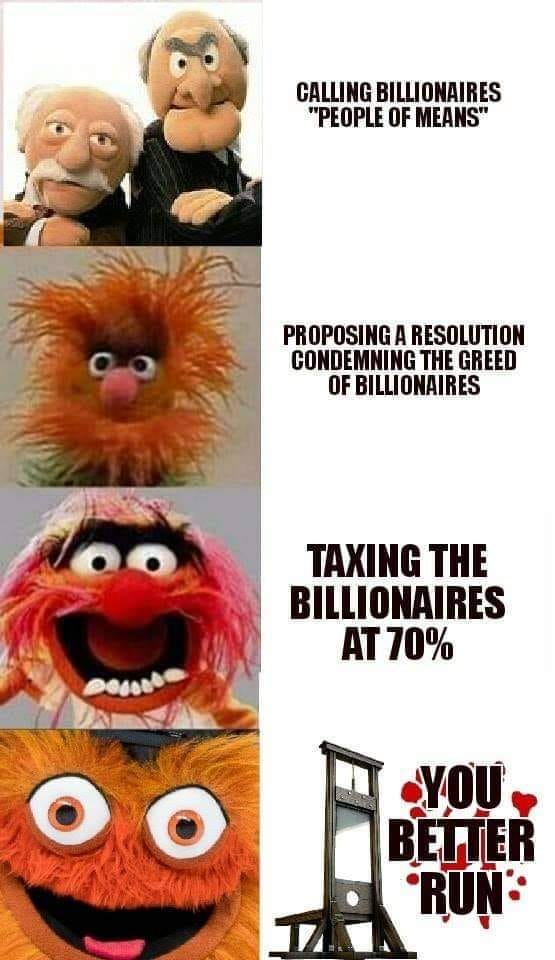
This anti-billionaire meme depicts a escalating progression of hostility toward wealth. It begins with a polite label calling billionaires "people of means," which quickly turns into a formal policy of condemning their greed, and then culminates in an extreme financial proposal of taxing them at 70%. The punchline features a guillotine with the caption "You Better Run," suggesting that the only recourse against billionaire greed is to be executed.
simple-description (llama3.2-vision_11b)
The meme is a humorous illustration of a billionaire's response to a proposal to tax billionaires, featuring a cartoon character from the Muppet Show, with the text "I'm not paying taxes, I'm a billionaire" and "I'm not paying taxes, I'm a billionaire" with the character's face crossed out.
detailed-analysis (gemma3-27b-vision)
Okay, let's break down this meme through the requested theoretical lenses. It's...a complex visual, so we'll have to unpack it carefully.
Visual Description
The image is a four-panel meme consisting of pictures of Muppet characters, each associated with a text caption making a point about wealth inequality and taxation.
- Panel 1: A picture of Statler and Waldorf, the two old men Muppets known for heckling, with the text "Calling Billionaires 'People of the People'". Their facial expressions convey disapproval and sarcasm.
- Panel 2: A picture of Pepe the King Prawn, with the text “Proposing a Resolution Condemning the Greed of Billionaires.” He has a concerned and serious expression.
- Panel 3: A picture of the Swedish Chef, with the text “Taxing the Billionaires at 70%.” He is shouting with a frantic expression.
- Panel 4: A picture of Elmo, with the text “You Better Run.” This is superimposed on a dark background with imagery of a gate, and heart icons. Elmo is looking directly at the viewer, in a threatening manner.
The overall visual aesthetic is jarring and intentionally absurd, relying on the juxtaposition of seemingly innocent Muppet characters with pointed political statements. It's a meme format, meaning it relies on quick consumption and recognition of pre-existing cultural references.
Foucauldian Genealogical Discourse Analysis
This meme can be analyzed through a Foucauldian lens by looking at how discourses of wealth, power, and social responsibility are constructed and contested.
- The Discourse of Legitimacy: The text "Calling Billionaires 'People of the People'" is presented with the disapproving Statler and Waldorf, which deconstructs the effort to make the ultra-rich appear relatable and deserving of their wealth. It hints at how discourses around meritocracy are used to legitimize extreme wealth accumulation.
- The Discourse of "Greed": The meme labels the actions of billionaires as “Greed.” This is a key ethical and moral categorization used to frame the issue. By explicitly naming this, it’s not just about economic inequality, but about moral failing.
- The Discourse of Taxation as Punishment: The shift to "Taxing the Billionaires at 70%" and "You Better Run" marks a move from critique to a perceived threat. Taxation isn’t presented as a reasonable redistribution of wealth, but as a punitive measure. The threat embedded in "You Better Run" suggests a desire for retribution against the wealthy. The image of the gate could indicate they are trying to flee or bar themselves from the rest of society.
- Power/Knowledge: Foucault argued that power and knowledge are inextricably linked. This meme demonstrates this by presenting the perception of wealth inequality as a truth that requires correction.
Critical Theory
From a Critical Theory perspective, this meme is a form of social commentary attempting to expose power dynamics and societal structures.
- Ideology Critique: The meme actively challenges the dominant ideology that justifies vast wealth inequality. It rejects the notion that wealth is solely the result of hard work and merit, implying that it is gained at the expense of others.
- The Culture Industry: The use of Muppets is interesting. They are products of the “culture industry” (Adorno & Horkheimer). By appropriating these seemingly harmless characters, the meme subverts their original intent and uses them as tools for political expression. This highlights how even seemingly innocent cultural products can be imbued with ideological significance.
- Domination and Resistance: The progression from critical observation to a threat ("You Better Run") can be interpreted as a form of resistance against the structures of power. It suggests a desire for systemic change.
Marxist Conflict Theory
From a Marxist perspective, this meme is a clear expression of class conflict.
- The Bourgeoisie vs. The Proletariat: The "Billionaires" represent the bourgeoisie (the owning class), while the implied audience of the meme (those who share and engage with it) potentially represent the proletariat (the working class). The meme's message is a direct challenge to the wealth and power of the bourgeoisie.
- Exploitation and Alienation: While not explicitly stated, the meme implicitly acknowledges the exploitative nature of capitalism and how wealth is accumulated through the labor of others.
- Revolutionary Potential: The image of "You Better Run" can be seen as a call for revolution, a warning to the wealthy that their power is being challenged and that their position is precarious.
Postmodernism
A postmodern interpretation would emphasize the fragmentation and playfulness of the meme.
- Pastiche and Irony: The meme combines seemingly disparate elements (Muppets and political commentary) creating a pastiche. The absurdity of the combination is itself a form of commentary, highlighting the absurdity of the current socio-economic situation.
- Deconstruction of Grand Narratives: The meme rejects the idea of universal truths or solutions. It presents a subjective, critical perspective on wealth inequality, rather than a prescriptive program for change.
- Simulation and Hyperreality: The meme operates within the realm of digital media and the internet, which can be seen as a form of hyperreality, where simulations and representations are more real than reality itself.
Queer Feminist Intersectional Analysis
This analysis requires a bit of stretching, as the meme doesn't explicitly address gender or sexuality, however, there's some potential for analysis through an intersectional lens:
- Deconstructing Power Structures: The meme challenges established power structures, reflecting a core tenet of Queer and Feminist theories, which aim to dismantle hierarchies.
- Critique of Capitalism's Impacts: Extreme wealth inequality disproportionately affects marginalized communities (women, people of color, LGBTQ+ individuals) who often face systemic barriers to economic opportunity. The meme, by targeting wealth accumulation, indirectly addresses these inequalities.
- The "Run" as Self-Preservation: For communities facing ongoing marginalization and violence, the "You Better Run" sentiment can resonate as a message of self-preservation and a warning to those who wield power oppressively.
- Subversion of Normative Imagery: The use of Muppets, traditionally associated with childhood innocence, to deliver a radical political message can be seen as a subversion of normative imagery and a challenge to traditional power dynamics.
Important Note: These analyses are interpretations. There's no single "correct" reading of a meme. The meaning is constructed by the viewer based on their own background, beliefs, and theoretical frameworks.
simple-description (llama3.2-vision)
The meme features a series of images from the popular children's television show "Sesame Street" with their faces superimposed over various stock photos of famous historical figures. The text reads: "Calling billionaires 'people of means' / Proposing a resolution condemning the greed of billionaires / Taxing the rich at 70% / You better run." The image is meant to be humorous and satirical, using the beloved characters from "Sesame Street" to poke fun at the idea of calling out the wealth of the rich and proposing ways to address it.
tesseract-ocr
(= ar /e ~ Ss Ke a i" = | PROPOSING A RESOLUTION — CONDEMNING THE GREED a OF BILLIONAIRES PP we tH BILLIONAIRES ti y , aw te soe P £ ™ 7 atin © | | BEGIER D> “4 “RUN < | /] A