First Seen
2023-05-24T22:39:01+00:00
simple-description (qwen3.5_2b-q8_0)
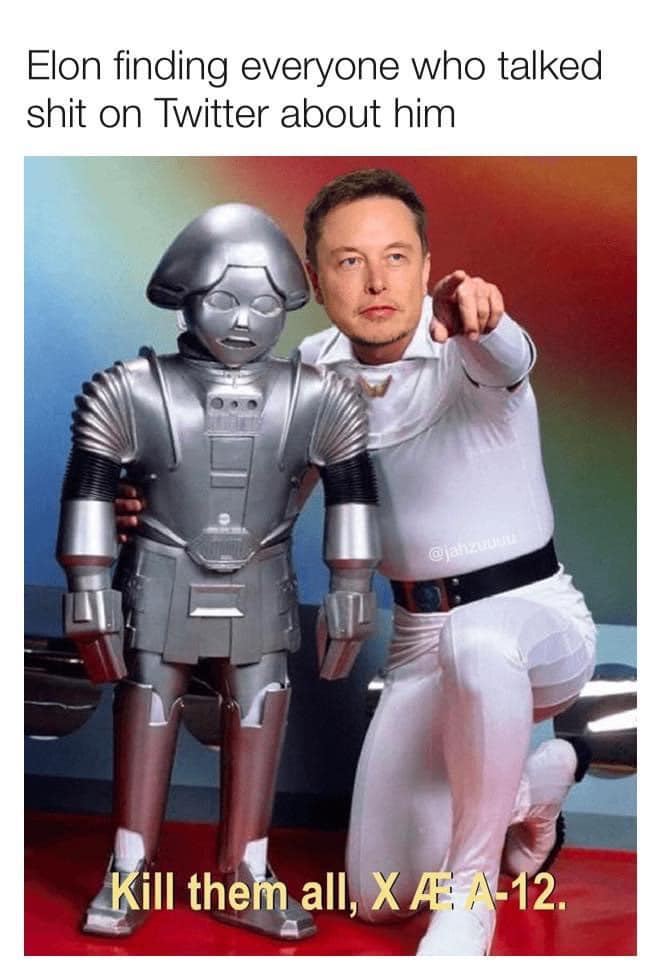
This meme portrays Elon Musk as an aggressive defender of his immense wealth, where he plans to destroy anyone who insults his massive brand on Twitter. The image includes the text "Kill them all, X Æ-12," which references a fan-fiction character he famously loved to create, symbolizing his "killer" nature. This fits the Anti-Billionaire category by depicting him as a wealthy, ruthless force that is aggressively defending his billions against verbal attacks.
simple-description (llama3.2-vision_11b)
The meme features a photo of Elon Musk with a robot, and the text "Elon finding everyone who talked s**t on Twitter about him". The image is a play on the classic sci-fi movie "The Terminator" where the character of the Terminator is told to "Kill them all, and let God sort them out". In this meme, the robot is saying "Kill them all, X for 12" which is a play on the original quote. The meme is a humorous take on Elon Musk's online presence and the reactions to his tweets.
detailed-analysis (gemma3-27b-vision)
Here's an analysis of the image, broken down into the sections you requested, only where applicable. It's a complex image with a lot of potential interpretation. I'll aim for thoroughness while staying within the scope of the analytical frameworks you've provided.
Visual Description
The image is a digitally altered photograph. It features Elon Musk standing in a white outfit, pointing aggressively forward. Beside him is a vintage toy robot from the 1980s, likely a variation of a "Big Trak" or similar robotic toy. The robot is metallic grey and red. Beneath the image is text: "Kill them all, X AE-A-12," referring to the name of Musk’s child. The top of the image has the text "Elon finding everyone who talked shit on Twitter about him". The background is a glossy red floor, indicative of a set or stage. The overall aesthetic is a deliberately jarring juxtaposition of a tech mogul with a retro toy, and the inclusion of violent text.
Foucauldian Genealogical Discourse Analysis
This image is ripe for Foucauldian analysis. The image discourse constructs Elon Musk as a figure of power who feels entitled to aggressively monitor and potentially eradicate dissenting voices on Twitter, now known as X.
- Power/Knowledge: Foucault argued that power and knowledge are inextricably linked. The image demonstrates this: Musk’s power stems from his control over a major platform for public discourse (X/Twitter), and he exercises this power by attempting to know (monitor) those who criticize him, framed as an enemy ("shit talkers"). This "knowledge" then justifies a violent response.
- Genealogy: Looking at the genealogy of this discourse (the historical emergence of this way of thinking), we can see it connected to long-standing patterns of those in positions of authority attempting to silence dissent. The depiction of Musk with a retro robot, which is a simple machine that follows commands, implies that he views individuals on social media as programmable entities, deserving of punishment for deviating from his preferred narrative. It suggests a desire to control the flow of information and suppress any negativity directed towards him.
- Disciplinary Power: The image hints at disciplinary power, the way institutions create norms and punish those who deviate. In this context, Musk is attempting to construct a norm of uncritical adoration, punishing those who step out of line with a threat of annihilation (figuratively represented by "kill them all").
Critical Theory
The image functions as a critique of the concentration of power in the hands of a few tech billionaires. Critical theorists like Adorno and Horkheimer, in Dialectic of Enlightenment, warned about the potential for technology to become an instrument of domination. This image embodies that fear.
- Instrumental Rationality: Musk's depicted actions—aggressive monitoring and implied violence—demonstrate instrumental rationality taken to an extreme. He treats online criticism as a problem to be solved, using the tools at his disposal (the robot, representing his control over technology) to eliminate it, regardless of ethical considerations.
- Culture Industry: The image can be seen as a commentary on the culture industry's ability to shape public opinion and normalize authoritarian tendencies. Musk’s perceived willingness to suppress dissent online contributes to a climate where critical thinking is discouraged and conformity is rewarded.
- The Authoritarian Personality: The image subtly suggests an authoritarian personality trait in Musk. The aggressive pose and the violent instruction to the robot point to a desire for control and a intolerance of opposition.
Marxist Conflict Theory
From a Marxist perspective, the image represents a power dynamic rooted in class conflict. Musk, as a member of the capitalist class, uses his wealth and control of a powerful media platform (X/Twitter) to suppress dissent from those who challenge his authority.
- Base and Superstructure: The "base" (economic system) is reflected in the "superstructure" (cultural forms, ideologies, etc.). Musk’s ability to silence critics on Twitter is a manifestation of the unequal power relations inherent in the capitalist system, where wealth and control are concentrated in the hands of a few.
- Ideology: The image subtly reinforces the ideology of meritocracy – the idea that success is solely based on individual effort and ability. By presenting Musk as a powerful figure who is willing to defend his reputation, the image implicitly justifies his actions and discourages criticism.
- False Consciousness: The image could also be seen as contributing to “false consciousness,” wherein individuals are unaware of the structural inequalities that shape their lives. By normalizing the suppression of dissent, the image discourages critical thinking and reinforces the status quo.
Postmodernism
The image is deeply postmodern in its use of irony, pastiche, and the blurring of boundaries between reality and simulation.
- Simulacra and Simulation: The image isn’t about real violence; it’s a simulation of it. The robot, the violent text, and the overall aesthetic create a hyperreality where the boundaries between the real and the artificial are blurred. This reflects Jean Baudrillard's concept of simulacra.
- Irony and Parody: The image's juxtaposition of a powerful tech mogul with a vintage toy is ironic. It mocks the seriousness with which Musk seems to take online criticism, presenting it as something that warrants a violent response.
- Deconstruction: The image can be “deconstructed” to reveal the underlying power dynamics at play. By challenging the conventional narratives surrounding Musk and his relationship to social media, the image forces us to question the assumptions we hold about power, control, and censorship.
Queer Feminist Intersectional Analysis
While not the central focus, a Queer Feminist Intersectional lens can reveal subtle implications within the image.
- Power Dynamics & Masculinity: The image plays into tropes of hypermasculinity and dominance. The aggressive pose, the violent instruction, and Musk’s overall presentation reinforce a traditional model of power where authority is asserted through force.
- Silencing Dissenting Voices: This resonates with feminist concerns about the silencing of marginalized voices. The threat of “killing” those who criticize Musk could be interpreted as a metaphor for the ways in which dominant groups suppress dissent from those who challenge their power.
- Intersectional Considerations: If the “shit talkers” on Twitter include marginalized groups (e.g., women, people of color, LGBTQ+ individuals), the image becomes even more problematic. It suggests that those who challenge the status quo—and especially those who are already marginalized—are subject to increased scrutiny and potential punishment. The image implicitly reinforces existing power structures and hierarchies.
I hope this comprehensive breakdown, organized by the requested analytical frameworks, is helpful! Let me know if you'd like me to explore any of these themes further.
simple-description (llama3.2-vision)
This meme is a satirical image of Elon Musk, the founder of Twitter and who f
tesseract-ocr
Elon finding everyone who talked shit on Twitter about him Pe @) eat a, 7 kana \} Y : \) fal Z , SZ eS PSs i \ ; nm = S if = Pat a El we my