First Seen
2023-05-24T22:39:02+00:00
simple-description (qwen3.5_2b-q8_0)
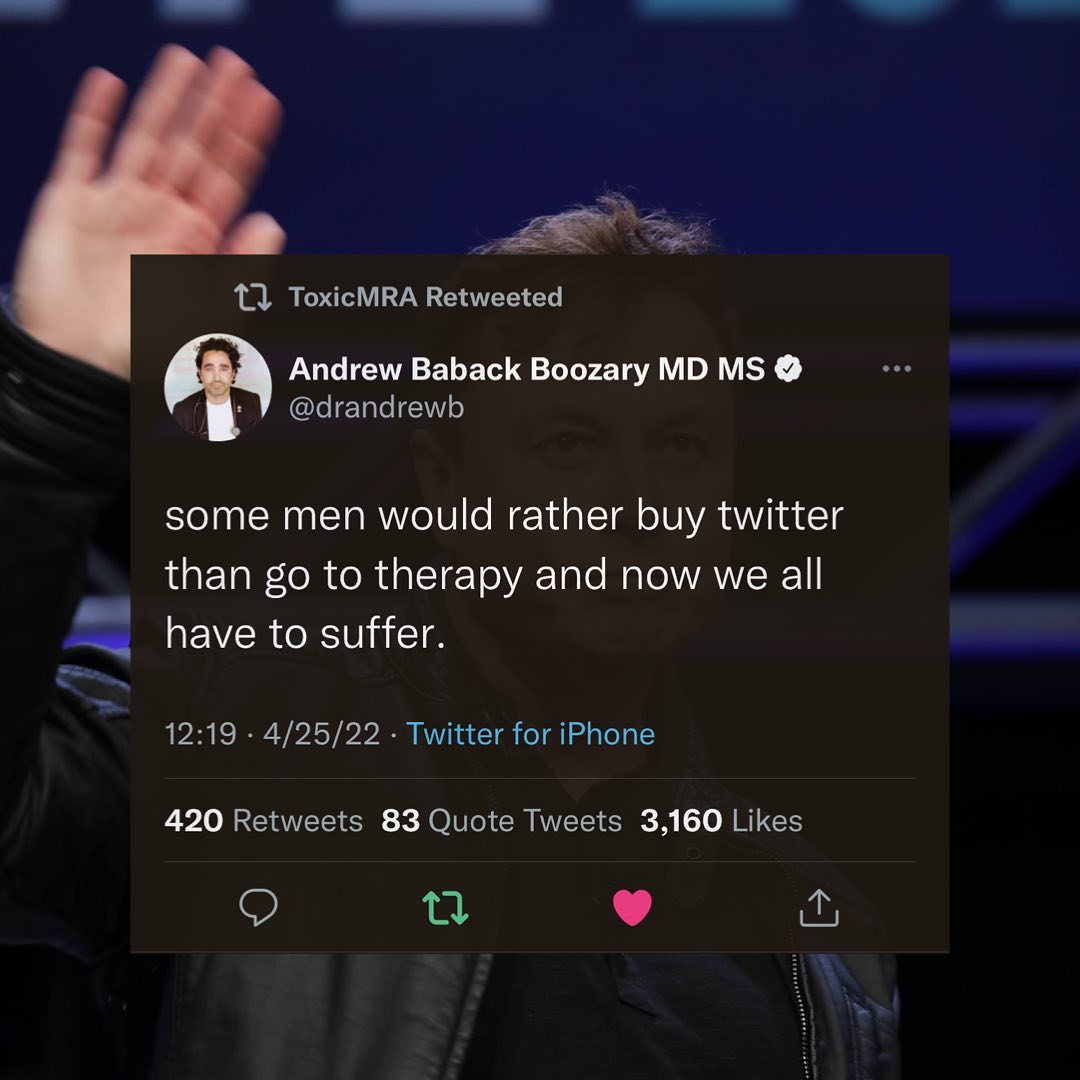
This meme features Andrew Babbage, a billionaire, with the text: "some men would rather buy twitter than go to therapy and now we all have to suffer." In the context of "Anti-Billionaire" humor, it mocks the wealthy's ego and perceived lack of empathy, suggesting that men are so superior they would rather pay for a social media app (Twitter) than seek mental health treatment, making him a "billionaire in the wrong way." The tweet has accumulated 420 retweets, 83 quote tweets, and 3,160 likes.
simple-description (llama3.2-vision_11b)
The meme is a screenshot of a tweet from Andrew Yang, a former presidential candidate, that says: "If men were interested in women's empowerment, they'd get vaccinated when pregnant, support equal pay, and not mansplain." The meme is captioned "If men were interested in women's empowerment..." and features a photo of Andrew Yang.
detailed-analysis (gemma3-27b-vision)
Okay, let's break down this tweet with the requested theoretical frameworks. Please note that applying complex theoretical frameworks to a single tweet is, by its nature, a bit of a stretch and relies on interpretation. I will aim for nuanced analysis where applicable.
Visual Description
The image is a screenshot of a tweet posted by Andrew Baback Boozary MD MS (@drandrewb) on April 25, 2022, via Twitter for iPhone. The background is a blurred, dark purple. The tweet itself is presented in a light-colored rectangle. It states: "some men would rather buy twitter than go to therapy and now we all have to suffer." Below the text are metrics indicating 420 retweets, 83 quote tweets, and 3160 likes. Icons for commenting, re-tweeting, liking, and sharing are visible at the bottom. Above the message is notation that the tweet was retweeted by the account ToxicMRA. The user’s Twitter profile picture is displayed above.
Foucauldian Genealogical Discourse Analysis
This tweet lends itself well to a Foucauldian analysis. Foucault would be interested in the discourse surrounding masculinity, mental health, and social responsibility.
- Power/Knowledge: The tweet frames a specific problem ("men buying Twitter instead of therapy") as leading to a generalized suffering. This asserts a form of power – the ability to define a problem and its consequences. The assertion implicitly positions the speaker as someone who knows what’s best for "we all," reinforcing authority.
- Genealogy: A genealogical analysis would trace the historical emergence of the idea that emotional labor and mental well-being are individually resolvable through therapy, rather than through community, social structures, or shared responsibility. This is particularly relevant given the rise of "self-improvement" culture and the commodification of mental health solutions. The tweet implicitly critiques a perceived shift from collective care to individualistic solutions.
- Discipline and Normalization: The tweet normalizes the idea that seeking therapy is the "correct" or "responsible" action. It also implicitly disciplines men who don’t engage in this practice, framing their choice as contributing to wider suffering.
- Discourse of "Suffering": The use of the word "suffer" is noteworthy. It broadens the scope of the impact beyond the individual man, implying a societal cost for choosing status/online presence over mental health.
Critical Theory
From a Critical Theory perspective (drawing from the Frankfurt School, especially), this tweet exemplifies several themes:
- Critique of Instrumental Reason: The tweet suggests a prioritization of "buying Twitter" (a purely instrumental act, focused on achieving a goal – status, influence) over the more complex, emotionally demanding work of therapy. This reflects a broader critique of a society that values productivity and quantifiable results over subjective well-being.
- Culture Industry: The reference to "buying Twitter" can be interpreted as a commentary on the culture industry – the mass production of commodified experiences and distractions. The tweet subtly suggests that men are being lured into a system that prioritizes consumption over self-reflection.
- Domination: The tweet frames the situation as a form of domination – the individual (the man) is "choosing" to prioritize superficiality, but this choice ultimately leads to harm for "we all." This echoes the Frankfurt School's concern with how cultural forces can perpetuate systems of control.
Marxist Conflict Theory
While a direct Marxist analysis is somewhat strained, connections can be made:
- Class and Consumption: "Buying Twitter" (or, more accurately, investing in the platform and its associated status) can be viewed as a form of conspicuous consumption, a display of wealth and status. This aligns with Marxist critiques of capitalist culture, where material possessions are used to signify social position.
- Alienation: The tweet subtly suggests that men are alienated from their own emotional needs, substituting genuine self-care with the pursuit of external validation (through Twitter).
- False Consciousness: It implies that men are operating under "false consciousness," believing that achieving status on social media will bring fulfillment, while neglecting the root causes of their emotional distress. The "we" in "we all suffer" suggests a collective exploitation of attention and engagement.
Postmodernism
A postmodern reading would focus on the instability of meaning and the fragmentation of the self:
- Hyperreality: The tweet highlights the blurring lines between "real" self-care (therapy) and simulated self-presentation (building a persona on Twitter). It suggests a shift towards a hyperreality where signs and symbols (Twitter status) become more important than the underlying reality (emotional well-being).
- Deconstruction of Masculinity: The tweet implies a critique of traditional masculine norms that discourage emotional vulnerability and self-reflection. It suggests that men are pressured to conform to a superficial image of success, even at the expense of their mental health.
- The Subject and Discourse: From a postmodern perspective, the "men" in the tweet are not unified subjects with essential characteristics. Rather, they are constructed through discourse—the dominant ways of thinking and talking about masculinity, social media, and mental health.
Queer Feminist Intersectional Analysis
This is where things get particularly complex, as the tweet doesn't directly address queer or feminist themes. However, an intersectional analysis can offer insights:
- Patriarchy and Emotional Labor: The tweet implicitly critiques patriarchal norms that discourage men from engaging in emotional vulnerability and self-care. It suggests that this silence and repression contribute to wider societal suffering. Patriarchy, therefore, plays a role in the cycle of emotional disconnect.
- The Burden on Others: "We all suffer" highlights the social cost of emotional unavailability. Those around the individual (partners, family, friends) may be disproportionately burdened with providing emotional support, or dealing with the consequences of the individual's emotional disconnect. This burden often falls on women.
- Masculinity and Vulnerability: The tweet touches upon the societal pressure on men to suppress vulnerability, which can contribute to a lack of access to mental health resources and support. An intersectional approach would recognize how race, class, and other identities intersect with masculinity to shape individual experiences of emotional expression and well-being.
- Toxic Masculinity & Harm: The account that retweeted the message, "ToxicMRA," illustrates a potential intersection with harmful ideologies. The original message, taken in connection with the retweeter, suggests a connection between failing to address mental health and a broader pattern of harmful behavior rooted in anti-feminist and patriarchal ideologies.
Important Caveats: This analysis is necessarily interpretive. The tweet is brief, and its meaning is open to debate. A comprehensive analysis would require more context and a deeper understanding of the author's intentions and the broader social and cultural landscape.
simple-description (llama3.2-vision)
This meme is a tweet from Andrew Baback Boozary, MD, MS, a doctor who tweets about health and social media. The tweet says, "Some men would rather buy Twitter than go to therapy and now we all have to suffer." The tweet is likely meant to be humorous and satirical, but it also points to a real issue: the rise of social media and its effects on mental health. The tweet is likely meant to be taken in a humorous way, but it also highlights the growing concern of social media's impact on our health.
tesseract-ocr
— —_ nl —E —_— ——— 2 AM ey een y Wat an -T-1c-ie} Andrew Baback Boozary MD MS @ wee + ¥ @drandrewb —_— some men would rather buy twitter than go to therapy and now we all o— | have to suffer. eines tae > 12:19 - 4/25/22 - Twitter for iPhone 420 Retweets 83 Quote Tweets 3,160 Likes ‘2 ce Vd ra \ Bl