First Seen
2023-05-24T22:39:03+00:00
simple-description (qwen3.5_2b-q8_0)
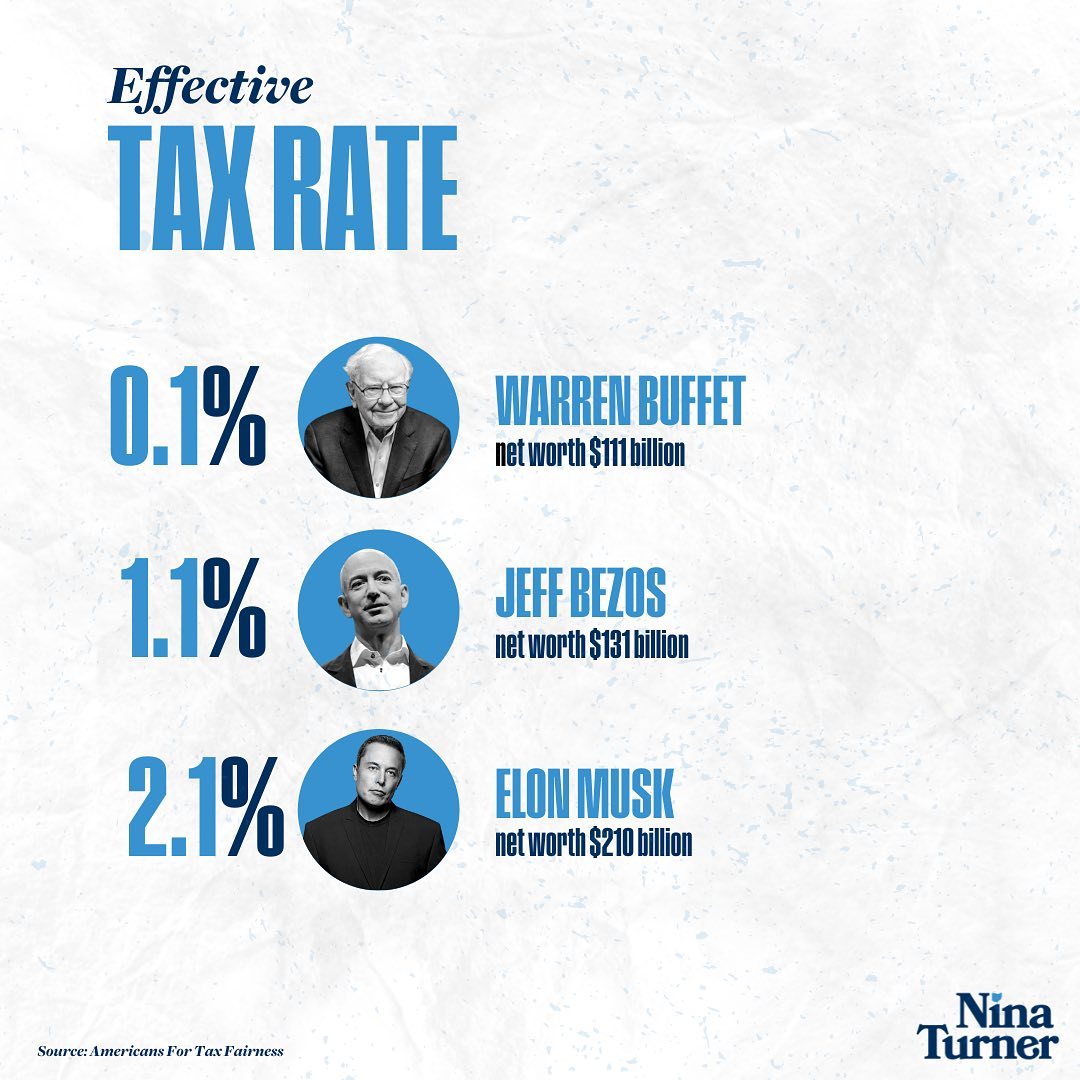
This anti-billionaire meme plays on the absurdity of taxing massive fortunes so lightly. It visually correlates the net worth of three major investors—Warren Buffett, Jeff Bezos, and Elon Musk—against their "Effective TAX RATE." As their wealth grows, the tax rate only increases slightly from 0.1% to 2.1%, highlighting that billionaires pay less than 1% of their wealth in taxes. The source, "Americans For Tax Fairness," is used to argue that these tiny rates are negligible compared to the millions involved.
simple-description (llama3.2-vision_11b)
The meme is a humorous image that compares the effective tax rates of billionaires to the average American. It shows a list of billionaires with their effective tax rates, with some having rates as low as 0.1% or even negative. The image is captioned "Anti-Billionaire" and features a quote from Warren Buffett saying "There's class warfare, when you have it, the rich have it, and they're going to keep it"
detailed-analysis (gemma3-27b-vision)
Okay, here’s a breakdown of the image, analyzed through several of the requested theoretical lenses. I will only include sections where the theoretical framework genuinely applies to the image and its implications.
Visual Description
The image is a graphic displaying the effective tax rates paid by three prominent billionaires: Warren Buffett, Jeff Bezos, and Elon Musk. The background is a light, mottled grey. The title "Effective TAX RATE" is in large, bold, blue lettering. Below this, each billionaire’s name is listed alongside their image (in a circular frame) and their stated net worth, alongside their effective tax rate. The rates are listed in ascending order: 0.1% (Buffett), 1.1% (Bezos), and 2.1% (Musk). The graphic is signed by Nina Turner at the bottom right, and the source is “Americans for Tax Fairness”. The visual layout emphasizes the disparity in tax rates paid by these extremely wealthy individuals.
Critical Theory
This image is a clear example of critical theory in action. It doesn't simply state a fact (the tax rates), but rather questions the status quo. The graphic challenges the assumption that wealth automatically translates to proportionate tax contribution. It implicitly asks: Is a system just where individuals with immense wealth pay a significantly lower percentage of their income in taxes than the majority of the population?
- Power Dynamics: The graphic highlights the power structures that allow extreme wealth accumulation and a disproportionately low tax burden. The selection of these three high-profile figures—individuals often seen as innovators and symbols of success—is a strategic move. It implicates the system, not necessarily the individuals themselves, as the primary problem.
- Ideology Critique: The image functions as a deconstruction of the ideology of meritocracy – the idea that success is based purely on individual effort and talent. It suggests that the system itself is rigged in favor of the wealthy, allowing them to accumulate wealth and minimize their tax obligations, regardless of their merit or the social consequences.
Marxist Conflict Theory
This graphic is inherently linked to Marxist conflict theory, as it explicitly points to class disparities and the exploitation embedded within the capitalist system.
- Class Struggle: The image represents a visual manifestation of the ongoing conflict between the bourgeoisie (the wealthy elite, represented by Buffett, Bezos, and Musk) and the proletariat (the working class, implicitly represented by those who pay a higher percentage of their income in taxes). It implicitly argues that the wealthy are unfairly benefiting at the expense of the rest of society.
- Capital Accumulation: The graphic highlights the dynamic of capital accumulation – the process by which wealth is concentrated in the hands of a few. By illustrating the low effective tax rates of these billionaires, it suggests that this accumulation is further facilitated by a tax system that disproportionately benefits the wealthy.
- False Consciousness: This graphic is an attempt to shatter "false consciousness"—the Marxist concept that the working class is unaware of the true nature of their exploitation. It seeks to reveal the reality of wealth inequality and encourage critical awareness of the structural factors that perpetuate it.
Foucauldian Genealogical Discourse Analysis
A Foucauldian analysis would examine how this image participates in a discourse surrounding wealth, taxation, and fairness. It would not focus on whether the information presented is "true" or "false," but rather on how the image constructs meaning and exercises power.
- Discursive Formation: The image is part of a larger discursive formation surrounding wealth inequality, progressive taxation, and social justice. This formation includes academic research, media coverage, political debate, and grassroots activism.
- Power/Knowledge: The image relies on and reinforces the power/knowledge nexus. The "knowledge" of these billionaires' tax rates gives power to those who present it. By framing these rates as unjust, the image seeks to shift the balance of power and influence policy change.
- Genealogy of Tax Policy: A deeper genealogical analysis would trace the historical evolution of tax policies and regulations, examining how they have been shaped by specific power dynamics and ideologies over time. The image implicitly challenges the current state of these policies.
- Discipline and Control: Tax systems are often framed as neutral mechanisms for funding public services. This image challenges that framing, suggesting that tax policies are, in fact, tools for exercising social control and maintaining existing power structures.
Note: Postmodernism and Queer Feminist Intersectional Analysis do not directly apply to this image in a significant way. While elements of social critique are present, the image primarily focuses on economic disparities rather than addressing questions of identity, representation, or power dynamics based on gender, sexuality, or other marginalized identities.
Let me know if you’d like me to elaborate on any of these analyses or explore other theoretical frameworks.
simple-description (llama3.2-vision)
The meme is a humorous comparison of the effective tax rates of three wealthy individuals. The image features a list of three names, with their net worths and effective tax rates: Warren Buffet (0.1%), Jeff Bezos (1.1%), and Elon Musk (2.1%). The text at the top of the image reads "Effective Tax Rate" and the source is listed as "Americans for Tax Fairness".
tesseract-ocr
Effective 0.1% & wawe 11% @ sams 2%@ au