First Seen
2023-05-24T22:39:03+00:00
simple-description (qwen3.5_2b-q8_0)
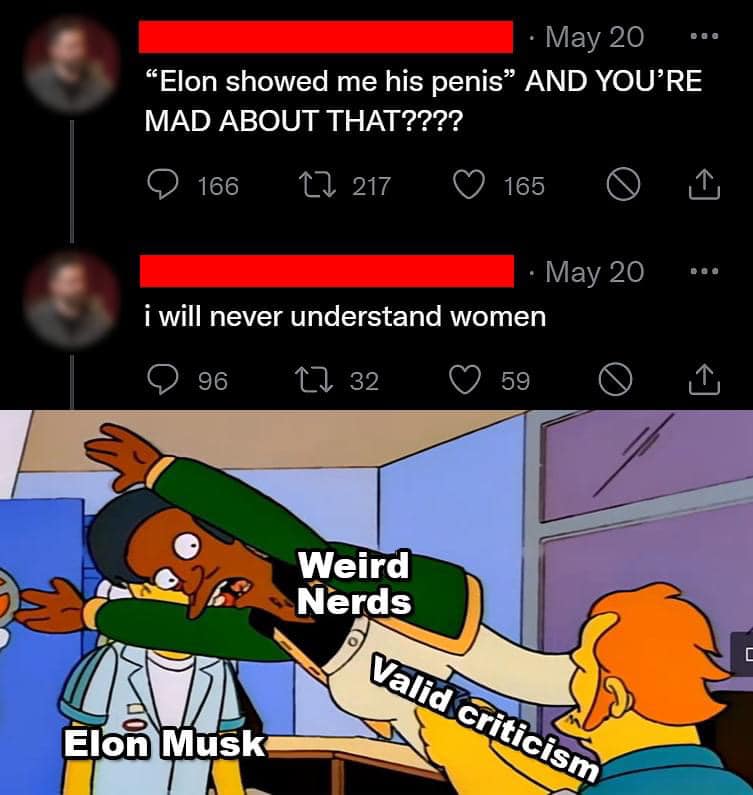
This meme plays on the "anti-billionaire" narrative by suggesting Elon Musk has lost his control and is now being treated as a vulnerable object by the community that judges his sexuality. The top text mocks his physical appearance with the claim "his penis," while the bottom image parodies the scene by labeling the woman in the nurse's uniform as "Elon Musk" and having "Weird Nerds" strike her for "Valid criticism." It visually connects the "men" aspect of the top image to the "nurse" aspect of the bottom image, implying Musk is a woman who has lost the respect of his "natives."
simple-description (llama3.2-vision_11b)
The meme is a screenshot of a tweet from Elon Musk, where he responds to a comment about his wealth by saying "I don't read it that way". Below the tweet, an image from the TV show "South Park" is overlaid with the words "I don't read it that way" in a caption box. The image shows a character from the show, Cartman, saying "You're not reading it that way, that's your interpretation, not my interpretation."
detailed-analysis (gemma3-27b-vision)
Okay, let's break down this image and the associated tweets through the requested theoretical lenses. It's important to note this is an interpretation; these theories are complex, and application can be nuanced.
Visual Description
The image is a compilation of two Twitter posts layered above a frame from the animated TV show Family Guy. The first post reads, in all caps, “'Elon showed me his his penis' AND YOU'RE MAD????” and includes metrics for retweets, likes, and replies. The second post reads, "I will never understand women" with similar metrics.
Below, the Family Guy image features Peter Griffin attempting to forcefully embrace and kiss Lois Griffin, who is visibly repulsed and pushing him away. Labels have been added to the image: "Elon Musk" is written near Peter Griffin, "Weird Nerds" over Peter’s back, and "Valid Criticism" along the line of Lois’s push. The overall visual effect implies a comparison between Peter's unwanted advances and the reactions to the claims about Elon Musk.
Foucauldian Genealogical Discourse Analysis
This image operates heavily within the realm of power/knowledge, central to Foucault's work. The tweets and the associated image construct a discourse around sexual entitlement and responses to alleged abuse.
- Power/Knowledge: The first tweet establishes a power dynamic by presenting the claim ("Elon showed me his penis") as if it’s a trivial event, and the subsequent anger is presented as an irrational overreaction. This utilizes power/knowledge by defining acceptable responses to sexual harassment or assault. The framing positions those expressing outrage as unreasonable while subtly normalizing the behavior of Musk.
- Genealogy: We could trace the genealogy of this discourse to broader historical patterns of male entitlement and the minimization of sexual harm. This image doesn't create the problem; it's a symptom of a long-standing historical power imbalance. It draws upon existing tropes of men believing they are owed attention (and more) from women.
- Disciplinary Power: The response ("I will never understand women") acts as a form of disciplinary power, framing women as inherently incomprehensible and justifying the lack of accountability for harmful behaviors. It's a silencing tactic disguised as bewilderment.
Critical Theory
The image strongly aligns with themes within Critical Theory, specifically focusing on:
- Ideology: The image presents a skewed ideology which normalizes and even justifies potentially harmful behaviors by a powerful man, while dismissing legitimate outrage. The implication is that focusing on harm is somehow a problem, rather than the behavior itself.
- Hegemony: The image suggests a hegemonic power structure where the actions of wealthy and influential figures (like Musk) are implicitly defended, and critiques are marginalized. The "weird nerds" label suggests a dismissive attitude toward those who object. The visual positioning of Lois pushing Peter away with “Valid Criticism” is undermined.
- Commodification of the Body: The initial tweet (regarding Musk and his penis) contributes to the objectification and commodification of women's bodies and sexual experiences. Framing it as something that elicits anger implies a possessive attitude towards both Musk and those who respond.
Marxist Conflict Theory
While not the primary lens, Marxist thought can offer some insight:
- Class and Power: Elon Musk embodies the capitalist class – a powerful figure with substantial economic and social capital. The image subtly reinforces class dynamics by framing criticisms of Musk as resentment toward his success or status.
- Ideological Control: The presentation of the situation as an overreaction can be interpreted as a form of ideological control, reinforcing the dominant narrative that protects the interests of the wealthy and powerful.
- Exploitation and Control: The initial claim (regarding sexual display) could be seen as reflecting a dynamic of power and control, where Musk leverages his status to exert influence and potentially exploit others.
Postmodernism
Postmodern themes are present in the image’s deconstruction of traditional narratives:
- Meta-Narratives: The image challenges the meta-narrative of romantic pursuit (as depicted in Family Guy), subverting it by labeling it as problematic. The image suggests that the typical “boy pursues girl” trope is not innocent but can be a manifestation of harmful power dynamics.
- Simulacra and Simulation: The image operates as a simulacrum of a genuine critique. It appears to address concerns about power and abuse, but ultimately reinforces the harmful behavior.
- Deconstruction of Meaning: The juxtaposition of the tweets and the Family Guy image deconstructs the meaning of both. It intentionally creates ambiguity and forces viewers to question the underlying assumptions.
Queer Feminist Intersectional Analysis
This is where the analysis becomes particularly strong:
- Sexual Harassment/Assault: The initial tweet directly engages with issues of sexual harassment/assault. Framing outrage as irrational minimizes the harm caused and centers the perpetrator's agency.
- Misogyny & Gender Roles: The image perpetuates harmful gender roles. It subtly implies that women are overly sensitive or unreasonable in their reactions to male behavior. The claim that the tweeter “will never understand women” underscores a belief in inherent female incomprehensibility.
- Intersectionality: While not explicitly stated, the image highlights the intersection of power, gender, and class. Musk’s wealth and influence provide him with a level of protection and impunity that others would not have. The image reflects a dynamic where powerful men are afforded more leeway while women’s concerns are dismissed.
- Invalidation of Experience: The framing of "valid criticism" being repelled by Peter Griffin/Musk demonstrates the systematic invalidation of women’s experiences and voices. It presents a situation where speaking out against harm is met with resistance and dismissal.
In conclusion: The image is a complex and disturbing example of how power, ideology, and gender dynamics intersect online. By using a popular meme format, it normalizes harmful behavior and silences critical voices. Applying these theoretical lenses helps to unpack the underlying assumptions and power imbalances that are at play.
simple-description (llama3.2-vision)
The meme is a screenshot of a Twitter thread where someone is defending their right to make a joke about someone's name. The person is saying that they are not making a personal attack, and that they are just making a joke about someone's name. The person is also saying that they are not going to get into a debate about the person's name, and that they are going to leave it. The image is accompanied by a image of a person being attacked by a person with a sign that says "Weird Nerds" and "Valid Criticism". The text at the bottom of the image says "I will never understand women".
tesseract-ocr
Zs os \V/F-\V"4@ ‘ “Elon showed me his penis” AND YOU’RE MAD ABOUT THAT???? Ow tlar Oo OQ FW e Pa Wee. x i will never understand women Os tMWs2 Os OQ w& (i a Cc ! Sy a at Nerds } | y . y We / f nt A [as a C C Ul CTP ( JG —— eR! o = = Si be - Elon)Musk NY ORS ae! r T SS SO eee