First Seen
2023-06-05T01:51:19+00:00
simple-description (qwen3.5_2b-q8_0)
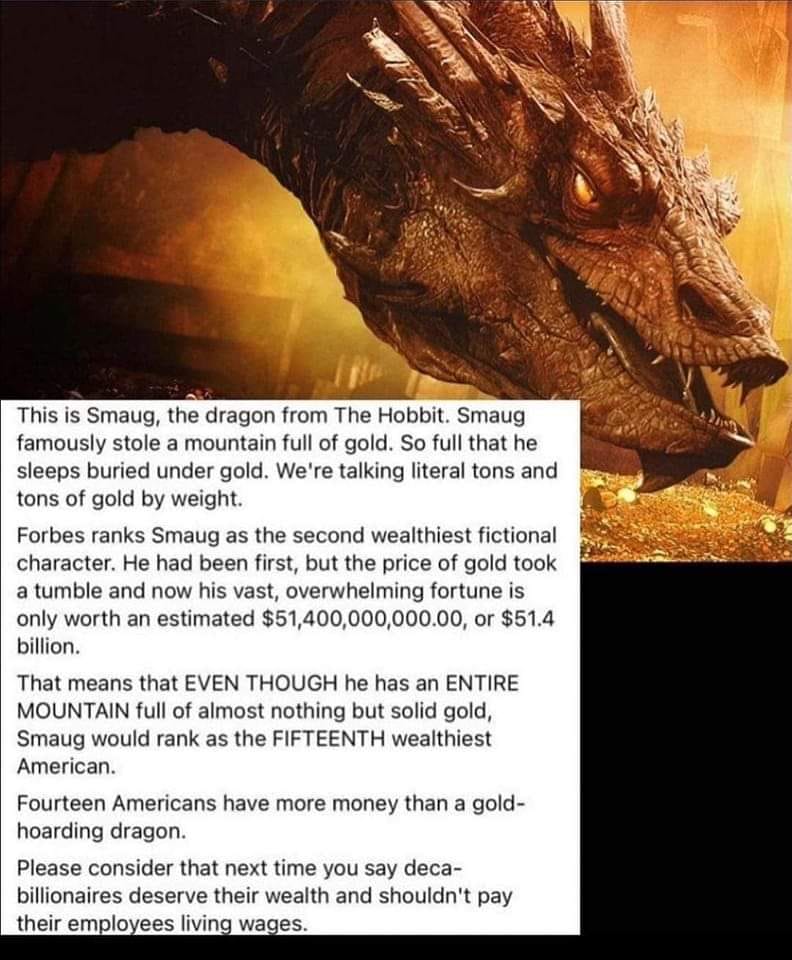
This meme features the dragon Smaug from The Hobbit, a character famous for his vast hoard of gold. From an Anti-Billionaire perspective, the image satirizes the absurdity of billionaire wealth by noting that despite owning an entire mountain of gold, his fortune is estimated to be only worth $51 billion, ranking him merely 15th among the wealthiest Americans. It concludes with a sarcastic twist, implying that "decabillionaires" shouldn't expect to pay their employees a living wage.
simple-description (llama3.2-vision_11b)
The meme is a humorous take on the concept of wealth and the absurdity of billionaire's statements. The image features a quote from J.R.R. Tolkien's "The Lord of the Rings" where Bilbo Baggins says "It's like the one ring to rule them all, one ring to find them, one ring to bring them all, and in the darkness bind them." but replaced with a quote from a billionaire saying "It's like the one dollar to make them, one dollar to find them, one dollar to make them richer." The meme pokes fun at the idea that billionaires often say things like "it's like one ring to rule them all" but in reality they are just saying "it's like one dollar to make them, one dollar to find them, one dollar to make them richer."
detailed-analysis (gemma3-27b-vision)
Okay, let's break down this image and accompanying text through the requested theoretical lenses. It's a rich little piece for analysis!
1. Visual Description
The image depicts Smaug, the dragon from J.R.R. Tolkien's The Hobbit. He’s rendered in a fiery, digitally painted style. The image focuses on his head, highlighting his scales, teeth, and piercing eye. The predominant colors are reds, oranges, and golds, evoking fire, wealth, and danger. Smaug appears powerful, majestic, and almost regal in his pose, despite being mid-roar. The artist emphasizes the immense scale of the dragon through the focus on a part of the head, suggesting the entirety of his being is massive. The texture is heavily detailed, emphasizing the material reality (scales, teeth) while also giving a fantastical impression.
2. Foucauldian Genealogical Discourse Analysis
The text sets up a discourse around wealth and valuation. A Foucauldian approach would trace the history of how “wealth” itself came to be understood as something quantifiable, particularly through the act of ranking (Forbes list).
- Power/Knowledge: The Forbes ranking isn’t simply a neutral assessment. It constitutes Smaug's and the Americans' worth through this act of evaluation. It’s a power/knowledge relation – the ability to rank and assign monetary value gives Forbes and the institutions they represent significant power.
- Discontinuity & Historical Layers: The shift in Smaug’s rank due to fluctuations in the price of gold demonstrates that wealth isn’t a fixed, inherent quality. It’s historically contingent, a product of markets and valuation systems that change over time.
- Discursive Formations: The very premise – comparing a mythical dragon’s hoard to the wealth of contemporary Americans – highlights the way society discursively defines worth. It’s not about use value (what something does) but exchange value (what it’s worth in monetary terms). This demonstrates how our contemporary valuation systems have become divorced from material needs and ethical considerations.
3. Marxist Conflict Theory
This image and text are highly relevant to Marxist thought.
- Class Struggle & Unequal Accumulation: The core message is the stark inequality of wealth distribution. Smaug, who acquired his wealth through (essentially) theft and hoarding, is outranked by fourteen Americans. This is a clear example of how wealth tends to concentrate in the hands of a few.
- Means of Production (absent): Smaug’s hoard is accumulated, not produced. The comparison subtly implicates modern American billionaires who derive their wealth from exploitative labor practices and control of the means of production (like factories, resources, etc.).
- Superstructure & Ideology: The final line – "Please consider that… billionaires deserve their wealth and shouldn't pay their employees living wages" – is a powerful statement of ideology. It’s a justification for the existing power structure, an attempt to legitimize vast inequality. This is the “superstructure” (ideas, beliefs) working to maintain the “base” (economic system) of exploitation. It’s designed to normalize the idea that extreme wealth is deserved, even at the expense of worker well-being.
- Alienation: Smaug’s relationship to his gold is one of possessive obsession. There's no apparent use of the gold to better society; it's solely about the accumulation of capital. This reflects a core element of Marxist theory: alienation from the fruits of labor and the potential for meaningful contribution.
4. Critical Theory
The image and text lend themselves to Critical Theory in several ways.
- Domination & Power Structures: The core message critiques existing power structures and the normalization of extreme wealth inequality. The comparison between Smaug and the American billionaires serves to expose the underlying mechanisms of domination that maintain this inequality.
- Frankfurt School influence: The text reveals the insidious ways in which dominant ideologies (like the “billionaires deserve their wealth” argument) become ingrained in our collective consciousness.
- Critique of Enlightenment Rationality: The image subverts the idea that economic valuation is objective and rational. By comparing a mythical dragon’s hoard to contemporary wealth, it highlights the arbitrary and often illogical nature of capitalist valuation systems.
- The Culture Industry: The ranking by Forbes is a component of the “culture industry” that perpetuates certain beliefs and values.
5. Postmodernism
A postmodern reading would focus on the blurring of boundaries and the deconstruction of meaning.
- Hyperreality & Simulation: The comparison between Smaug and the Americans is a simulation, a constructed comparison that doesn’t necessarily have a basis in “reality.” It creates a hyperreal situation where fantasy and reality are intertwined.
- Deconstruction of Value: The text challenges the notion of “objective” value. What does it mean to rank a dragon’s hoard alongside human wealth? It highlights the constructed nature of value and the arbitrary systems we use to measure it.
- Meta-Narratives: The text subtly critiques the “meta-narrative” of capitalist progress and the idea that wealth accumulation is inherently good.
- Irony & Parody: The juxtaposition of a mythical dragon with modern billionaires could be read as ironic or even parodic, suggesting that both operate within similar systems of greed and hoarding.
6. Queer Feminist Intersectional Analysis
While not the most central focus of the image, an intersectional analysis adds important layers:
- Patriarchal Capitalism: The billionaires mentioned (implied) are overwhelmingly male, reflecting the historical dominance of men in wealth accumulation. This speaks to the intersection of capitalism and patriarchy, where systems of power reinforce each other.
- Labor and Exploitation: The final line advocating for low wages highlights the gendered and racialized dimensions of labor exploitation. Women and people of color are disproportionately represented in low-wage jobs, making them particularly vulnerable to exploitation.
- Hoarding and Scarcity: Smaug’s hoarding of gold can be read as a metaphor for the ways in which resources are disproportionately controlled by a few, creating scarcity and inequality for others. This links to feminist critiques of patriarchal control over resources.
- Critique of the "Deserving" Narrative: The line about billionaires deserving their wealth relies on narratives of meritocracy that often ignore the systemic barriers faced by marginalized groups, further solidifying inequalities.
Let me know if you’d like me to elaborate on any of these theoretical lenses or explore another aspect of this image and text.
simple-description (llama3.2-vision)
The meme is a satirical article about Smaug, the dragon from J.R.R. Tolkien's "The Hobbit," comparing him to modern-day wealthy individuals. The text describes Smaug's massive gold hoard and compares it to the wealth of 14 Americans. The article ends with a call to action, asking readers to consider the wealth of Smaug compared to that of 14 Americans and to consider the wealth of Smaug's gold compared to that of the 15th wealthiest American.
tesseract-ocr
A ~ oN ; SEN —— a WSS a Nae Sk R aS. aS ; Ss th x re y i) . AS 4 ; SS ay A a Ne ay * BAN: \ pe NS ay » N —s This is Smaug, the dragon from The Hobbit. Smaug famously stole a mountain full of gold. So full that he a sleeps buried under gold. We're talking literal tons and =Saaa4 oe tons of gold by weight. SASS Forbes ranks Smaug as the second wealthiest fictional § 23 character. He had been first, but the price of gold took eine a tumble and now his vast, overwhelming fortune is only worth an estimated $51,400,000,000.00, or $51.4 billion. That means that EVEN THOUGH he has an ENTIRE MOUNTAIN full of almost nothing but solid gold, Smaug would rank as the FIFTEENTH wealthiest American. Fourteen Americans have more money than a gold- hoarding dragon. Please consider that next time you say deca- billionaires deserve their wealth and shouldn't pay their employees living wages.