First Seen
2023-06-03T22:06:53+00:00
simple-description (qwen3.5_2b-q8_0)
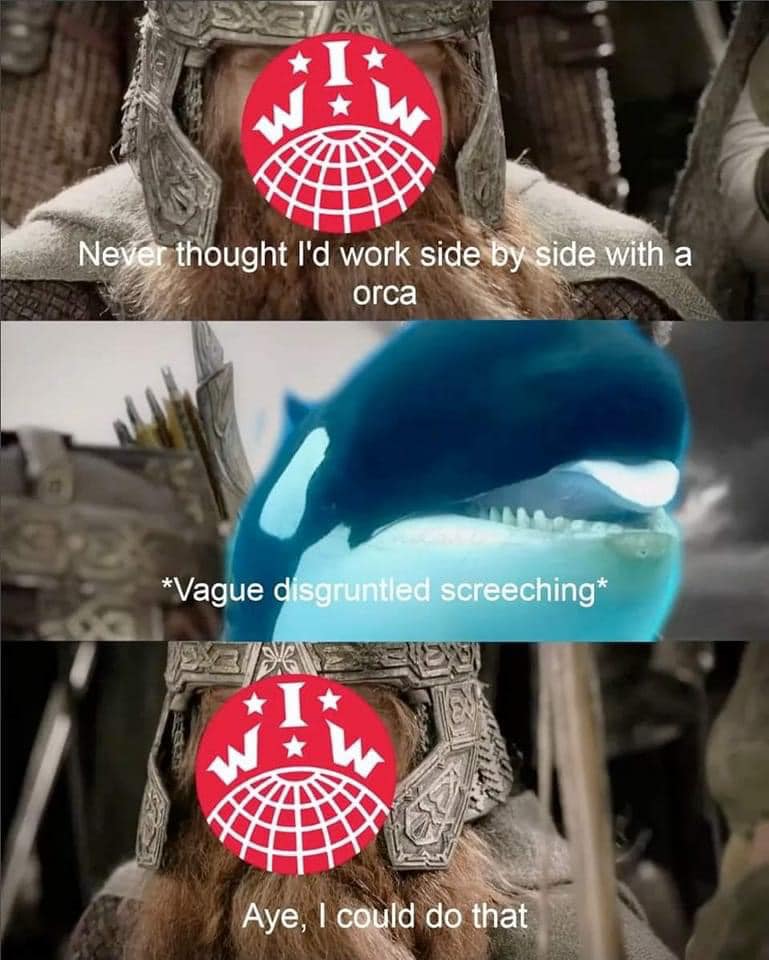
This meme features Bilbo Baggins from The Lord of the Rings, humorously portraying him as someone who finds the deal incredibly cheap. He wears a "WIW" (World Is Wrong) sticker over his face, implying that despite the absurdity, he is happy to participate in the low-cost activity. The text "Never thought I'd work side by side with an orca" suggests he expected the price to be astronomical, but his reaction "Aye, I could do that" confirms his view that the deal is a bargain he is willing to accept.
simple-description (llama3.2-vision_11b)
The meme is a humorous take on the idea that a billionaire would be unable to relate to a worker's struggles. The image shows a billionaire (played by a comedian) saying "I'd work for $0.50 an hour" in response to a worker's complaint about low wages. The text is a play on the idea that billionaires are so disconnected from the struggles of the working class that they wouldn't even be able to understand the concept of low wages.
detailed-analysis (gemma3-27b-vision)
Okay, let's break down this meme using the requested theoretical frameworks. It’s quite a layered image, so we'll go into detail.
Visual Description
The image is a three-panel meme constructed from stills likely extracted from a film or video game.
- Panel 1: Features a character, recognizably a Viking/Norse warrior, wearing elaborate armor. On their chest is a circular emblem containing a stylized "IWW" (Industrial Workers of the World) logo set against a blue globe. Text reads, "Never thought I'd work side by side with an orca."
- Panel 2: Shows a digital rendering of an orca, depicted in a simplified, almost cartoonish style. The background is a blurred, watery scene. Text reads "Vague disgruntled screeching".
- Panel 3: Returns to the Viking/Norse warrior, emphasizing the IWW emblem on the armor. The text reads, "Aye, I could do that."
The image clearly utilizes meme structure – juxtaposition of images and text – to create a humorous and potentially ironic statement. The aesthetic mixes historical/fantasy elements (Viking) with overtly political iconography (IWW).
Foucauldian Genealogical Discourse Analysis
This image can be examined through a Foucauldian lens by tracing the discourses at play and how power relations manifest.
- Discourses: The image blends several discourses. There’s the discourse of labor and class struggle (IWW representing socialist/anarcho-syndicalist ideals), the discourse of environmentalism and marine life (the orca), and the historical discourse surrounding Vikings (representing a warrior culture). We can also see a discourse of internet memes themselves, with their inherent playfulness and subversion.
- Power/Knowledge: The IWW emblem represents a challenge to traditional power structures based on capital and the state. By associating this emblem with a warrior figure, the meme subtly suggests a potential for direct action and resistance. The orca, often seen as an apex predator, introduces the discourse of natural power, yet it's rendered in a passive, "disgruntled" manner.
- Genealogy: Tracing the “genealogy” of the IWW reveals its origins in the late 19th/early 20th century labor movements. The meme utilizes this historical baggage to create a sense of radical potential. The orca, in contrast, taps into more contemporary environmental concerns. The juxtaposition highlights how seemingly disparate struggles can be linked.
- Panopticism: The Viking's image and implied authority can be seen as akin to a disciplinary structure (panopticon). However, the IWW logo complicates this, suggesting an internal resistance to that structure, and the orca, as a somewhat rebellious element, challenges the entire framework.
Critical Theory
From a Critical Theory perspective (drawing on Frankfurt School thinkers like Adorno and Horkheimer), this meme can be viewed as a form of cultural critique.
- Culture Industry: The meme itself is a product of the “culture industry,” a system that produces mass-produced culture for consumption. It parodies and recombines existing imagery and ideologies.
- Ideology: The IWW logo represents a counter-ideology to mainstream capitalism. The meme, by presenting it alongside a historically ‘brutal’ figure, presents an interesting critique. It isn't advocating for this 'brutality', but rather subverting the expectation by layering a symbol of socialist labor values over it.
- Enlightenment Dialectic: The image could be seen as a distorted reflection of the Enlightenment project. The Enlightenment promised rationality and progress, but also led to new forms of domination (like industrial capitalism). The meme seems to suggest a need for radical change and resistance.
Marxist Conflict Theory
This meme directly resonates with Marxist Conflict Theory.
- Class Struggle: The IWW is explicitly a labor organization committed to worker empowerment and challenging capitalist exploitation. The meme’s imagery is inherently linked to the struggle between the proletariat (workers) and the bourgeoisie (owners of capital).
- False Consciousness: The meme could be interpreted as a playful attempt to break through “false consciousness” - the ideological indoctrination that keeps workers from recognizing their own exploitation. By pairing a traditionally ‘powerful’ figure with a symbol of worker solidarity, it disrupts typical power dynamics.
- Revolutionary Potential: The meme subtly hints at the possibility of revolutionary change. The pairing of the Viking and the IWW emblem suggests that resistance can take unexpected forms. The orca, as an ally to the Viking, suggests an expansion of the revolutionary coalition beyond traditional class boundaries (to include environmental concerns).
Postmodernism
From a Postmodern perspective, this meme embodies several key themes:
- Pastiche & Intertextuality: The meme is a pastiche, combining elements from disparate sources (Vikings, IWW, digital graphics). It’s intertextual, relying on the viewer’s prior knowledge of these references.
- Deconstruction: The meme deconstructs traditional notions of power, authority, and solidarity. It disrupts the expected associations between the Viking archetype and the IWW ideology.
- Simulacra & Simulation: The meme is a simulation of meaning, playing with signs and symbols in a self-referential way. The ‘vague disgruntled screeching’ of the orca is a particularly strong example – a signifier without a clear signified, adding to the ambiguity and playfulness.
- Rejection of Metanarratives: The meme eschews grand, overarching narratives. It does not offer a simple solution or ideology. Instead, it presents a fragmented, ironic, and ambiguous image.
Queer Feminist Intersectional Analysis (This is a stretch, but let’s explore it.)
Applying a Queer Feminist Intersectional lens requires a bit more creativity:
- Challenging Normative Structures: The meme, by subverting expected power dynamics, challenges normative structures of authority. The Viking, traditionally a symbol of masculinity and dominance, is aligned with a symbol of worker solidarity, hinting at a rejection of traditional hierarchies.
- Coalition Building: The alliance between the Viking, the IWW, and the orca represents a form of coalition building. It suggests that struggles for social justice (labor rights, environmental protection, queer liberation) can be interconnected.
- Deconstructing Masculinity: The Viking archetype can be seen as a representation of toxic masculinity. By associating this figure with a symbol of worker solidarity (historically a movement that challenged patriarchal structures), the meme subtly deconstructs traditional notions of masculinity.
- Non-Human Agency: The inclusion of the Orca, a non-human animal, acknowledges the ecological interconnectedness and can be seen as a move towards a more inclusive feminist framework that considers non-human animal agency and rights. (This is speculative, but fits within ecofeminist thought.)
I hope this breakdown is helpful! It's a rich image that lends itself to multiple interpretations, which is part of what makes it a successful meme. Let me know if you’d like me to delve into any of these theoretical frameworks in more detail.
simple-description (llama3.2-vision)
The meme is a humorous exchange between two characters, one of whom is a member of the International Workers of the World (IWW) union. The character says "Never thought I'd work side by side with an orca" and the response is "Aye, I could do that". The image is a play on the idea of a worker being able to work with a large and dangerous animal like an orca, and the response is a humorous and unexpected answer to the situation.
tesseract-ocr
Ia°¢- =e bole * Sd \ 4 y raw) a sac ~ Tulle ano asisce ss, eh iue eS orca S 3g a \ V4 ' ,- i. 4 at a “Vague qi 7 Peres Som ) ge xJ* Ry if x Ww PN cane ea P = J Aye, | cquld do that