First Seen
2023-06-21T03:06:37+00:00
simple-description (qwen3.5_2b-q8_0)
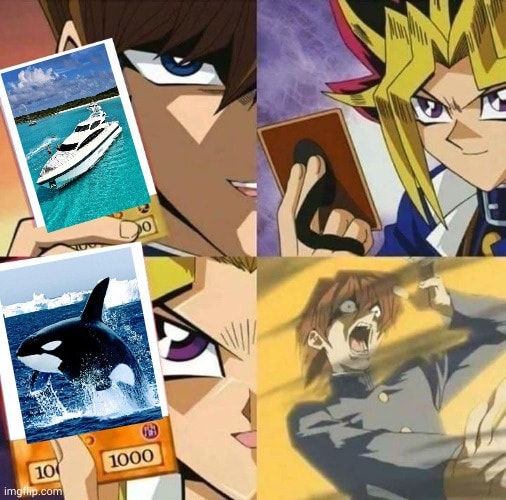
The meme pairs a luxurious yacht with a terrifying killer whale, suggesting that holding a fortune brings bad luck. Labeled with yellow chips reading "10" and "1000," the image plays on the absurdity of such opulence, mocking the idea that the wealthy lifestyle (represented by the yacht) is just as scary and dangerous as the creatures they inhabit.
simple-description (llama3.2-vision_11b)
The meme is a humorous critique of billionaires' excesses, with a photo of a yacht juxtaposed with a picture of a whale. The image is captioned "When you're worth more than the entire city of New York but you still can't afford a decent whale". The meme is poking fun at the absurdity of billionaires' wealth, implying that even their vast fortunes can't buy them a whale, a symbol of the natural world that's often more expensive than their yachts.
detailed-analysis (gemma3-27b-vision)
Okay, here's an analysis of the image, structured into the requested theoretical frameworks, and only covering those where the image provides relevant points for discussion.
Visual Description
The image is a four-panel meme format, using characters and elements from the anime/manga series Yu-Gi-Oh!. The central figure is Seto Kaiba, a prominent character known for his wealth, dueling prowess, and ego. He's depicted in two panels, with portions of his face visible.
The other two panels feature digitally added images styled to resemble Yu-Gi-Oh! monster cards. The top card depicts a yacht sailing on a calm blue ocean. The bottom card features an orca (killer whale) breaching the surface of a tumultuous sea. Both cards include digitally added numerical stats as seen on Yu-Gi-Oh! cards.
The overall aesthetic is intentionally low-resolution and memetic, leveraging the recognizable visual language of Yu-Gi-Oh! and the contrast between the serene yacht and the powerful orca.
Marxist Conflict Theory
This image lends itself strongly to a Marxist interpretation. The contrast between the yacht and the orca can be read as a metaphor for class struggle.
- The Yacht: Symbolizes the opulence and privilege of the capitalist class. It represents leisure, excess, and the appropriation of natural resources for personal enjoyment. It’s a symbol of unearned wealth, detached from labor.
- The Orca: Represents the raw power of nature, but also the forces that are exploited and subjugated by capital. The turbulent sea suggests struggle and resistance. The orca, despite its power, is ultimately confined to a "card," controlled within the rules of the "game" (capitalism).
- Seto Kaiba: As a character deeply rooted in wealth and control within the Yu-Gi-Oh! universe, Kaiba embodies the capitalist archetype. He is the one wielding these symbolic cards, asserting dominance over both the luxury of the yacht and the power of the orca. The fact that he's holding the cards implies that, within the "game," he controls these forces.
The meme suggests a conflict between the forces of luxury and nature, controlled by a single, powerful entity (Kaiba/capital). The implied conflict is that nature will ultimately revolt against the excesses of capitalism.
Postmodernism
The image exemplifies several elements of postmodern thought:
- Pastiche/Intertextuality: The image is a mashup of different cultural references: Yu-Gi-Oh! anime, images of wealth and luxury, and natural imagery. It relies on the audience's recognition of these elements to create meaning.
- Simulation/Hyperreality: The "cards" are simulations of reality – images representing a yacht and an orca, framed within the rules of a game. This blurs the lines between the real and the representation, creating a hyperreal effect. The image isn’t about the yacht or the orca directly; it's about the idea of them within a constructed context.
- Deconstruction of Meaning: The contrast between the elements disrupts any simple, straightforward interpretation. The meme doesn't offer a clear message; instead, it invites the audience to actively construct meaning based on their own associations and interpretations.
- Irony and Parody: The use of a childhood anime character in connection with capitalist critique suggests a degree of irony and parodies the tropes of both fandom and social commentary.
Foucauldian Genealogical Discourse Analysis
A Foucauldian reading can focus on the “rules of the game” represented by the Yu-Gi-Oh! cards and how these rules shape our understanding of power and control.
- Discourse & Power: The card game itself constitutes a discourse, a system of thought and language that produces particular understandings of power. The stats on the cards (attack, defense) are not inherent qualities of the yacht or the orca but are assigned by the rules of the game, illustrating how power is constructed and measured through discourse.
- Genealogy of Control: One could trace the genealogy of how we’ve come to understand and control nature and wealth. The cards represent a modern attempt to categorize, quantify, and therefore control these forces. The game imposes a system of measurement on things that are inherently beyond simple quantification.
- Panopticism (though less directly): While not a perfect fit, the idea of the “game” implies a system of surveillance and control. Players are bound by the rules, constantly assessed and categorized (by card stats).
In essence, the image can be seen as a metaphor for how modern power operates—not through brute force, but through the construction of systems of knowledge and control (the rules of the game) that shape our perceptions and behaviors.
I've avoided sections on Critical Theory and Queer Feminist Intersectional Analysis because the image does not readily lend itself to meaningful analysis through those lenses without significant stretching or imposition of concepts. While one could try to find connections, it would feel forced and not particularly illuminating.
Let me know if you'd like me to elaborate on any of these points!
simple-description (llama3.2-vision)
This meme is a collage of four images. The top-left image is a picture of a boat on the water, the top-right image is a character from the anime "Yu-Gi-Oh!" holding a card, and the bottom-left image is a picture of a whale. The text "1000" appears in the bottom-right image, which is a picture of a character from the anime "Yu-Gi-Oh!" looking shocked. The meme is likely making a humorous comparison between the value of a whale's life (1000) and the value of a boat on the water.
tesseract-ocr
ea al === —_. Ss SY MG V / \ > p ! \ (Sa een x , | a 1 ae / 104 4000 s 7!