First Seen
2023-06-21T03:06:51+00:00
simple-description (qwen3.5_2b-q8_0)
This is an anti-billionaire meme that mocks the wealthy for using political arguments to blame the poor for their own suffering. The text "I'm joining the war on orcas who attack boats" is a sarcastic jab at how billionaires frame the struggles of the underclass as an attack on nature, effectively justifying their own excess spending. The visual of the child in an orca costume references the massive profits made by the fishing industry, suggesting that the wealthy fund the industries people are supposed to fight against.
simple-description (llama3.2-vision_11b)
The meme is a play on the phrase "I'm with stupid" and features a person in a whale costume, referencing the 1993 movie "Free Willy" where a whale named Willy is set free. The text overlayed on the image says "I'm with stupid" and "I'm with stupid on the side of the whales", implying that the person is pointing out someone who is being foolish, much like the phrase's original intention.
detailed-analysis (gemma3-27b-vision)
Okay, let's break down this meme through various critical lenses. It’s a rather… unique image, so some lenses will yield more fruit than others.
Visual Description
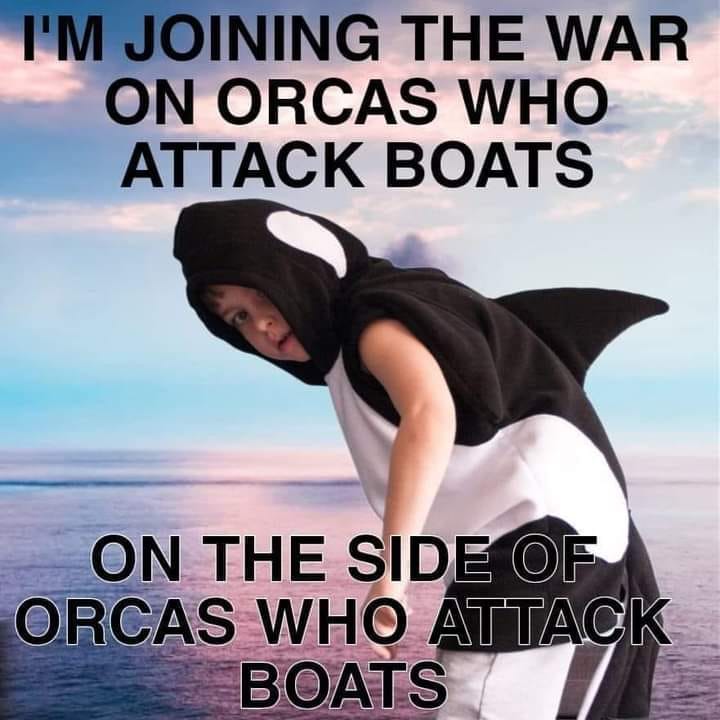
The image features a young child wearing a costume resembling an orca (killer whale). The costume is a white body suit with a black dorsal fin attached to the back, and a black hood featuring the orca’s head over the child’s face. The background is a blurred ocean scene with a blue sky. Text overlays the image. At the top, it reads "I'M JOINING THE WAR ON ORCAS WHO ATTACK BOATS." Beneath the image it reads “ON THE SIDE OF ORCAS WHO ATTACK BOATS.” The image is clearly humorous and intentionally absurd. The contrast between the child dressed as a predator and the stated allegiance to the “attacking orcas” creates the core joke. The visual simplicity combined with the nonsensical text is indicative of internet meme culture.
Foucauldian Genealogical Discourse Analysis
This meme participates in a discourse about animal behavior, particularly the recent (and much-discussed) phenomenon of orcas intentionally targeting boats. A Foucauldian analysis would examine how this discourse is constructed and what power dynamics it reveals.
- Discourse: The meme positions itself within a developing discourse concerning orcas and their "attacks." This discourse has been shaped by media coverage, online commentary, and expert opinion. The meme, however, re-frames the discourse by taking a side, and a deliberately absurd one, in this conflict.
- Power/Knowledge: The “knowledge” of orca behavior (they are intelligent, complex creatures capable of learning and even teaching each other tactics) intersects with power relations. Humans hold power over orcas due to technological and economic advantages. However, the recent behavior suggests a shifting of that power dynamic, and the meme acknowledges this.
- Genealogy: Looking back, the historical understanding of orcas was largely as apex predators, but not as agents of targeted rebellion against human structures (boats). The meme represents a break from that traditional understanding, highlighting a new narrative that emerges from the current conflict.
- The Absurdity as Resistance: The meme itself is a playful disruption of the discourse. By positioning a child as an orca, and on the side of the "attackers", it rejects a straightforward human-centric narrative.
Critical Theory
The meme can be seen as a commentary on the human-animal relationship and the imposition of human values onto animal behavior.
- Critique of Anthropomorphism: The meme, while absurd, highlights the tendency to interpret animal behavior through a human lens. The idea of “war” or taking “sides” implies a level of intentionality and political awareness that may or may not exist in orca behavior.
- Deconstructing the “Natural”: Traditionally, we see boat-orca interactions as an accidental collision or natural behavior. The meme disrupts this understanding. It asks us to consider the possibility that these aren’t merely accidents, but a form of protest or resistance.
- The Role of Spectacle: The attention given to the orca behavior itself is part of the spectacle. The meme plays into this spectacle by embracing the absurdity of the situation.
Marxist Conflict Theory
This application is a bit of a stretch, but we can find some connections.
- Class Struggle (Symbolic): We can view the conflict between orcas and boats as a symbolic representation of class struggle. Boats represent human industrial/economic power, and the orcas represent a marginalized group resisting that power.
- Exploitation & Resistance: Orcas have historically faced threats from human activities like captivity, pollution, and overfishing. The “attacks” could be interpreted as a form of resistance against this exploitation. The meme, by taking the orca’s side, aligns itself with this resistance.
- Reclaiming Agency: The meme, even playfully, attempts to reclaim agency for the orcas. It suggests they are not simply reacting to external forces, but are actively choosing to “attack” (symbolically).
Postmodernism
The meme embodies many postmodern characteristics.
- Irony & Parody: The meme relies heavily on irony and parody. The image and text are clearly not meant to be taken literally. They are a playful mockery of the “serious” discourse surrounding the orca behavior.
- Hyperreality & Simulation: The meme exists within a hyperreal space – the internet. It's a simulation of a conflict, divorced from the “real” world.
- Deconstruction of Meaning: The meme intentionally destabilizes meaning. It presents a nonsensical scenario that forces the viewer to question their assumptions about animal behavior, conflict, and the human-animal relationship.
- Intertextuality: The meme relies on the viewer's awareness of the broader conversation around orcas attacking boats. It’s a self-aware reference to a specific moment in internet culture.
Queer Feminist Intersectional Analysis
This is the most challenging lens to apply, but we can find some points of connection.
- Challenging Human Exceptionalism: Queer and feminist theory often critiques hierarchical structures that privilege certain groups (humanity) over others (animals). By siding with the orcas, the meme challenges the assumption that humans are inherently superior.
- Disrupting Normative Structures: The absurdity of the meme disrupts the "normal" way we think about animals, conflicts, and the natural world. Queer theory emphasizes the importance of challenging norms and embracing difference.
- Intersectionality & Environmental Justice: The threats facing orcas (pollution, overfishing, climate change) are often linked to systems of exploitation and oppression that also impact marginalized human communities. Taking the side of the orcas can be seen as a form of solidarity with environmental justice movements.
- Reclaiming Agency & Voice: The meme, though humorous, can be interpreted as an attempt to give a voice to a non-human entity. This aligns with feminist efforts to amplify marginalized voices.
I hope this breakdown provides a useful analysis of the meme through these various critical lenses. It's a strange image, and therefore invites a lot of interpretation!
simple-description (llama3.2-vision)
The meme features a child dressed as an orca (also known as a killer whale) in a humorous, child-sized orca costume. The text at the top reads, "I'm joining the war on orcas who attack boats." The text at the bottom says, "On the side of orcas who attack boats."
tesseract-ocr
iM JOINING THE WAR ON ORCAS WHO ATTACK BOATS ON THE y F ORCAS WHO Aime k