First Seen
2023-06-21T03:08:06+00:00
simple-description (qwen3.5_2b-q8_0)
This meme depicts a scene from the animated series Bob's Burgers where a child character (the orca-headed Bob) points aggressively at a scientist character, acting with arrogant dismissiveness. In the context of the "Anti-Billionaire" meme format, it mocks the wealthy elite and the idea that money buys status. The caption, "You son of a bitch, I'm in...", is added to emphasize the character's attitude of superiority and contempt.
simple-description (llama3.2-vision_11b)
The meme is a screenshot from the TV show "Rick and Morty" where Rick says "Wubba lubba dub dub!" while pointing at a group of people. The image is captioned "When you're a billionaire and you're still a billionaire".
detailed-analysis (gemma3-27b-vision)
Okay, let's break down this meme/image using the requested theoretical frameworks. It's quite a bizarre image, so some sections will be stronger than others.
Visual Description
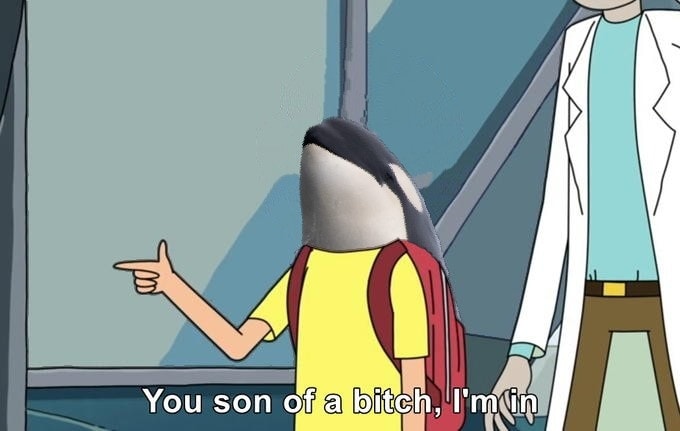
The image appears to be a digitally altered screenshot from the animated television show Rick and Morty. The central figure is a character whose head has been replaced with a realistic image of an Orca/Killer Whale. The body remains in the cartoon style of the show, clothed in a yellow shirt and a red backpack. The character is pointing accusingly (or dramatically) with one arm, while the other arm is obscured. The background is a nondescript hallway or airport terminal rendered in a flat, cartoon style. At the bottom of the image, there's a caption that reads “You son of a bitch, I’m in”. The juxtaposition of the cartoon body and realistic whale head creates a surreal and absurd effect. The overall composition suggests a dramatic or confrontational moment.
Postmodernism
This image is highly postmodern. Several key concepts align:
- Pastiche & Juxtaposition: The image is a blatant example of pastiche – taking elements from disparate sources (cartoon animation, wildlife photography) and combining them into something new. The absurd juxtaposition of the cartoon body and the realistic whale head is the core of its humor and meaning.
- Hyperreality: The image blurs the lines between reality and representation. It’s not actually a cartoon character with a whale head, but a digital fabrication. This plays with our understanding of what is "real" and what is simulated, contributing to a sense of hyperreality – a simulation of reality that becomes more real than real.
- Irony & Parody: The use of a seemingly random, aggressive caption ("You son of a bitch, I'm in") combined with the utterly bizarre visual creates a strong sense of irony. It mocks the conventions of dramatic confrontation while simultaneously being a confrontation in its own right.
- Deconstruction of Meaning: There’s no inherent, stable meaning in the image. The viewer is left to interpret the relationship between the visual elements and the caption, creating a subjective and fluid meaning that resists easy categorization.
Foucauldian Genealogical Discourse Analysis
Analyzing this image through a Foucauldian lens focuses on how power operates through discourse, and how that shapes our understanding of the image and its elements:
- Power/Knowledge: The choice to represent the character with a whale head isn't arbitrary. Whales, particularly Orcas, have accumulated a discourse around them. They are often seen as powerful, intelligent, sometimes fearsome, and sometimes vulnerable creatures. By attaching this "whale discourse" to the character, the image leverages existing power dynamics and perceptions.
- Genealogy of the Orca Image: To perform a proper genealogy, we’d need to trace the historical shifts in how Orcas have been represented – from monstrous sea creatures in older narratives to the increasingly complex and compassionate representations we see today (think Free Willy). This history influences how we read the image – are we meant to see a fearsome aggressor, a majestic being, or a creature out of its natural habitat?
- Disciplinary Power: The dramatic, accusatory posture and caption suggest a power dynamic. The character is asserting themselves, potentially challenging someone's authority. The image could be interpreted as a subversion of expected social norms or a rejection of disciplinary power.
Critical Theory
This image, while absurd, can be read through a critical theoretical lens focusing on the construction of identity and societal critique:
- Alienation & Fragmentation: The image embodies a sense of alienation and fragmentation. The mismatch between the cartoon body and the realistic whale head represents a disruption of wholeness and a blurring of boundaries. This could be interpreted as a metaphor for the fragmented experience of modern life.
- The Absurdity of Existence: The image's lack of coherent meaning highlights the absurdity of existence. It throws into question the search for rational explanations and invites us to embrace the irrational and chaotic nature of reality. This aligns with existentialist thought (a branch of critical theory).
Queer Feminist Intersectional Analysis (Limited Application)
This framework is more challenging to apply directly, but some threads are present.
- Disrupting Natural Categories: The image subverts natural categories. A whale is not supposed to have a human-like body, and that very disruption can be seen as a challenge to fixed categories. This resonates with queer theory's deconstruction of binaries and heteronormative structures.
- Intersectionality & Dislocation: While not explicit, the image can be interpreted as representing a sense of displacement. The whale, a creature of the ocean, is forcefully placed in a human-built environment. This displacement can be read metaphorically for the experiences of marginalized groups who are often excluded from dominant narratives and spaces.
Marxist Conflict Theory (Weak Application)
The application of this theory is the weakest, but a loose connection can be drawn:
- Alienation from Labor/Nature: The whale, as a symbol of the natural world, is juxtaposed with the artificiality of the cartoon world. This could be interpreted as a critique of capitalist exploitation of nature and the alienation of humans from the natural world.
- Power Dynamics & Struggle: The aggressive caption hints at conflict. This could be broadly interpreted as a representation of class struggle, where the whale (representing the exploited) is confronting its oppressor. However, this is a very tenuous connection.
I hope this comprehensive analysis, broken down by the requested theoretical frameworks, is helpful. Let me know if you'd like me to elaborate on any specific point!
simple-description (llama3.2-vision)
The meme features a character from the animated series "BoJack Horseman" who is known for his sarcastic and often dark humor. The character is pointing at someone, and the text "You son of a bitch, I'm in" is superimposed over the image. The meme is likely poking fun at the character's sarcastic and sometimes aggressive tone, and the phrase is likely used to express a sense of annoyance or frustration.
tesseract-ocr
Zz Ea S 4 ( \ ; c a \ | i x | You son EIS, |