First Seen
2023-06-22T01:27:22+00:00
simple-description (qwen3.5_2b-q8_0)
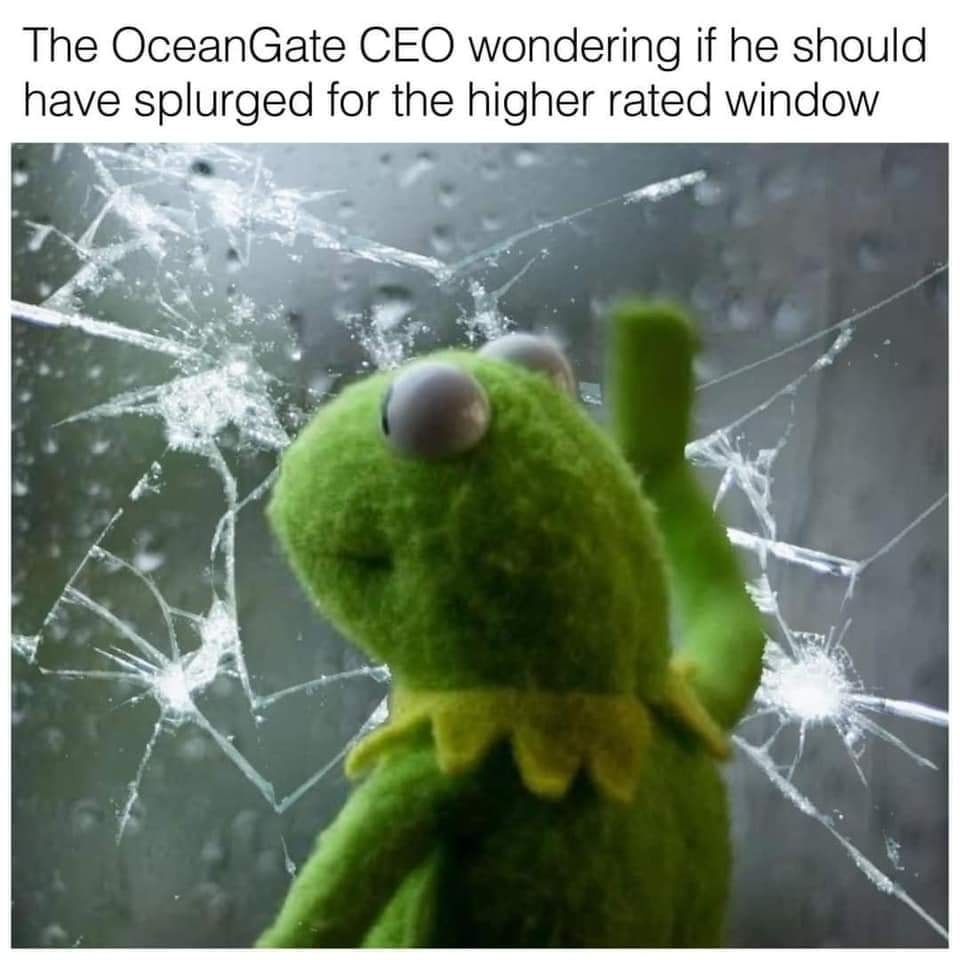
The caption asks if the OceanGate CEO should have paid for higher-rated insurance to survive the ship's failure. This "Anti-Billionaire" joke critiques the idea that wealthy corporate leaders should invest heavily in financial safety, noting that such decisions often lead to catastrophic tragedy. It uses Kermit the frog to symbolize the fragile reality of high-stakes risk, where the cost of safety can far exceed the value of the gamble itself.
simple-description (llama3.2-vision_11b)
The meme is a photo of a broken window with the caption "When you're a billionaire and you can't even afford to fix your own windows". The image is a play on the phrase "I'm worth billions, but I can't even..." and is a humorous commentary on the wealth and privilege of billionaires.
detailed-analysis (gemma3-27b-vision)
Okay, here’s an analysis of the meme, broken down into sections as requested. I'll focus on the sections that genuinely lend themselves to analysis, and skip those where the connection is tenuous or doesn’t add significant insight.
Visual Description
The image is a digitally manipulated meme. It features Kermit the Frog, seemingly submerged in water, with a fractured, web-like pattern of white lines superimposed over the background, mimicking the appearance of a cracked or imploding window. Kermit is looking upwards with a slightly vacant or pensive expression. His pose, with one hand raised, suggests a moment of contemplation or realization. The text overlay reads: “The OceanGate CEO wondering if he should have splurged for the higher rated window.” This explicitly links the meme to the Titan submersible disaster and the perceived cost-cutting measures that may have contributed to it. The overall effect is darkly humorous, using a beloved children’s character to comment on a tragic and controversial event.
Foucauldian Genealogical Discourse Analysis
This meme, while seemingly simple, can be analyzed through a Foucauldian lens. The "truth" surrounding the Titan submersible disaster isn’t a straightforward objective fact, but is constructed through discourse. The meme re-articulates this discourse.
- Power/Knowledge: The meme highlights the power dynamics at play. Stockton Rush, the OceanGate CEO, wielded power as an innovator and entrepreneur, framing the submersible as a disruption of the traditional deep-sea exploration industry. However, this power was intertwined with specific forms of knowledge—engineering standards, safety protocols, and a willingness to accept (or disregard) risk. The meme suggests that this "knowledge" was shaped by profit motives.
- Genealogy of Safety: A genealogical analysis could trace the history of deep-sea submersible safety standards. What were the original norms? How did they evolve? What pressures led to deviations from these norms (like Rush's dismissal of certification)? The meme alludes to this by implying a willful abandonment of established safety standards in pursuit of cost savings.
- Discourse & Subjectivation: The meme subjects Rush to ridicule and criticism. It participates in a wider discourse that constructs him as reckless and irresponsible. This shapes how we understand the tragedy – not as a simple accident, but as the outcome of a deliberate disregard for safety.
Critical Theory
This meme invites critical analysis of the structures that allowed the Titan disaster to happen.
- Commodification of Risk: The submersible itself, and the experience it offered, can be seen as a commodified form of risk. Wealthy individuals were buying the experience of extreme adventure, and Rush was selling it. The meme implicitly criticizes the logic of a system that prioritizes profit over safety, even when dealing with life-threatening ventures.
- Rationality & Instrumental Reason: The meme hints at the dangers of “instrumental reason” – a focus on efficiency and achieving goals (in this case, cheaper construction) without considering ethical implications or potential consequences. Rush's decision to use unconventional materials and skip certification can be interpreted as a triumph of purely technical rationality over broader considerations.
- The Spectacular Society: The submersible disaster, and the subsequent media coverage, can be seen through a "spectacular society" lens (drawing on Guy Debord). The experience itself was marketed as a unique spectacle, and the tragedy has become another spectacle—a drama played out in the media with sensationalized details.
Marxist Conflict Theory
While not a central theme, elements of Marxist conflict theory can be applied.
- Class Conflict: The passengers of the submersible were wealthy individuals, and the disaster highlights the privileges and risks associated with extreme wealth. They were able to afford an experience unavailable to most, and the tragedy underscores the exploitative nature of a system that caters to the desires of the elite.
- Capital Accumulation & Cost-Cutting: The drive for profit—capital accumulation—is implicitly criticized in the meme. The suggestion that Rush skimped on the window to save money points to a larger pattern of cost-cutting measures that prioritize profit over safety.
- Alienation: There's a subtle element of alienation present – the alienation of the CEO from the consequences of his decisions. He’s removed from the immediate risk and focused on the financial gains, creating a disconnect between profit and human life.
Postmodernism
The meme itself embodies certain postmodern characteristics:
- Irony & Parody: The use of Kermit the Frog—a wholesome, innocent character—to comment on a tragic event is inherently ironic and parodic. It subverts expectations and creates a jarring juxtaposition.
- Simulacra & Simulation: The submersible experience was, in a way, a simulation of deep-sea exploration. The meme plays with this idea by presenting a digitally manipulated image that further blurs the line between reality and representation.
- Deconstruction of Authority: The meme implicitly challenges the authority of Rush as an innovator and entrepreneur. It suggests that his expertise was misguided and that his actions were irresponsible.
I hope this detailed breakdown is helpful. Let me know if you'd like me to elaborate on any of these points.
simple-description (llama3.2-vision)
The meme features a picture of Kermit the Frog standing in front of a shattered glass window, with a thought bubble above his head. The text at the top of the image reads: "The OceanGate CEO wondering if he should have splurged for the higher-rated window." The meme is a humorous commentary on the tragic loss of the OceanGate submersible and the CEO's potential regret over not investing in a more durable window.
tesseract-ocr
The OceanGate CEO wondering if he should have splurged for the higher rated window ee é - — r¥ = 3 os Bn ae eM i Pe oe. » Wee oes i. q . aN % a a Ba . % f by y x ~ ‘4 4 4 , ae ‘