First Seen
2023-06-23T21:52:29+00:00
simple-description (qwen3.5_2b-q8_0)
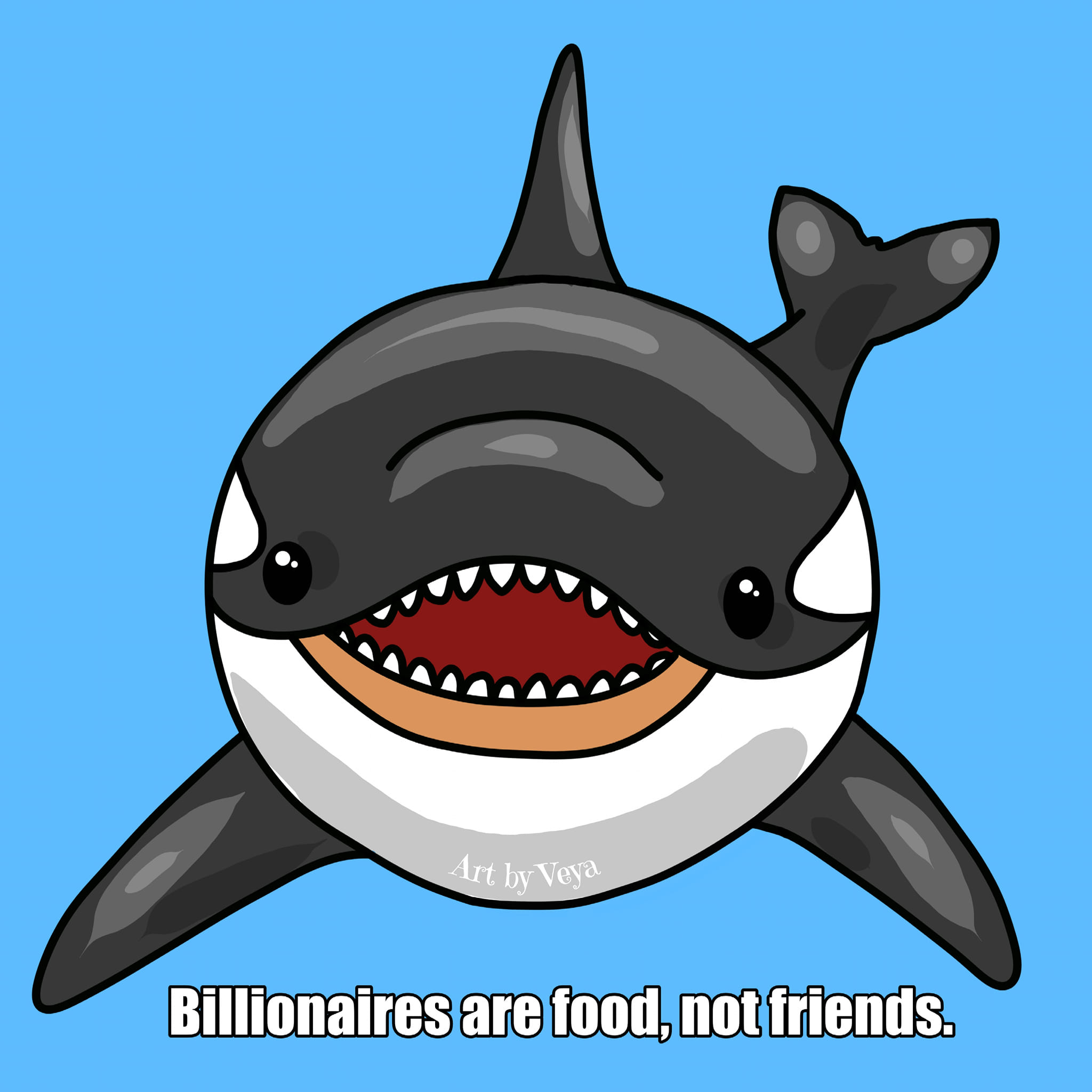
This anti-billionaire meme features a shark aggressively biting the word "Billionaires." In this context, it portrays these wealthy individuals not as allies, but as dangerous food to be consumed. The text explicitly states, "Billionaires are food, not friends," implying that their ambition is a threat that must be dealt with.
simple-description (llama3.2-vision_11b)
The meme is a humorous illustration of a shark with a smiling face, captioned "Billionaires: 'I'm just a shark, I'm not a predator, I'm just a shark, I'm not a predator'". The image is a play on the stereotype that billionaires are ruthless and exploitative, with the shark's innocent and playful demeanor subverting this expectation.
detailed-analysis (gemma3-27b-vision)
Okay, let's break down this image with analysis through several theoretical lenses.
Visual Description
The image depicts a cartoon orca (killer whale) with a somewhat exaggerated and menacing appearance. The orca is rendered in a simple, graphic style with bold black outlines and flat coloring. Its body is primarily black and white, the typical orca coloration. However, the mouth is open in a wide grin, revealing numerous sharp teeth and a bright red interior. The eyes are large and round, with small black pupils, giving it a somewhat manic or unsettling expression. The background is a flat, bright blue. Below the image is text that reads “Billionaires are food, not friends,” with the words “Art by Vaya” printed near the bottom of the graphic. The overall effect is jarring; the cute cartoon style clashes with the predatory nature implied by the open mouth and teeth.
Foucauldian Genealogical Discourse Analysis
This image functions as a disruption of the discourse surrounding wealth and the ultra-rich. Typically, the media and cultural narratives around billionaires involve narratives of innovation, philanthropy, and even aspiration. They are often framed as "job creators," "visionaries," or even presented as individuals to be emulated. This image genealogically challenges that discourse.
The choice of an orca, a top-level predator, is central. Orcas aren't 'friends' they are a force of nature. The graphic forces a re-evaluation of how we conceptualize the relationship between the ultra-wealthy and the rest of society. Instead of viewing them as partners in progress, it positions them as a force to be consumed or neutralized—something to be taken from, not befriended. The stark imagery deconstructs the carefully constructed narratives surrounding wealth and power, revealing a more brutal power dynamic beneath the surface. It asks: who is actually "preying" on whom?
Marxist Conflict Theory
From a Marxist perspective, this image is a potent visual representation of class conflict. The phrase “Billionaires are food, not friends” encapsulates the fundamental contradiction inherent in capitalism: the vast accumulation of wealth by a small elite at the expense of the majority.
The orca is symbolic of that dominating class, not as a benevolent provider, but as a predatory force that consumes resources and labor. The image suggests that the relationship between the ultra-wealthy and the working class isn’t one of mutual benefit, but one of exploitation. The image implicitly advocates for a fundamental restructuring of the system, suggesting that the ultra-wealthy should not be treated as allies or role models, but as obstacles to be overcome. It hints at a revolutionary sentiment—the need to "consume" or dismantle the structures that allow such vast wealth inequality to persist.
Postmodernism
The image plays with the simulacrum and the breakdown of grand narratives. The cute cartoon style is a hyperreality—an over-the-top, artificial representation that draws attention to its own constructedness. This clashes with the harsh message, creating a sense of irony and unsettling the viewer.
The image deconstructs the traditional “rags to riches” narrative and the ideology of meritocracy often associated with wealth. It suggests that wealth isn't earned through hard work and innovation, but is a form of predation. The image rejects the idea of a coherent, universal truth about wealth and instead presents a fragmented, ironic commentary on the power dynamics at play. It acknowledges the constructed nature of meaning, prompting the viewer to question the narratives surrounding wealth and power.
Queer Feminist Intersectional Analysis
While not immediately obvious, a queer-feminist intersectional reading could analyze the image through the lens of predation and power imbalances. Historically, marginalized groups—women, queer people, people of color—have often been positioned as the prey in patriarchal and capitalist systems. This image flips that dynamic, positioning the ultra-wealthy as the predatory force.
The image can be interpreted as a metaphor for dismantling oppressive power structures. Just as an orca hunts and consumes its prey, marginalized groups are reclaiming their power and challenging the systems that exploit them. This reading highlights the importance of collective action and solidarity in challenging the predatory behaviors of those in power.
Let me know if you’d like me to elaborate on any of these analyses, or explore other theoretical frameworks!
simple-description (llama3.2-vision)
The meme features a cartoon orca whale with a wide, toothy grin. The text "Billionaires are food, not friends" appears below the orca. The image is a humorous commentary on the idea that billionaires are not to be trusted or treated as friends, implying that they are more like a food source.
tesseract-ocr
ay v4 oV \ S . ry 4 N Billionairesjare}foodsnotiriends: