First Seen
2023-08-03T04:17:41+00:00
simple-description (qwen3.5_2b-q8_0)
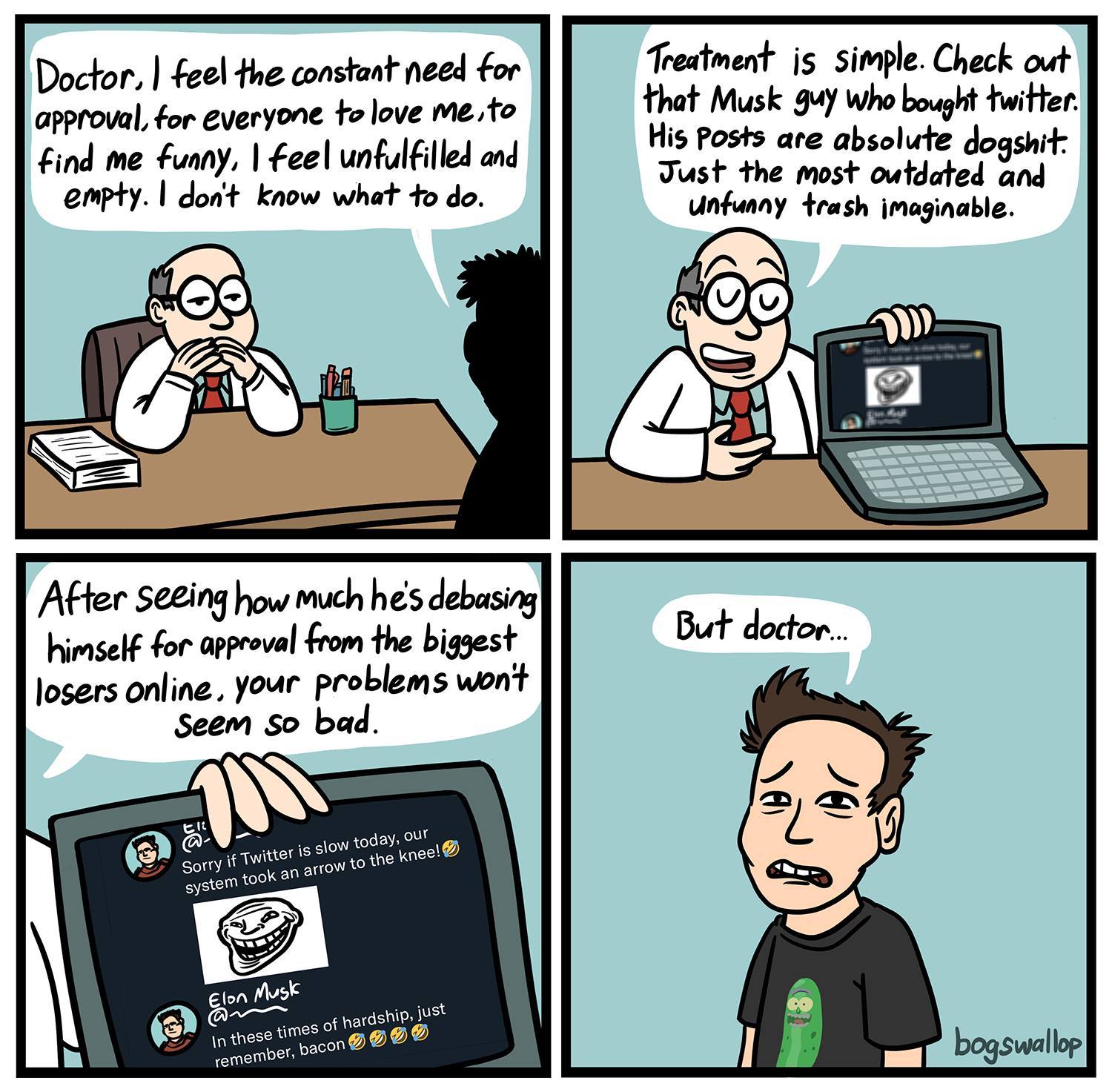
This meme utilizes the "anti-billionaire" meme to mock billionaires for being selfish and lacking in human connection. It suggests Elon Musk, who bought Twitter, is a "loser" who debases himself constantly for approval. The joke implies that the patient's feelings of emptiness and social anxiety are actually worse than this rich guy's outdated and unfunny behavior.
simple-description (llama3.2-vision_11b)
The meme is a satirical commentary on the billionaire Elon Musk, who is known for his provocative and often humorous tweets. The image depicts a doctor's office, where a patient is complaining about the billionaire's tweets, saying "I feel like I'm reading a Twitter thread from my therapist every time I check my feed." The text "I feel like I'm reading a Twitter thread from my therapist every time I check my feed" is a humorous observation about the constant stream of tweets from Elon Musk, who is known for his prolific and often provocative tweeting.
detailed-analysis (gemma3-27b-vision)
Okay, here's a breakdown of the comic, addressing the requested theoretical lenses. It's important to note that applying all these lenses is complex and can lead to overlapping interpretations. I will present interpretations where applicable.
Visual Description
The comic is a four-panel cartoon, rendered in a fairly simple, slightly sketchy style. The color palette is limited, using muted browns, beiges, and grays.
- Panel 1: A distressed-looking man, with messy hair and a gloomy expression, is lying on a therapist’s couch. A small Twitter bird icon sits on a side table, subtly indicating the focus of the conversation. The man is lamenting his need for approval and feeling unfulfilled.
- Panel 2: The therapist, with a somewhat condescending expression, is seated behind a desk with a laptop open. He’s pointing at the screen, indicating that the solution is to observe Elon Musk’s Twitter account.
- Panel 3: A close-up of the laptop screen displays a series of incredibly juvenile and desperate tweets from an account styled as "Elon Musk". The tweets consist of emojis and basic phrases signaling a need for validation.
- Panel 4: The patient’s distress is magnified. He’s looking directly at the viewer with a deeply pained expression, suggesting the “treatment” is making him feel worse.
The overall aesthetic is one of cynicism and dark humor. The cartoon style undermines any potential seriousness of the subject matter, creating an ironic effect.
Foucauldian Genealogical Discourse Analysis
This comic is ripe for a Foucauldian analysis. The entire setup revolves around discourse – the ways in which we talk about mental health, validation, and celebrity.
- Power/Knowledge: The therapist’s “treatment” isn’t based on established psychological methods but on observing a spectacle of self-abasement. This demonstrates how power operates through discourse: the therapist, as an authority figure, defines what constitutes “treatment.” He is essentially saying "look at this spectacle, and see how much worse your issues aren't".
- Genealogy: We can trace a "genealogy" of validation-seeking behavior. The comic suggests a link between the patient's emotional needs and the public performance of those needs by celebrities like Musk (represented in the comic). The genealogy isn't about origins, but about how the concept of "self-worth" has been shaped through historical social practices (like social media).
- Disciplinary Power: The comic subtly plays with disciplinary power. The therapist doesn’t force the patient to watch Musk’s tweets, but suggests it as a means to normalize and potentially, internalize Musk's behavior. The patient will begin to view his issues as relatively benign in comparison.
- Spectacle: The use of Elon Musk as a spectacle—a public figure who embodies the pursuit of validation—highlights how power operates through visibility and attention.
Critical Theory
The comic can be analyzed through the lens of Critical Theory, specifically focusing on the critique of culture and mass media.
- Commodification of the Self: The central theme revolves around the commodification of the self in the digital age. Both Musk (as portrayed) and the patient are seeking external validation as a substitute for internal fulfillment. This is linked to a broader cultural trend where self-worth is tied to likes, shares, and external approval.
- Ideology and False Consciousness: The therapist’s "treatment" subtly perpetuates a damaging ideology. It suggests that the solution to emotional distress lies in comparing oneself to the worst examples of public behavior. This promotes a false consciousness, masking the underlying social and psychological causes of the patient’s unhappiness.
- Critique of Celebrity Culture: The comic offers a scathing critique of celebrity culture. Musk’s portrayal reduces him to a desperate attention-seeker. It implies that the values promoted by celebrity culture are ultimately destructive and contribute to widespread insecurity and unhappiness.
Marxist Conflict Theory
While not the primary focus, Marxist Conflict Theory can offer some insights:
- Alienation: The patient's feelings of emptiness and need for approval can be interpreted as a form of alienation—separation from one’s true self due to the demands of a capitalist society that prioritizes external validation and performance. The patient is seeking fulfillment through external means, rather than internal growth.
- Commodification of Attention: Attention itself is a commodity in the digital age. Musk, as portrayed, is actively trying to buy attention through desperate and degrading posts. This dynamic represents a conflict between the need for genuine connection and the commodification of human interaction.
Postmodernism
This comic strongly aligns with postmodern themes:
- Deconstruction of Authority: The therapist is not presented as a knowledgeable authority. His “treatment” is absurd and undermines the traditional role of the therapist. This deconstruction of authority is a hallmark of postmodern thought.
- Simulation and Hyperreality: Musk’s Twitter feed is presented as a simulation of authenticity. It's a performance of desperation, designed to elicit a response. This blurring of the lines between reality and simulation is characteristic of hyperreality.
- Irony and Cynicism: The comic is infused with irony and cynicism. It challenges the notion of genuine connection and suggests that all interactions are ultimately self-serving.
Queer Feminist Intersectional Analysis (Applicable but less central)
While not the primary lens, an intersectional analysis can add nuance:
- Performance of Masculinity: The portrayal of Musk can be read as a deconstruction of traditional masculinity. His desperate plea for validation subverts the expectation of stoicism and self-sufficiency.
- Vulnerability and Shame: The comic explores themes of vulnerability and shame. The patient's distress and Musk's desperate tweets both stem from a fear of being seen as inadequate. This connects to feminist analyses of societal pressures on individuals to conform to unrealistic standards.
- Power Dynamics: The therapist-patient relationship, coupled with Musk's position of power, highlights the ways power dynamics influence emotional expression and validation-seeking behaviors.
In conclusion, this comic is a rich and complex work that lends itself to a variety of theoretical interpretations. It provides a cynical and thought-provoking commentary on the challenges of mental health, the commodification of self-worth, and the absurdity of contemporary culture.
simple-description (llama3.2-vision)
This meme is a humorous exchange between a doctor and a patient. The patient, who is unhappy with the doctor's response, says "I feel like I'm not getting the help I need" and the doctor responds with a sarcastic comment. The patient then takes a screenshot of the doctor's response and shares it on Twitter, where it gets a lot of attention and the doctor's response becomes a meme.
tesseract-ocr
Doctor, | feel the constant need for Treatment js simple. Check out approval, for everyone to love me,to par Mast g4Y we ul twitter. find me funny, | feel unfulfilled and is Posts are absolute dogshit: ‘ Just the most outdated empty. | dont know what to do. untusny teas imaginal and tae bar >) Ye D QAN —4)))} | AY fb == ‘<x - a) \ ees N= a= y oo : Atter seeing how much he's debasing himself for approval from the biggest But doctor... losers online, your problems wont Seem So bad. AWS 5, a aw Pmt a AG @ sort co hereto d J a 2 Pe eas = oF as Paci Woe cd ~T @ Le eee nen XZ ; ] ) — bogswallop