First Seen
2023-09-16T23:37:31+00:00
simple-description (qwen3.5_2b-q8_0)
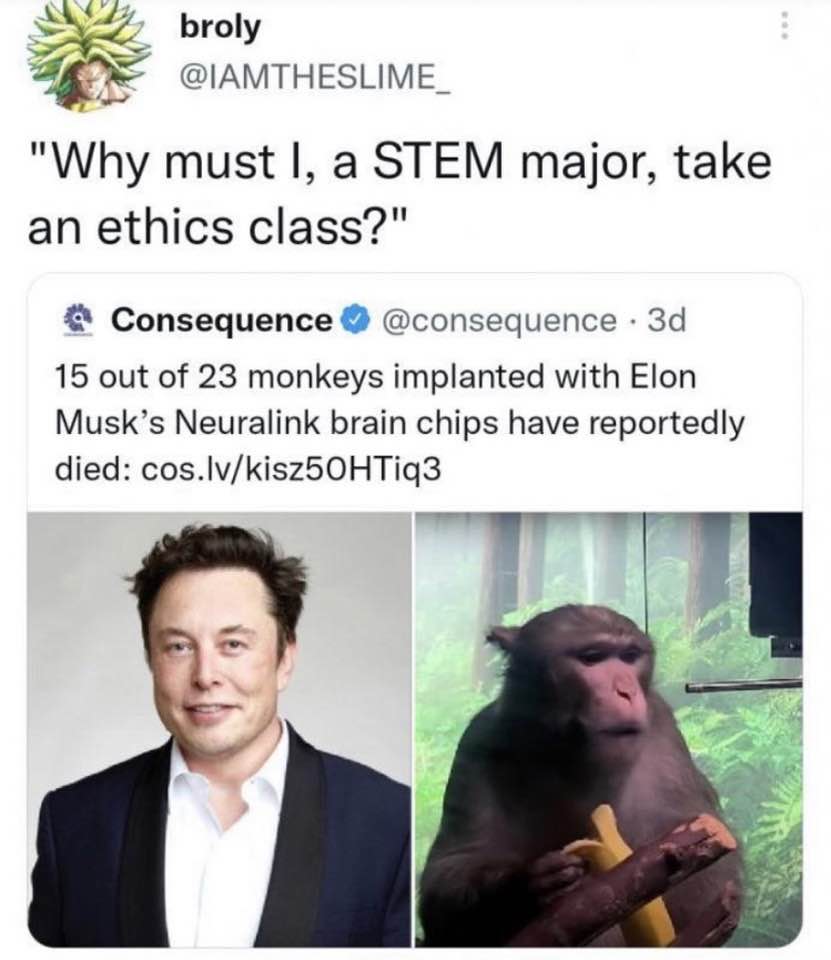
This anti-billionaire meme mocks Elon Musk and his company, Neuralink, by implying that they are wealthy entrepreneurs who prioritize making money over doing the right thing. The joke contrasts the top tweet—suggesting that an ethics course is a normal part of university—against the grim text reporting a high death toll from monkeys testing the chips. The bottom image shows a monkey eating a banana-shaped Neuralink chip, highlighting the absurdity of the company testing its technology on live animals.
simple-description (llama3.2-vision_11b)
The meme is a satirical commentary on the wealth and influence of billionaires, particularly Elon Musk. The image juxtaposes a quote from Elon Musk's Twitter account, "Why must I, a billionaire, be a slave to my billionaire's desires?" with a photo of a chimpanzee holding a banana. The text is a play on the phrase "I, a billionaire, am a slave to my billionaire's desires," implying that even a chimpanzee is more free than a billionaire.
detailed-analysis (gemma3-27b-vision)
Okay, let's break down this image/social media post through the lenses you've provided. It’s important to note that applying all these theories can be complex, and some will be more relevant than others. I'll aim for a nuanced analysis.
Visual Description
The image is a screenshot of a Twitter (now X) post. It features two elements overlaid:
- Top: The Twitter post from an account named @IAMTHESLIME_. It presents a question framed as a complaint: "Why must I, a STEM major, take an ethics class?"
- Bottom: A reply from an account named @consequence. This post states: "15 out of 23 monkeys implanted with Elon Musk's Neuralink brain chips have reportedly died" and includes a link. Below that are two images: a headshot of Elon Musk smiling in a suit and a picture of a monkey in a cage with visible surgical sites on its head.
The juxtaposition is stark. The first post presents a dismissive attitude towards ethics, while the second post highlights the very real ethical concerns surrounding Neuralink and its impact on animal testing. The visuals reinforce this contrast: a successful, confident human figure versus an animal suffering as a result of technological experimentation.
Foucauldian Genealogical Discourse Analysis
This post lends itself well to a Foucauldian analysis. Foucault was interested in how power operates through discourse—how language, knowledge, and institutions shape our understanding of the world and control us.
- Discourse of Progress: The implicit narrative of Neuralink is one of “progress” and technological innovation. This discourse positions STEM fields as inherently positive and focused on solving problems. The student’s question ("Why must I take ethics?") actively resists the intrusion of ethical considerations into this narrative of progress. The question assumes ethical considerations are impediments.
- Biopower: The post explicitly demonstrates biopower, the way modern states and institutions regulate life through technologies and practices. Neuralink itself is an example of biopower; it's an attempt to directly manipulate and control the brain. The statistic of monkey deaths highlights the violent and often invisible cost of this biopower.
- Genealogy of Ethics: A Foucauldian genealogy wouldn't ask why the student is resistant to ethics, but how this resistance has come to be. It would examine the historical development of discourses that prioritize technological advancement over animal welfare or broader ethical considerations. It would question the very definition of "ethics" in the context of STEM—how it has been historically framed and whose interests it serves.
Critical Theory
From a Critical Theory perspective (drawing from the Frankfurt School), this post is an illustration of the instrumentalization of reason.
- Reason and Domination: Critical theorists argued that Enlightenment reason, while aiming for liberation, had become a tool of domination. In this context, the STEM student’s question reflects a reduction of knowledge to its practical application—how STEM fields can do things—without considering the ethical implications of those actions. The student prioritizes instrumental reason—the means to an end—over critical reflection.
- Commodification of Life: The post reveals how life (in this case, animal life) can be reduced to a resource for technological experimentation. The high death rate of the monkeys is treated as a statistic, a regrettable side effect of progress, rather than a moral catastrophe.
- Critique of Positivism: The post implicitly critiques the positivist belief that knowledge is objective and value-neutral. The STEM student assumes that ethical considerations are subjective and irrelevant to the "objective" pursuit of scientific progress.
Marxist Conflict Theory
While not a direct illustration of class conflict, a Marxist reading can focus on power dynamics and exploitation.
- Capital and Technology: Neuralink represents an investment of capital in technological development. The suffering of the monkeys can be viewed as a consequence of this pursuit of profit. The drive for innovation, and therefore profit, supersedes concerns about animal welfare.
- Alienation: The student’s question can be seen as a symptom of alienation—a disconnect from the ethical implications of their work. The student is focused on the technical aspects of their field and has become alienated from the broader social and ethical context.
- Exploitation of non-human animals: The death of the monkeys due to Neuralink experimentation represents the exploitation of a vulnerable population.
Postmodernism
A postmodern analysis might focus on the deconstruction of grand narratives and the questioning of objective truth.
- Deconstructing Progress: The post challenges the narrative of inevitable technological progress. The fact that the experiment resulted in a high number of animal deaths introduces a contradiction and disrupts the smooth narrative of advancement.
- Relative Truth: A postmodern perspective would question the very notion of objective ethics. It would suggest that ethical considerations are socially constructed and contingent on particular power relations. This doesn’t necessarily justify the animal deaths, but it highlights the complexities and ambiguities of ethical reasoning.
- Simulacra and Simulation: The shiny technology of Neuralink, the promises of human enhancement, and the carefully curated public image of Elon Musk can be seen as a simulation—a representation that obscures the underlying reality of animal suffering.
Queer Feminist Intersectional Analysis
This is perhaps the most challenging lens to apply directly, but it can offer a unique perspective.
- Vulnerability and Marginalization: Animal testing disproportionately affects vulnerable populations—in this case, non-human animals, who lack agency and the ability to consent. Feminist and Queer theory often focus on the experiences of marginalized groups, and this post highlights the power dynamics that allow for the exploitation of those who are unable to defend themselves.
- Care Ethics: The death of the monkeys and the dismissal of ethics could be interpreted as a failure of care. Care ethics emphasizes the importance of relationships, empathy, and responsibility for others. The post shows a lack of concern for the wellbeing of the animals and a prioritization of technological advancement over ethical considerations.
- Speciesism and Power: The post implicitly reinforces speciesism—the belief that humans are superior to other animals and therefore have the right to exploit them. Queer and Feminist theory often challenge hierarchical systems of power and advocate for the rights of all beings, regardless of their species or other characteristics.
Important Note: These analyses are not mutually exclusive. The post is complex and can be interpreted through multiple theoretical lenses. Each perspective offers a unique insight into the power dynamics, ethical considerations, and broader social implications of this situation.
Let me know if you'd like me to delve deeper into any of these theoretical frameworks or explore other potential interpretations.
simple-description (llama3.2-vision)
This meme is a humorous take on a news article about a monkey that was implanted with Neuralink brain chips, but ultimately died. The article's title is not shown, but the meme's caption reads: "15 out of 23 monkeys implanted with Elon Musk's Neuralink brain chips have died." The meme is accompanied by a photo of a monkey holding a banana, and a photo of Elon Musk. The meme is poking fun at the idea that a STEM major (a student studying science, technology, engineering, and mathematics) would need to take an ethics class, implying that the monkeys' deaths are a result of the lack of ethics in the field.
tesseract-ocr
SS broly £ @IAMTHESLIME_ "Why must |, a STEM major, take an ethics class?" & Consequence @ @consequence - 3d 15 out of 23 monkeys implanted with Elon Musk’s Neuralink brain chips have reportedly died: cos.|v/kiszS5OHTiq3 = ~ ————— y